
Brand messaging for medical and clinical practices.
Built on real research into how medical patients search, compare, and decide. Not generic AI.
Every medical practice looks qualified. Your messaging makes you the obvious choice.
When a patient chooses between two or three referred practices, every one of them looks credentialed and qualified. The practice whose messaging is specific about who it serves and how wins before the phone rings.
Start Your Blueprintof patients research a practice extensively before booking a first appointment
rater8, 2025
growth in concierge and direct primary care practices from 2018 to 2023
Health Affairs, 2025
of patients now research providers using AI tools, social media, and voice search
rater8, 2025
Credentials Don't Differentiate
Every practice in your category looks qualified. What separates the ones that win is what they say next.
Sameness Is the Risk
Generic messaging makes patients default to the familiar name, the closest location, or whoever has an opening.
Specificity Builds Trust
Messaging that names a population, a problem, and an experience earns trust before the first appointment.
The Sameness Problem
Every practice leads with care, compassion, and nothing more.
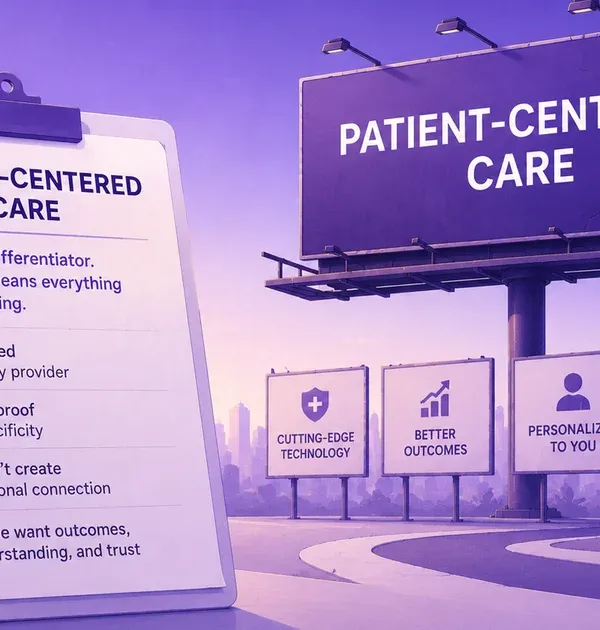
Patient-centered care. Compassionate providers. Dedicated to your health. These phrases appear on thousands of practice websites and give no prospective patient a reason to pick up the phone.
Practices that win in competitive markets do the opposite: they name the patient they serve best, the problem they solve, and what a visit actually feels like.
BrandBlueprint brings this research into your blueprint before the first question is answered.
What the Blueprint Already Knows
BrandBlueprint already knows how patients in this category decide.
BrandBlueprint already knows the review signals patients trust, the credential language that converts, and the access questions they ask before they call.
That research is built into your discovery process before a single word of copy is written.
The SpecificPractice Wins
Positioning Research
Practices that name a patient type, a problem, and an approach convert referred patients faster than generalists.
InsuranceFilters First
Buyer Behavior
Payment model is the first question before specialty, before credentials, before anything else on the list.
ComplianceCreates Sameness
Category Insight
Board rules and HIPAA push practices toward vague language. The ones that find specific language within those limits win.
Every Specialty Covered
Deep research across every medical and clinical specialty.
Every specialty in this category has its own buyer psychology, compliance rules, and competitive landscape. A pediatric dentist, a concierge cardiologist, and a solo therapist all live here but share almost nothing in how patients find and choose them. Your blueprint is built for the one you actually practice.
Common Questions
Brand messaging for medical practices: common questions
Medical practices operate under compliance rules that shape every marketing sentence. HIPAA governs what can be published, how reviews can be answered, and what patient stories can legally be shared. Layer in state medical board rules and specialty certification guidelines, and the brand strategy must be bounded in ways most agencies never consider. The language that wins in this category is specific, credentialed, and carefully built.
Hospital networks win on insurance breadth, integration, and brand recognition. What they cannot offer is a named provider who knows your history, same-week access for a real concern, or a visit that takes as long as it needs to. Independent practices that name those differences specifically and build their site around them consistently convert referred patients before the system's name ever enters the picture.
Yes, and smaller practices often gain more from specific positioning than large ones do. A solo internist or two-provider dental group competing with a regional chain wins on specifics, not volume. The blueprint draws out what a small practice does that larger ones cannot: the named provider relationship, the access speed, the continuity across visits. Those are positioning advantages, not consolation prizes.
Two reasons. State medical boards restrict comparative claims, and many practices retreat to language safe enough to clear any review, which leaves every site with the same cautious phrases. The second reason is that clinical training focuses on credentials and modalities, not buyer psychology or positioning. The result is a category full of practices with real differences that have never learned to name what those differences are.
The blueprint covers the full range of medical and clinical specialties: primary care, family medicine, dentistry, mental health and psychiatry, dermatology, women's health and OB/GYN, pediatrics, direct primary care and concierge medicine, chiropractic, and specialty internal medicine including cardiology, gastroenterology, and orthopedics. The research behind each is specific to how patients in that discipline find and choose, not a generic template applied across the whole category.
The blueprint produces a complete brand messaging strategy built around your practice's voice, patient type, and competitive situation. It covers messaging pillars, patient personas, and differentiated positioning for your specific sub-vertical. The result is a voice guide for your website, provider bios, review responses, and referring-provider materials. It is designed for the practice that wants to stop sounding like every other one in the market.
From the Blog
Insights for medical and clinical practices
Your patients have already looked you up.
They read the reviews before you answered the call. Most practices in this category have left that impression to chance. BrandBlueprint builds the messaging that makes what they find make you the obvious choice.
Start Your Blueprint