
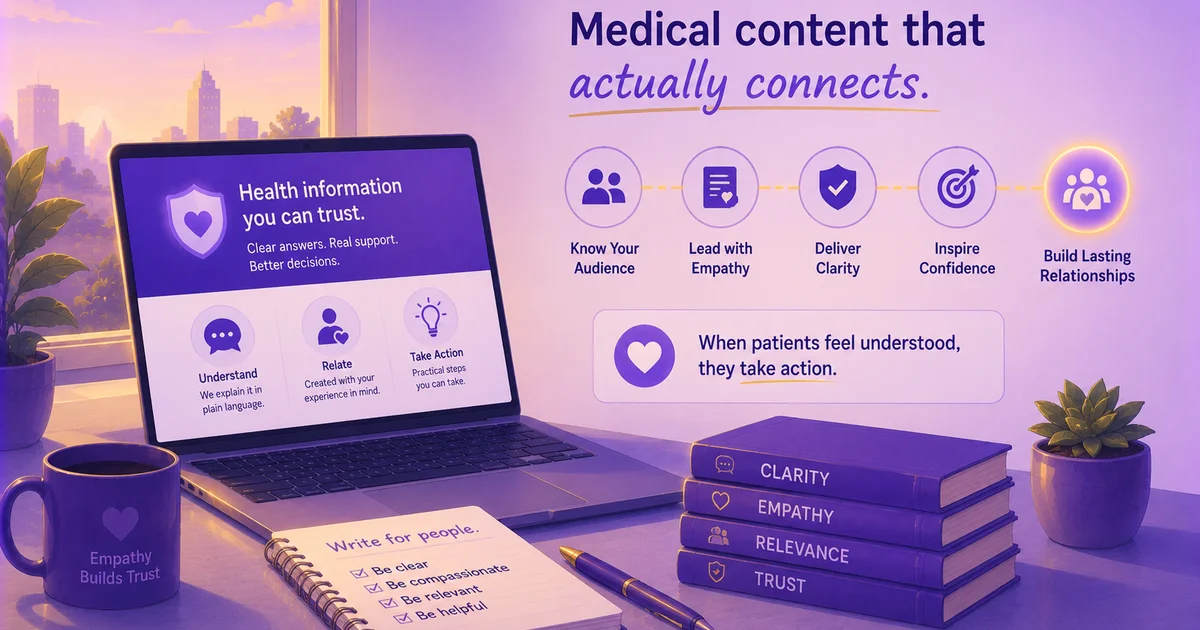
Getting new patients to choose your practice starts with how you talk about their problems, not your credentials. Most medical professionals lead with their degrees and decades of experience, but patients who land on your website are already in pain, confused, or scared. They want to know if you understand what they're going through before they care about where you went to medical school.
Medical copywriting that converts new patients focuses on patient pain points first, then builds credibility through specific expertise rather than generic qualifications. The most effective health content uses empathy-driven messaging paired with scannable formatting, clear next steps, and language that balances medical authority with human accessibility.
Why Most Medical Copy Fails to Connect
Walk through ten healthcare websites and you'll see the same pattern: "board-certified physicians," "compassionate care," and "state-of-the-art facility" repeated endlessly. This approach misses how patients actually make decisions. Someone searching for "anxiety therapist near me" at 2 AM isn't comparing board certifications. They want to know if you've helped people who feel exactly like they do right now.
The fundamental mistake is leading with credentials instead of connection. A gastroenterologist's homepage that starts with "Dr. Smith graduated magna cum laude from Johns Hopkins" tells patients nothing about whether this doctor understands their specific digestive struggles. Compare that to "Struggling with digestive discomfort? Our team helps you find relief through personalized nutrition care" and the difference is immediate.
Patients research differently now. They arrive at your website with reviews already read, AI summaries already processed, and a list of three potential providers already narrowed down. Your copy's job isn't to make the case from scratch. It's to confirm that you're the right fit for their specific situation.
The most successful medical practices understand this shift. They write for the person who's been bounced between specialists for two years, or the parent whose child's pediatrician doesn't seem to listen, or the patient who's tired of feeling like a chart number instead of a person.
The Patient-First Content Framework
Start with Their Problem, Not Your Solution
Traditional medical marketing teaches you to lead with what you do. Patient-first content leads with what they're experiencing. Instead of "We provide comprehensive cardiology services," try "Heart palpitations keeping you awake at night? Let's figure out what's causing them."
This approach works because it meets patients where they are emotionally. Someone researching cardiologists isn't thinking about "comprehensive services." They're thinking about whether that weird chest feeling is serious, how long they'll have to wait for answers, and whether this doctor will take their concerns seriously.
The language shift is subtle but powerful. "We treat anxiety" is about you. "Anxiety doesn't have to control your life" is about them. "Our fertility clinic has a 78% success rate" is a statistic. "After two miscarriages, you deserve a team that understands the emotional weight of trying again" acknowledges their actual experience.
Use Keywords That Match Patient Language
Medical professionals think in clinical terms, but patients search in everyday language. The gap between these two vocabularies is where most medical copywriting fails. A dermatologist optimizing for "dermatological conditions" misses patients searching for "weird skin rash" or "mole that's changed color."
Effective medical copywriting bridges this gap systematically. Use clinical terms for credibility and SEO, but pair them with patient-friendly language for connection. "IBS (Irritable Bowel Syndrome)" captures both the medical accuracy and the search terms patients actually use.
The most valuable keywords in medical content are often the long-tail phrases that reveal patient intent: "therapist who specializes in postpartum anxiety," "pediatrician who doesn't rush appointments," or "cardiologist who explains things in plain English." These phrases have lower search volume but much higher conversion rates because they match exactly what patients want.
Research your actual patients' language by reading your Google reviews, patient portal messages, and intake forms. The words they use to describe their problems become your keyword strategy. If patients consistently mention feeling "dismissed" by previous doctors, that becomes part of your messaging framework.
Making Medical Content Scannable and Actionable
Format for Skimming, Not Reading
Most patients won't read every word on your website. They're scanning for signals that you understand their situation and can help. Scannable formatting with short paragraphs, bullet points, and subheadings makes the difference between a page that converts and one that gets abandoned.
Break up large text blocks ruthlessly. A paragraph about your approach to treating diabetes should be three short paragraphs, each focused on one aspect: diagnosis process, treatment philosophy, and ongoing support. Use bullet points for lists of services, conditions treated, or insurance plans accepted.
Subheadings guide the scanning eye to key information. Instead of generic headers like "Our Services," use specific, keyword-rich headers like "Same-Day Appointments for Urgent Dermatology Concerns" or "Anxiety Therapy That Actually Works for Working Parents."
The formatting choices you make signal whether your practice prioritizes patient experience or provider convenience. Dense text blocks and medical jargon suggest a practice that hasn't thought about what patients need to make decisions.
Include Clear, Specific Next Steps
The biggest conversion killer in medical copywriting is the vague call to action. "Contact us to learn more" puts the burden on the patient to figure out what happens next. "Book a 15-minute consultation to discuss your sleep issues" gives them a specific, low-commitment step forward.
Different patient types need different next steps. Someone researching therapists for the first time might want to "send a question" before booking anything. A patient seeking a second opinion for a serious diagnosis might be ready to "schedule a consultation this week." Your calls to action should match the urgency and commitment level your typical patients bring.
Make the path to appointment as friction-free as possible. If you accept their insurance, say so prominently. If new patients typically wait two weeks for appointments, set that expectation upfront. If you offer telehealth for certain services, make that clear immediately.
The practices that convert best online remove every possible reason for patients to keep looking. They answer insurance questions, explain what the first visit involves, and make scheduling feel simple rather than bureaucratic.
Building Trust Through Specificity
Replace Generic Claims with Concrete Details
"Compassionate care" means nothing to patients because every medical practice claims it. Specific details about how your practice works differently create actual differentiation. "Your first appointment lasts 60 minutes, not 15" is a concrete promise patients can evaluate.
Provider bios are the highest-value content on most medical websites after the homepage. Patients book providers, not practices. But most bios read like resume summaries: medical school, residency, board certifications. The bios that convert include personal details that help patients assess fit: "Dr. Martinez chose family medicine after watching her grandmother navigate multiple specialists" or "Dr. Chen speaks Mandarin and understands the cultural factors that affect how Asian families approach mental health care."
Specific storytelling that addresses how you entered the medical field, patient success stories, and challenges overcome converts better than generic credentials. But medical storytelling has legal boundaries. You can share why you became a pediatrician without naming specific patients. You can describe your approach to treating anxiety without revealing patient details.
The goal is helping patients picture themselves working with you. Specificity creates that picture. "I believe every patient deserves time to ask questions" is generic. "I schedule extra time after each appointment because the best treatment happens when patients understand their options completely" shows how that belief translates into practice.
Address Common Concerns Directly
Every medical specialty has patient concerns that never get voiced directly. Patients worry about being judged, rushed, dismissed, or misunderstood. They worry about costs, insurance coverage, and whether their problems are serious enough to warrant specialist care. Address these concerns proactively in your content.
Mental health practices face unique stigma concerns. Patients worry about confidentiality, insurance billing codes, and how therapy might affect their work or family relationships. The practices that convert best acknowledge these concerns explicitly: "We use the most general billing codes possible to protect your privacy" or "Many of our patients are executives and healthcare workers who need complete confidentiality."
Primary care patients often worry about being rushed or not taken seriously. Address this directly: "We limit our patient panel so every appointment can be thorough" or "If you've had doctors dismiss your symptoms before, we want you to know that won't happen here."
Specialty practices should explain when patients need their services versus when primary care is sufficient. This builds trust by showing you're not trying to capture every possible patient. "Most back pain resolves with conservative treatment. We focus on the cases where surgery genuinely improves quality of life."
Compliance and Content: Writing Within Legal Boundaries
Understanding HIPAA in Content Creation
Medical copywriting operates under legal constraints that don't exist in other industries. HIPAA shapes every sentence, from patient testimonials to review responses. The regulatory boundaries must be learned first, then creative writing happens within them to prevent costly rewrites and legal violations.
Patient success stories require specific written authorization to share any details that might identify someone. This includes combinations of demographic information, condition details, and treatment timelines that could identify a patient even without naming them. Most practices find it safer to share general outcome statistics ("85% of our anxiety therapy patients report significant improvement within 12 weeks") rather than individual stories.
Review responses require special care. Responding to negative reviews by addressing specific medical details violates HIPAA even if you're defending your care. The response "Mr. Johnson, as we discussed in your appointment, your medication dosage was appropriate for your weight and condition" reveals protected health information. Safer responses acknowledge the concern without revealing any medical details: "We're sorry you had a frustrating experience. We'd welcome the chance to discuss your concerns privately."
The practices that handle HIPAA well in their marketing create templates and guidelines for all patient communication. They train staff on what can and cannot be shared publicly. They understand that protecting patient privacy isn't just legally required – it's part of building the trust that converts prospects into patients.
Plain Language Passes Regulatory Review Better
Counterintuitively, plain-language copy is easier to get through regulatory review than technical jargon because it's harder to misinterpret. Regulatory reviewers flag content that could mislead patients. Overly technical language often raises more red flags than clear, simple explanations of what patients can expect.
This creates an opportunity for patient-friendly practices. While competitors hide behind medical jargon, you can explain procedures, treatments, and outcomes in language patients actually understand. "Minimally invasive" means less to patients than "small incisions that heal faster than traditional surgery."
The key is balancing accuracy with accessibility. You can't promise outcomes you can't deliver, but you can explain what typical patients experience during treatment. You can't guarantee results, but you can describe what success looks like for most people with similar conditions.
Transparency becomes a competitive advantage. The practice that clearly explains costs, typical treatment timelines, and what patients should expect builds more trust than the practice that speaks only in medical abstractions.
Converting Different Patient Types
New Patients Versus Established Relationships
New patient acquisition requires different content than patient retention. New patients need education about your approach, credentials, and how you're different from alternatives. Established patients need information about new services, policy changes, or continuing care options.
For new patients, focus on reducing the barriers to that first appointment. Address insurance questions prominently. Explain what happens during initial consultations. Make scheduling feel simple and low-pressure. Use content to handle common pre-appointment questions so phone staff can focus on booking rather than education.
Patient retention content serves existing relationships. Email newsletters about seasonal health topics, patient portal messages about preventive care reminders, and updates about new services or providers. This content can assume more medical knowledge and focus on maintaining engagement rather than building initial trust.
The most successful medical practices create content funnels that move prospects from awareness to appointment. Blog posts about conditions attract initial traffic. Condition-specific landing pages educate prospects about treatment options. Provider bios help patients choose the right fit. Scheduling pages remove friction from booking.
Serving Both Patients and Referring Providers
Many specialty practices get patients through two channels: direct self-referrals and referrals from other healthcare providers. These audiences need different information and different language. Patients want to understand what's wrong and how you'll help. Referring providers want to know your expertise, typical patient flow, and communication protocols.
Create content for both audiences without confusing either. Your homepage should speak primarily to patients, with a clear "For Referring Providers" section that addresses professional concerns. Referring providers care about your fellowship training, patient volume in specific conditions, and how quickly you can see urgent referrals.
Some content serves both audiences effectively. Detailed explanations of your treatment approach help patients understand what to expect and help referring providers understand whether you're the right fit for their patients. Clear communication about which conditions you treat in-house versus refer out helps both audiences set appropriate expectations.
The practices that excel at dual-audience content understand that referring providers are often the ultimate decision-makers. A patient might prefer you based on your website, but if their primary care doctor doesn't trust your expertise or communication style, the referral doesn't happen.
What the Data Says
84% of patients check online reviews before choosing a healthcare provider, with 51% reading at least six reviews before deciding (rater8, 2025) – Your website content must align with the impression your reviews create, not contradict it.
61% of patients now prioritize online reviews over personal recommendations from friends and family (rater8, 2025) – Digital trust signals have become more influential than traditional word-of-mouth referrals.
31% of patients use generative AI tools to research or compare providers, with 70% of US adults open to using AI for provider research (Medical Economics, 2026) – Your content must be structured to appear in AI-generated summaries and comparisons.
40% of patients say negative reviews have caused them to cancel or avoid an appointment (rater8, 2025) – Negative review management and response strategy directly impacts patient acquisition.
Concierge and direct primary care practices grew 83.1% from 2018 to 2023, reaching 3,036 sites and 7,021 clinicians (Health Affairs, 2025) – Alternative payment models are reshaping patient expectations about access and relationship depth.
Medical Copywriting FAQs
Q: How do you write patient testimonials without violating HIPAA?
Focus on general outcomes rather than specific patient details. Share statistics about patient satisfaction or treatment success rates instead of individual stories. If you do share patient stories, obtain specific written authorization that complies with HIPAA requirements.
Q: Should medical content include technical terms or stick to plain language?
Use both strategically. Include technical terms for credibility and SEO, but pair them with plain-language explanations. This approach serves both patients who search using medical terms and those who use everyday language to describe their symptoms.
Q: How specific should you be about treatment outcomes in medical copy?
Be honest about typical timelines and success rates while avoiding guarantees. Use language like "most patients experience" or "typical outcomes include" rather than promising specific results. Focus on what patients can expect during the treatment process.
Q: What's the best way to handle insurance information in medical copy?
Make insurance acceptance prominent and specific. List major plans you accept, clarify whether you're in-network or out-of-network, and explain typical out-of-pocket costs. This information directly impacts conversion rates for most medical practices.
Q: How do you balance authority with approachability in medical content?
Lead with empathy and patient concerns, then build credibility through specific expertise rather than generic qualifications. Show your medical knowledge by explaining complex conditions in understandable terms rather than using jargon to sound impressive.
Key Takeaways
- Start every piece of medical content with the patient's problem or concern, not your credentials or services – this immediately shows you understand their perspective and creates connection before building credibility.
- Use scannable formatting with short paragraphs, bullet points, and descriptive subheadings because most patients skim rather than read, and clear structure helps them find the information they need to make decisions.
- Replace generic claims like "compassionate care" with specific details about how your practice works differently, such as appointment lengths, communication methods, or follow-up protocols that patients can evaluate.
- Address common patient concerns proactively in your content, including worries about being rushed, judged, or dismissed, as well as practical concerns about insurance, costs, and what to expect during treatment.
- Balance medical accuracy with plain language that regulatory reviewers can easily understand, since clear explanations actually pass compliance review more easily than technical jargon while also serving patients better.
How Your Brand Blueprint Can Help with This
Your Brand Blueprint's Buyer's Journey section maps exactly how prospective patients move from symptom awareness to booking appointments, including the specific questions they ask at each stage and the targeted messaging that moves them forward. The Brand Profile & Content Pillars section gives you the content themes that build trust and authority while staying compliant with medical marketing regulations.
Ready to put this into practice? BrandBlueprint.ai builds your complete brand messaging strategy – including the section that covers exactly what we talked about here.