
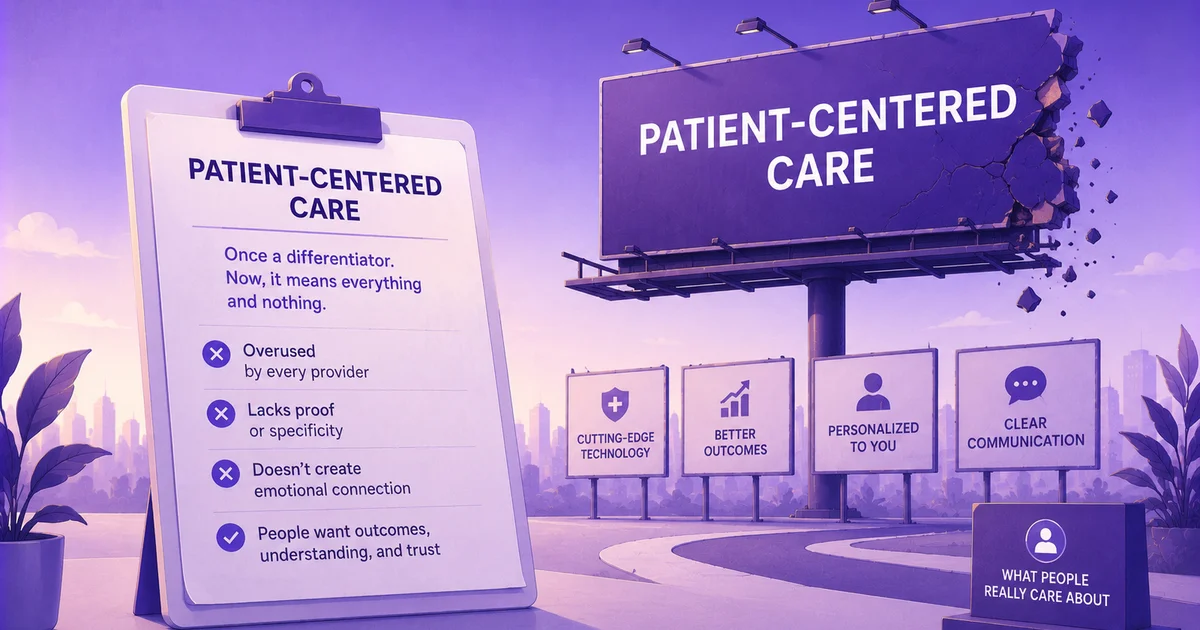
Healthcare providers slap "patient-centered care" on every website, mission statement, and marketing brochure. Walk into any medical practice, and you'll see this phrase prominently displayed. But when that same practice keeps you waiting 45 minutes past your appointment time for a 7-minute visit, or when your concerns get dismissed with a quick prescription refill, the gap between promise and reality becomes painfully clear. The term has become so overused and under-delivered that it's lost all meaning.
Patient-centered care has devolved into marketing speak that obscures rather than clarifies what patients can actually expect from their healthcare experience. While providers universally claim to practice it, the phrase now signals bureaucratic box-checking rather than genuine patient focus, leaving patients to decode what quality care actually looks like behind the rhetoric.
The Rhetoric-Reality Gap That's Breaking Healthcare
The problem isn't that healthcare providers are intentionally misleading patients. Most genuinely believe they're delivering patient-centered care. The issue is that the term has become so broad and diluted that it can describe virtually any interaction between provider and patient.
Consider what "patient-centered care" supposedly means. According to most definitions, it involves respecting patient preferences, ensuring patient involvement in decisions, providing emotional support, and coordinating care effectively. These sound reasonable until you realize that every healthcare system claims to do all of these things, regardless of their actual performance.
The paradox becomes clear when you examine real patient experiences. Studies show that patients rarely complain even when care goes wrong because they fear retaliation or assume nothing will change. Meanwhile, healthcare systems have built elaborate feedback mechanisms that burden patients to voice complaints while systematically ignoring the input they receive.
Take the standard patient satisfaction survey. These questionnaires ask about wait times, cleanliness, and staff courtesy, but rarely address whether patients felt heard, understood, or genuinely cared for. The metrics that matter most for true patient-centered care remain unmeasured, while easily quantifiable proxies get tracked obsessively.
When Protocol Trumps People
Modern healthcare's obsession with standardization has paradoxically moved us away from genuine patient focus. Electronic medical records, mandatory quality measures, and evidence-based protocols were designed to improve care consistency. Instead, they've created environments where checking boxes becomes more important than connecting with patients.
Walk into most medical offices and watch the provider spend more time looking at a computer screen than at you. They're documenting everything in real-time to meet regulatory requirements, but the human connection gets lost in the process. The very systems meant to improve patient care have inadvertently depersonalized it.
This isn't theoretical. Healthcare workers increasingly report that administrative burdens prevent them from spending meaningful time with patients. When providers feel constrained by protocols and documentation requirements, "patient-centered care" becomes an aspiration rather than a practice.
What 'Patient-Centered' Actually Looks Like in Practice
Real patient-centered care isn't about having the phrase on your website. It's about specific, measurable behaviors that patients can recognize immediately. Here's what distinguishes authentic patient focus from marketing rhetoric.
Time and Attention
Genuinely patient-centered providers allocate sufficient time for each visit and use that time effectively. They sit down during conversations, make eye contact, and avoid rushing through predetermined questions. When a patient brings up a concern, they explore it thoroughly rather than dismissing it or deferring it to another visit.
This requires intentional scheduling practices. Some providers deliberately block longer appointment slots, while others build buffer time between visits. The common thread is recognizing that meaningful patient interaction can't be rushed.
Communication That Connects
Patient-centered communication goes beyond explaining medical information clearly. It involves acknowledging patient emotions, validating concerns, and ensuring patients feel heard. This means asking open-ended questions and actually listening to the answers.
Contrast this with the typical medical encounter where patients get three minutes to describe their symptoms before the provider interrupts with diagnostic questions. True patient centering means allowing people to tell their stories in their own words before jumping to clinical assessment.
Shared Decision-Making That's Actually Shared
The rhetoric of shared decision-making appears everywhere in healthcare, but authentic implementation remains rare. Real shared decisions involve providers explaining options clearly, discussing the patient's values and preferences, and reaching decisions together rather than providers recommending their preferred approach and calling it "shared."
This process takes time and requires providers to genuinely respect patient autonomy. When a provider says "patient-centered care means patients are in complete control of decisions" but then subtly pressures patients toward specific choices, the sharing isn't genuine.
The Bureaucracy That Killed Patient Focus
Healthcare's current predicament didn't happen overnight. Multiple systemic factors have gradually eroded the patient-provider relationship while maintaining the language of patient-centeredness.
The Checklist Mentality
Modern healthcare operates on checklists, protocols, and standardized procedures. These tools were designed to improve consistency and reduce errors, but they've inadvertently shifted focus from individual patient needs to institutional requirements.
When providers must complete specific documentation for every visit, ask predetermined screening questions, and follow rigid protocols, the interaction becomes more about compliance than care. The patient becomes a series of boxes to check rather than a unique individual with specific concerns.
Reimbursement Pressures
Insurance reimbursement models reward volume over value, encouraging providers to see more patients in less time. When financial survival depends on maintaining high patient throughput, spending extra time with complex cases becomes economically unsustainable.
Value-based care initiatives claim to address this problem by tying reimbursement to patient outcomes and satisfaction. However, these programs often create new administrative burdens that further distance providers from direct patient care.
Technology as Barrier
Electronic health records were supposed to improve coordination and reduce errors. Instead, they've become time-consuming documentation requirements that interfere with patient interaction. Providers spend significant portions of each visit typing rather than engaging with the person in front of them.
The irony is stark: technology designed to improve patient care has become a primary barrier to patient connection. When providers are more focused on data entry than dialogue, the "patient-centered" label becomes meaningless.
Why Patients Are Seeking Alternatives
The failure of mainstream healthcare to deliver genuinely patient-centered care has created a boom in alternative models. Concierge and direct primary care practices grew 83.1% from 2018 to 2023, reaching 3,036 practice sites and 7,021 clinicians by 2023.
These models succeed because they abandon the rhetoric and focus on specific patient experience improvements: longer appointment times, direct provider access, reduced wait times, and genuine relationship-building. Patients are willing to pay extra for what traditional healthcare claims to provide but consistently fails to deliver.
The Boutique Model Success
Concierge practices typically limit patient panels to 400-600 patients per provider, compared to 2,000-3,000 in traditional primary care. This immediately enables longer visits and better access. When patients can reach their provider directly and schedule same-day appointments, the experience fundamentally changes.
The success of these models exposes the hollow nature of "patient-centered care" claims in traditional settings. If genuine patient focus requires structural changes like smaller patient panels and longer visits, then providers operating under traditional constraints can't honestly claim to be patient-centered.
What Patients Actually Value
Patient behavior reveals what they truly value beyond the rhetoric. They choose providers who:
- Answer calls and messages promptly
- Spend adequate time during visits
- Remember previous conversations and concerns
- Coordinate effectively with other providers
- Acknowledge when they don't know something
- Follow up proactively after visits
Notice that none of these require advanced medical training or expensive technology. They're relationship and communication skills that any provider can develop, but institutional structures often prevent providers from implementing them consistently.
Beyond Marketing: Building Authentic Patient Focus
Organizations serious about patient-centered care need to move beyond slogans and implement specific structural changes. This requires honest assessment of current practices and willingness to make difficult operational adjustments.
Redesign Scheduling Practices
True patient focus starts with scheduling that prioritizes quality over quantity. This might mean seeing fewer patients per day, blocking longer appointment slots for complex cases, or building genuine buffer time between visits.
Some practices implement "open access" scheduling that reserves spots for urgent same-day needs. Others offer different appointment types based on complexity rather than forcing all visits into identical time slots.
Train for Human Connection
Clinical training teaches diagnosis and treatment but rarely addresses the interpersonal skills that patients value most. Providers need specific training in active listening, empathetic communication, and shared decision-making.
This isn't about being "nicer" to patients. It's about developing concrete skills for understanding patient perspectives, acknowledging emotions, and collaborating effectively on treatment decisions. These skills can be taught and measured just like clinical competencies.
Measure What Matters
Most patient satisfaction surveys measure superficial aspects of the healthcare experience while missing the elements that create genuine patient-centeredness. Organizations need metrics that capture whether patients felt heard, understood, and respected.
This might involve asking specific questions about provider communication, time adequacy, and decision-making involvement rather than generic satisfaction ratings. Some practices use patient advisory groups to design more meaningful feedback mechanisms.
Align Incentives
When provider compensation depends primarily on volume metrics, patient-centered care becomes a luxury few can afford. Organizations need incentive structures that reward quality patient relationships and outcomes rather than just quantity of encounters.
This doesn't necessarily require abandoning fee-for-service models entirely, but it does mean creating specific rewards for behaviors that support genuine patient focus: appropriate visit lengths, patient satisfaction, and care coordination effectiveness.
The Path Forward: Substance Over Slogans
The healthcare industry needs to retire "patient-centered care" as a marketing phrase and focus on specific, measurable patient experience improvements. This requires honest acknowledgment that current systems often prevent rather than enable genuine patient focus.
Be Specific About What You Offer
Instead of claiming to be "patient-centered," describe exactly what patients can expect: "We schedule 30-minute appointments and start on time," or "Your provider will call you back within 24 hours," or "We coordinate directly with your specialists and share notes."
These concrete commitments give patients clear expectations and hold providers accountable for specific behaviors. They're harder to implement than general rhetoric, but they create genuine differentiation in a crowded marketplace.
Address Structural Barriers Honestly
Many patient experience problems stem from structural issues that individual providers can't control: insurance requirements, hospital policies, documentation demands, and productivity pressures. Organizations serious about patient-centered care need to address these barriers systematically rather than expecting providers to overcome them through individual effort.
This might require difficult conversations about business model changes, technology investments, or operational restructuring. But without addressing root causes, "patient-centered care" remains an aspiration rather than a reality.
Focus on Relationship Building
The most successful patient-centered initiatives prioritize relationship development over task completion. This means creating opportunities for providers and patients to connect as people, not just as clinical roles.
Some practices share provider personal interests and backgrounds, encourage longer conversations during visits, or create informal opportunities for patient-provider interaction. The goal is building genuine human connections that transcend the traditional clinical encounter.
What the Data Says
84% of patients check online reviews before choosing a healthcare provider, and 51% read at least six reviews before deciding (rater8 Patient Survey, 2025). This massive reliance on peer feedback suggests patients have lost trust in official marketing claims and seek real patient experiences instead.
60% of Americans report a recent negative healthcare experience (recent survey via Creyos). The widespread dissatisfaction indicates that current "patient-centered care" approaches aren't meeting basic patient expectations for quality interaction.
Concierge and direct primary care practices grew 83.1% from 2018 to 2023, reaching 3,036 practice sites and 7,021 clinicians (Health Affairs, 2025). This explosive growth demonstrates patient willingness to pay extra for genuinely relationship-focused care when traditional systems fail to deliver.
Patients rarely complain even when care goes wrong due to fears of retaliation (2016 studies). This silence means healthcare systems receive limited feedback about patient experience problems, allowing issues to persist unaddressed.
45% of primary care physicians report burnout in current models (Commonwealth Fund via Digital Health Insights, 2026). Provider burnout directly impacts patient relationship quality, making authentic patient-centered care difficult to maintain under current system pressures.
Common Questions About Patient-Centered Care
Q: How can patients identify genuinely patient-centered providers versus those just using the rhetoric?
Look for specific commitments rather than general statements. Providers who offer concrete details about appointment length, response times, and care coordination are more likely to deliver what they promise than those who rely on vague "patient-centered" language.
Q: Why do some providers claim to be patient-centered but still rush through appointments?
Many providers want to focus on patients but work within systems that prioritize volume over value. Insurance reimbursement models, productivity requirements, and administrative burdens often force providers to limit time per patient despite their genuine desire for better relationships.
Q: What should patients do when their provider uses patient-centered language but doesn't deliver patient-centered care?
Be specific about what you need: longer appointments, better communication, or more involvement in decisions. Many providers are willing to adjust their approach when patients clearly express their preferences rather than accepting inadequate care silently.
Q: Are concierge and direct-pay practices the only way to get truly patient-centered care?
No, but these models make it easier by removing some structural barriers. Some traditional practices achieve genuine patient focus through intentional scheduling, communication training, and operational changes, but it requires more deliberate effort within existing constraints.
Q: How can healthcare organizations move beyond patient-centered rhetoric to actual patient focus?
Start by measuring and improving specific patient experience elements: wait times, appointment length, provider communication skills, and follow-up consistency. Address structural barriers that prevent providers from building genuine relationships with patients.
Key Takeaways
- "Patient-centered care" has become meaningless marketing language that obscures rather than clarifies what patients can actually expect from their healthcare experience.
- Real patient focus requires specific, measurable behaviors like adequate appointment time, genuine listening, and shared decision-making, not just rhetoric about putting patients first.
- Structural barriers including reimbursement pressures, documentation requirements, and standardization protocols often prevent providers from delivering authentic patient-centered care despite their intentions.
- The explosive growth of concierge and direct-pay practices demonstrates patient willingness to pay extra for genuinely relationship-focused care when traditional systems fail to deliver.
- Organizations serious about patient-centered care need to retire the slogan and implement concrete operational changes that prioritize patient relationships over productivity metrics.
How Your Brand Blueprint Can Help with This
If you're a healthcare provider tired of empty "patient-centered care" rhetoric, your Brand Blueprint's Brand Messaging section helps you articulate exactly what patients can expect from your practice in concrete, specific terms. Instead of generic healthcare language, you'll have clear positioning that differentiates your actual patient experience. The Credibility, Proof & Transformation section shows you how to demonstrate genuine patient focus through real outcomes rather than marketing claims.
Ready to put this into practice? BrandBlueprint.ai builds your complete brand messaging strategy -- including the section that covers exactly what we talked about here.