
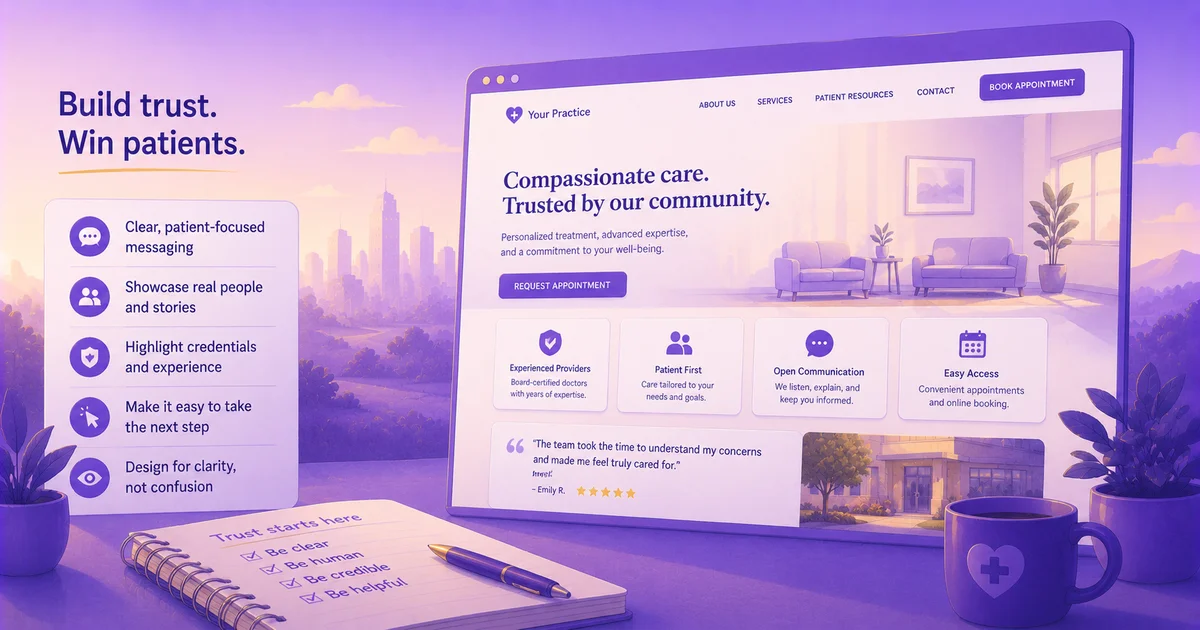
Medical practices face a unique challenge: patients arrive at your website already anxious, often skeptical from past experiences, and ready to judge your credibility within seconds. Your homepage isn't just competing against other practices—it's fighting against years of rushed appointments, dismissive attitudes, and broken promises from the healthcare system. The stakes are high because 84% of patients check online reviews before choosing a healthcare provider, and many have already formed an impression before they even reach your site.
Building trust on a medical practice homepage requires specific trust signals that address the five core domains patients evaluate: your competence as a healthcare provider, your commitment to their confidentiality, your honesty about treatments and costs, your fidelity to their best interests, and the global trust that ties it all together. These elements must be immediately visible and credible, not buried in generic "patient-centered care" language that every practice uses.
Why Medical Practice Trust Is Different from Other Industries
Healthcare trust operates under fundamentally different rules than other service industries. When someone chooses a restaurant or accountant, they're risking money or convenience. When they choose a doctor, they're risking their health and often sharing deeply personal information they've never told anyone else.
Research from the ABIM Foundation shows that medical professionalism centers on trust through specific commitments: managing conflicts of interest, maintaining honesty with patients, and preserving confidentiality. These aren't abstract values—they translate directly into what patients look for when they land on your homepage.
The trust equation is also complicated by timing. Patients often arrive at your website in pain, worried, or after a bad experience elsewhere. They're not browsing casually. They're evaluating whether you'll listen, whether you know what you're doing, and whether they can trust you with information they're scared to share.
The Five Trust Domains Your Homepage Must Address
Medical trust research identifies five specific domains that patients evaluate, often subconsciously, when they encounter a new healthcare provider.
Competence means patients need to see evidence that you have the skills to help them and make correct medical decisions. This goes beyond basic credentials to include specialization, experience with their specific condition, and proof of good judgment.
Confidentiality addresses whether patients can trust you to handle their private health information properly. With HIPAA violations making headlines and patients increasingly aware of privacy risks, this domain has become more prominent in patient decision-making.
Honesty covers truth-telling about diagnoses, treatment options, costs, and outcomes. Patients have been burned by providers who overpromised, hid costs, or weren't transparent about treatment success rates.
Fidelity measures whether patients believe you're working in their best interests rather than your own financial interests. This includes avoiding unnecessary procedures, making appropriate referrals, and prioritizing their health over your bottom line.
Global trust is the overall feeling that combines all other domains—the gut sense that this is someone they can trust with their health and their secrets.
Competence Signals That Actually Matter
Your homepage needs to demonstrate competence quickly and specifically. Generic statements about "excellence" don't work because every practice claims excellence. Patients are looking for proof of relevant expertise.
Board certification should be prominently displayed, but name the specific board and specialty. "Board-certified family medicine physician" carries more weight than "board-certified doctor." If you have fellowship training, subspecialty certifications, or training at recognizable institutions, lead with those details.
Experience with specific conditions matters more than years in practice. A dermatologist who treats 50 psoriasis patients monthly is more compelling to a psoriasis patient than one who's been practicing general dermatology for 20 years. If you specialize in certain conditions, patient populations, or procedures, be specific about your volume and focus.
Hospital affiliations and professional memberships provide third-party validation of your competence. List them prominently, especially if you're affiliated with respected local hospitals or national medical organizations.
Patient outcomes and success metrics, when appropriate and HIPAA-compliant, can demonstrate competence powerfully. Mental health practices might share average treatment length or therapy completion rates. Surgical practices might share complication rates or patient satisfaction scores.
Building Confidentiality Trust in the HIPAA Era
Patients are increasingly sophisticated about privacy rights, especially after high-profile healthcare data breaches. Your homepage must signal that you take confidentiality seriously through both explicit statements and subtle design choices.
A clear, accessible privacy policy linked from your homepage tells patients you're transparent about how their information is used. Don't bury it in footer fine print—make it a prominent link that signals you have nothing to hide about your data practices.
HIPAA compliance statements reassure patients that you understand federal requirements, but go beyond boilerplate language. Explain in plain English how you protect their information and what they can expect in terms of privacy.
Staff training and security measures, when mentioned briefly, demonstrate that confidentiality extends beyond the doctor to everyone who might handle patient information. Patients worry about reception staff, billing departments, and anyone else who might access their records.
Review response strategies that never disclose patient information show prospective patients that you understand boundaries. A North Carolina dental practice was fined $50,000 for HIPAA violations after disclosing patient information in a Google review response. Patients notice when practices respond to reviews professionally without revealing any medical details.
Honest Communication About Costs and Outcomes
Healthcare pricing opacity has eroded patient trust across the industry. Patients arrive expecting hidden costs, surprise bills, and unclear treatment outcomes. Your homepage can differentiate your practice by being refreshingly honest about what patients can expect.
Insurance information needs to be specific and current. Don't just list "most major insurances accepted." Name the specific plans you're in-network with, explain your out-of-network payment policies, and provide realistic cost estimates for common services.
Treatment outcome honesty builds trust even when the news isn't perfect. If you treat chronic conditions that require ongoing management rather than cures, say so. Patients trust providers who set realistic expectations more than those who overpromise.
Wait time transparency addresses one of patients' biggest frustrations with healthcare. If your typical wait time for new patients is three weeks, say so rather than having patients discover it when they call. If you typically run on time versus often running behind, that's a competitive advantage worth highlighting.
Payment policies and financial assistance options should be clearly explained. Patients worry about surprise costs and payment demands. Clear, upfront financial information signals honesty and reduces the anxiety many patients feel about healthcare costs.
Fidelity: Proving You're on Their Side
Patients have been burned by providers who seemed more interested in generating revenue than providing appropriate care. Your homepage needs to signal that you make treatment decisions based on their best interests, not your financial interests.
Referral practices that emphasize finding the best fit for patients rather than keeping everything in-house demonstrate fidelity. If you regularly refer complex cases to specialists or recommend second opinions when appropriate, mentioning that builds trust.
Treatment philosophy that emphasizes conservative approaches when appropriate shows patients you don't default to the most expensive option. Many patients specifically seek providers who try less invasive approaches before recommending surgery or complex treatments.
Continuing education and staying current with research signals that you make treatment recommendations based on the latest evidence rather than outdated protocols. Mention recent training, conferences, or new techniques you've adopted to help patients.
Time and attention commitments help patients understand that you won't rush them through appointments. If your practice schedules longer appointment slots, offers same-day communication, or provides thorough follow-up, these are fidelity signals that differentiate you from high-volume practices.
Addressing Specific Patient Fears and Concerns
Every medical specialty has common patient fears that your homepage should acknowledge and address directly. Patients arrive with specific anxieties, and addressing them builds trust faster than generic reassurance.
Judgment-free care messaging matters especially for sensitive specialties like mental health, reproductive health, or addiction medicine. Patients in these areas often delay seeking care because they fear being judged or shamed. Clear statements about non-judgmental care can be the difference between a patient calling and continuing to suffer in silence.
Pain management and comfort measures address universal healthcare anxiety. Whether you're a dentist explaining sedation options or a surgeon describing post-operative pain management, patients want to know you take their comfort seriously.
Communication accessibility shows patients they won't be left wondering about results or unable to reach you with questions. Explain your communication policies—patient portals, response timeframes, after-hours availability—so patients know what to expect.
Cultural competency and language services, where relevant, help patients from diverse backgrounds feel welcome and understood. If you serve non-English speaking populations or have cultural competency training, mentioning it builds trust with patients who may have felt misunderstood by other providers.
The Power of Social Proof in Medical Trust-Building
Patient testimonials and reviews serve as powerful trust signals, but they must be handled carefully in healthcare due to HIPAA requirements. You cannot share detailed patient stories without specific written authorization, but you can leverage social proof in HIPAA-compliant ways.
Review volume and ratings from third-party platforms like Google, Healthgrades, and Zocdoc provide independent validation of patient satisfaction. 59% of patients are more likely to choose a provider who responds to both positive and negative reviews, showing that you're engaged and responsive to patient feedback.
Professional recognition and awards offer third-party validation of your quality and reputation. Local "best doctor" awards, hospital recognition, or professional society honors provide external proof of competence and peer respect.
Colleague and peer referrals indicate that other healthcare providers trust your judgment enough to send their patients to you. If you receive referrals from specific types of providers or for particular conditions, mentioning that builds credibility.
Community involvement and health education activities show patients that you're invested in their community's health beyond your individual practice. Speaking engagements, health fairs, or educational workshops demonstrate expertise and community commitment.
Technical Trust Signals in Website Design
The design and functionality of your homepage itself sends trust signals before patients even read your content. Professional, secure, and user-friendly design builds confidence, while poor design raises questions about your attention to detail and competence.
SSL certificates and secure forms show patients that you take data security seriously. The padlock icon in the browser address bar and "https" in your URL are now expected trust signals for any healthcare website.
Professional photography and design quality reflect on your practice's overall attention to detail and quality. Stock photos of generic smiling doctors actually undermine trust—patients prefer authentic photos of actual providers and staff.
Current and accurate information demonstrates that you maintain your online presence professionally. Outdated information, broken links, or incorrect hours suggest inattention to detail that patients worry might extend to their medical care.
Mobile responsiveness and fast loading times show respect for patients' time and accommodate how most people browse healthcare information today. 73% of patients have adopted new research behaviors including mobile and voice search for healthcare information.
What the Data Says
84% of patients check online reviews before choosing a healthcare provider, with 51% reading at least six reviews before deciding (ABIM Foundation, 2025). This means your online reputation often determines whether patients even consider calling your practice.
61% of patients now prioritize online reviews over personal recommendations from friends and family (ABIM Foundation, 2025). Digital trust signals have become more influential than traditional word-of-mouth referrals in healthcare decisions.
40% of patients say negative reviews have caused them to cancel or avoid an appointment, even when they had a personal recommendation (ABIM Foundation, 2025). Poor online reputation can override positive personal experiences and referrals.
General trust in physicians correlates strongly with patient willingness to seek care, reveal sensitive information, submit to treatment, and follow recommendations (PMC Research, 2002). Trust isn't just about patient comfort—it directly impacts clinical outcomes and treatment effectiveness.
Trust operates across five key domains: fidelity, competence, honesty, confidentiality, and global trust, with each domain predicting different patient behaviors (PMC Research, 2002). Healthcare websites must address all five domains rather than focusing only on credentials or bedside manner.
Medical Practice Trust FAQs
Q: How quickly do patients form trust judgments about medical practices online?
Most patients make initial trust assessments within 10-15 seconds of landing on a homepage. They're scanning for immediate credibility signals like credentials, professional design, and specific expertise rather than reading detailed content initially.
Q: What trust elements matter most for different medical specialties?
Primary care practices need to emphasize accessibility and comprehensive care. Mental health practices must address stigma and confidentiality concerns. Surgical specialties should highlight competence through experience and outcomes. Specialty practices benefit from demonstrating deep expertise in specific conditions.
Q: How can medical practices build trust while staying HIPAA compliant?
Focus on aggregate outcomes rather than individual patient stories, respond to reviews without disclosing any patient information, use professional testimonials from colleagues, and highlight third-party certifications and awards. Never share specific patient details without written authorization.
Q: Should medical practices address negative reviews on their homepage?
Don't directly address negative reviews on your homepage, but do demonstrate that you take feedback seriously by showing how you've improved systems, training, or processes. Focus on proactive trust-building rather than defensive responses.
Q: What's the difference between trust signals for in-network versus out-of-network practices?
In-network practices should emphasize insurance acceptance, accessibility, and convenience. Out-of-network practices need to demonstrate exceptional value through personalized attention, longer appointments, and superior outcomes that justify the additional cost.
Key Takeaways
- Trust in healthcare operates across five specific domains—competence, confidentiality, honesty, fidelity, and global trust—and your homepage must address each domain with concrete evidence rather than generic statements.
- Patients form trust judgments within seconds based on specific credibility signals like board certifications, hospital affiliations, and evidence of expertise with their particular condition or concern.
- HIPAA compliance isn't just a legal requirement—it's a trust signal that shows patients you understand and respect privacy boundaries, which directly influences their willingness to share sensitive health information.
- Honest communication about costs, wait times, and treatment outcomes builds more trust than optimistic promises, especially when patients have been burned by healthcare surprises before.
- Social proof through reviews, ratings, and professional recognition carries more weight than self-reported claims about quality or patient satisfaction, but must be leveraged carefully within healthcare privacy regulations.
How Your Brand Blueprint Can Help with This
Your Brand Blueprint addresses medical practice trust through multiple sections that work together to build credibility. The 360 View section identifies exactly what trust concerns your specific patient population brings, while the Credibility, Proof & Transformation section provides the framework for presenting your qualifications and outcomes in trust-building ways. The Brand Messaging section ensures your core message addresses patient fears and builds confidence rather than just promoting services.
Ready to put this into practice? BrandBlueprint.ai builds your complete brand messaging strategy — including the section that covers exactly what we talked about here.