
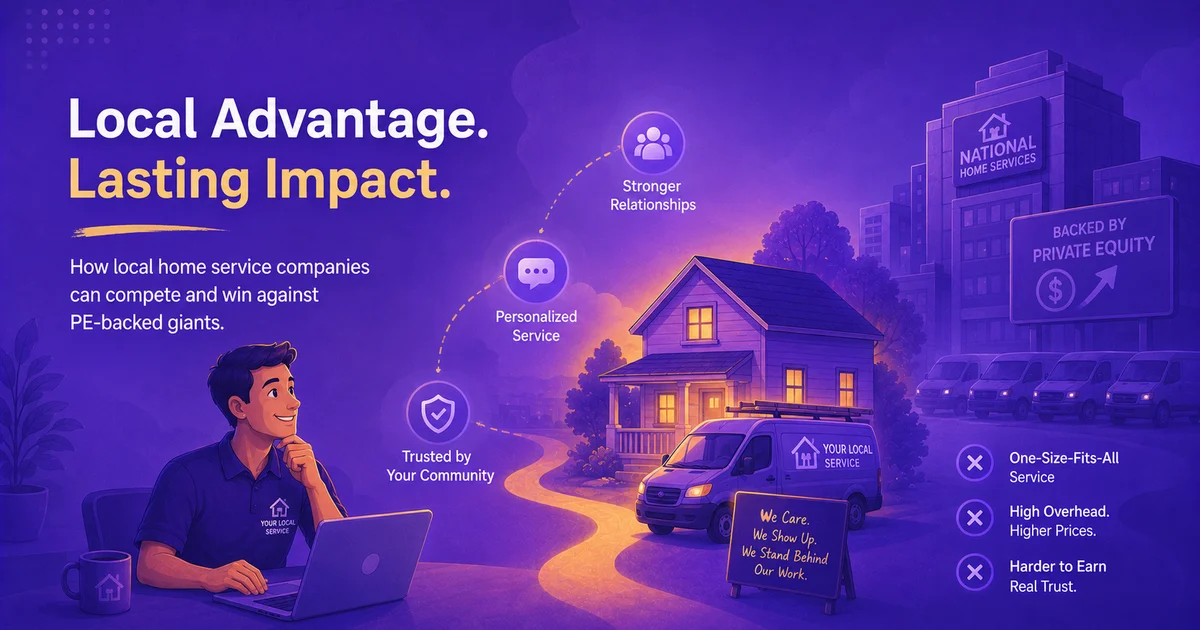
The home services industry is experiencing a wave of private equity acquisitions that's fundamentally changing the competitive landscape. As PE-backed companies roll up local contractors while maintaining their familiar names, independent operators face a new challenge: competing against well-funded chains that look local but operate with corporate resources. Your brand messaging for home service companies becomes your most powerful differentiator in this environment.
Independent home service companies can successfully compete with PE-backed chains by emphasizing authentic local ownership, personalized customer communication, and operational reliability. The key is positioning your genuine community connections and responsive service as advantages that corporate-owned competitors cannot replicate, regardless of their marketing budgets.
Why PE-backed Chains Are Changing the Game
Private equity has been systematically acquiring HVAC, plumbing, electrical, and roofing companies since 2022, often keeping the original business names after purchase. This creates confusion in the marketplace. Homeowners see the same familiar company name, but the business now operates under corporate quotas and standardized procedures.
The numbers tell the story. The U.S. home services market represents approximately $543 billion annually, with most operators traditionally being small, local, and founder-led. PE firms recognize this fragmentation as an opportunity for consolidation and margin optimization.
For genuine independents, this shift creates both challenges and opportunities. PE-backed companies bring larger marketing budgets and professional operations systems. However, they also lose the authentic local connections and decision-making flexibility that homeowners value. Your messaging strategy needs to highlight what they cannot replicate: real ownership accountability and genuine community investment.
The key is making the distinction clear without appearing to disparage competitors. Homeowners are starting to ask whether their contractor is truly local or corporate-owned. Your brand messaging should answer that question proactively and positively.
The Trust Mechanics That Matter Most
Research shows that 69% of consumers say having a direct messaging option increases their confidence in a brand. This statistic reveals something crucial: homeowners want to feel they can reach the actual people responsible for their project.
Ownership Transparency
State your ownership clearly and specifically. Instead of generic "family-owned" language, use concrete details: "Founded in 2011 by Mike and Sarah Chen, still operated by the same family." Include the year you started and whether you've ever been approached for acquisition. This level of specificity builds trust precisely because PE-backed companies cannot make the same claims.
Decision-Making Authority
Emphasize that estimates come from people who can actually approve pricing adjustments. PE-backed companies often require approval from regional managers for any deviation from standard pricing. Your technicians and estimators should be empowered to solve problems on the spot, and your messaging should communicate this advantage.
Local Hiring and Retention
Highlight technician tenure and local hiring practices. Many homeowners now understand that high turnover affects service quality. If your team members have been with you for years and live in the communities they serve, make that part of your brand story.
The goal is not to attack PE-backed competitors but to differentiate through authentic advantages they cannot replicate. Your home services brand strategy should emphasize what genuine local ownership delivers that corporate ownership cannot.
Communication That Scales Personally
PE-backed chains excel at consistent processes but struggle with personalized communication. This creates an opportunity for independent operators who can blend professional systems with personal touch.
Direct Response Times
While corporate chains route calls through call centers, you can offer direct communication with local team members. Your messaging should emphasize specific response commitments: "Text the owner directly" or "Same-day callback from your project manager."
SMS messaging delivers a 98% read rate and 8x higher response rates than email. Independent operators can use text messaging for personalized updates that feel local and immediate. "Your tech John will arrive between 2-3 PM today" creates a different customer experience than automated corporate notifications.
Seasonal Relationship Building
Corporate chains send generic seasonal reminders. Independent operators can reference specific customer history and local conditions. Your spring AC maintenance reminder can mention the customer's system age, last service date, and even local weather patterns that affect timing.
Problem Resolution Authority
When something goes wrong, homeowners want to talk to someone who can actually fix it. Your messaging should emphasize that complaints reach decision-makers, not customer service representatives following scripts. This becomes a powerful differentiator when homeowners have experienced corporate runarounds elsewhere.
Operational Excellence as Brand Messaging
The most effective brand messaging for home service companies connects promises to verifiable operational differences. Corporate chains may promise quality, but independent operators can point to specific practices that prove it.
Permit and Code Compliance
Many PE-backed companies face pressure to minimize job costs, sometimes cutting corners on permits. Independent operators can differentiate by explicitly stating their permit policy: "We pull permits for every job that requires them" or "Licensed electrician on every installation." This messaging appeals to homeowners who understand the long-term risks of unpermitted work.
Warranty Accountability
Corporate warranties often become meaningless after acquisitions or management changes. Independent operators can offer warranties tied to specific individuals: "Personally guaranteed by owner" or "Honored for as long as we're in business under the same ownership." This creates trust that corporate warranties cannot match.
Job Site Standards
Professional cleanup and respect for the customer's property differentiates independent operators who take personal pride in their reputation. Your messaging should specify standards that corporate technicians may not consistently follow: "We use floor protection on every job" or "Tool inventory check before we leave your property."
These operational promises become powerful brand messages because they address real homeowner frustrations with contractor experiences. They also create accountability that independent operators can maintain more easily than large corporate teams.
Digital Presence That Competes
PE-backed companies typically invest heavily in digital marketing, particularly paid search and lead generation platforms. Independent operators need strategies that maximize impact within smaller budgets while emphasizing local advantages.
Google Business Profile Optimization
Your Google Business Profile competes directly with corporate chains in local search results. Focus on elements that showcase local ownership: photos of the actual team members, responses to reviews that mention specific local landmarks or neighborhoods, and posts about community involvement.
Google Local Services Ads provide the "Google Guarantee" badge regardless of company size. This levels the playing field for paid local search visibility, allowing independent operators to appear alongside corporate chains in search results.
Review Strategy That Shows Local Connection
Corporate chains often generate reviews through automated systems that result in generic positive feedback. Independent operators can encourage reviews that mention specific employees by name, local knowledge, or community connections. These detailed reviews carry more weight with homeowners researching contractors.
Content That Demonstrates Local Expertise
Write content that only a genuine local operator could produce: local permit requirements, neighborhood-specific challenges, local supplier relationships, or seasonal considerations unique to your climate zone. This content ranks well in search engines while proving your local expertise.
Pricing and Transparency Advantages
Corporate chains often face pressure to maximize margins through standardized pricing and upselling quotas. Independent operators can use transparent pricing as a competitive advantage.
Published Pricing Ranges
While corporate chains typically require phone calls for quotes, independent operators can publish service call fees, diagnostic charges, and common repair ranges. This transparency builds trust and pre-qualifies serious customers.
No-Upsell Guarantees
Many homeowners have experienced aggressive upselling from corporate technicians working under quotas. Independent operators can explicitly state: "Our technicians are not commissioned on sales" or "We recommend only what your system needs." This messaging directly addresses homeowner concerns about corporate sales pressure.
Local Supplier Relationships
Independent operators often have relationships with local suppliers that allow for better pricing on materials and faster service. Your messaging can highlight same-day parts availability or preferred pricing that corporate chains cannot match due to centralized purchasing requirements.
Building the Anti-Corporate Brand
The most effective strategy for competing with PE-backed chains is not to ignore the elephant in the room but to address it directly. Homeowners increasingly understand that their familiar local contractor may have been sold to a corporate entity.
Ownership Commitment
Make explicit commitments about your independence: "Never sold, never will be" or "Committed to local ownership." These statements differentiate you from competitors who may not be able to make the same promise.
Community Investment
Corporate chains may sponsor local events, but independent operators can demonstrate deeper community connections: hiring locally, using local suppliers, supporting local schools or charities. Your messaging should highlight investments that corporate owners would not make.
Long-term Accountability
Emphasize that you will be available to service your work for years to come because you live and work in the same community. Corporate chains may relocate technicians or close locations based on corporate restructuring. Your local permanence becomes a competitive advantage.
What the Data Says
- 98% of SMS messages are read, compared to much lower email open rates, making text communication a powerful tool for direct customer engagement.
- 69% of consumers say having a messaging option increases their confidence in a brand, indicating that direct communication channels create competitive advantages for independent operators who can respond personally.
- Text messages generate 8x higher response rates than email, making SMS ideal for appointment confirmations, technician arrival updates, and follow-up communications that differentiate local service.
- 89% of consumers want to be able to message businesses directly, creating opportunities for independent contractors to provide more personalized communication than corporate call centers can match.
Common Questions About Competing with PE-backed Home Service Companies
Q: How can I tell if my local competitor has been acquired by private equity?
Look for changes in advertising style, sudden expansion into new service areas, increased emphasis on financing options, or technicians who don't seem familiar with local conditions. You can also research the business registration and ownership records in your state's business database.
Q: Should I mention competitors directly in my marketing?
Avoid naming specific competitors, but you can differentiate by emphasizing positive attributes they cannot claim: "Still owned by the founding family" or "All our technicians live in the neighborhoods they serve." Focus on your strengths rather than their weaknesses.
Q: How do I compete with their larger marketing budgets?
Focus on channels where local knowledge and personal relationships matter more than advertising spend: Google Business Profile optimization, neighborhood-specific content, referral programs, and community involvement. Quality engagement often beats quantity of impressions.
Q: What if they're undercutting my prices?
PE-backed companies sometimes use loss-leader pricing to gain market share, but they typically cannot sustain below-market pricing long-term. Compete on total value: transparent pricing, warranty terms, local accountability, and service quality rather than lowest price alone.
Q: How do I handle customers who want the "security" of a big company?
Emphasize the security advantages of local ownership: direct access to decision-makers, local accountability, and guaranteed service continuity. Large companies can disappear from local markets due to corporate decisions, while established local companies have community roots.
Key Takeaways
- Make your independence explicit and specific rather than relying on generic "family-owned" language that PE-backed companies often continue using after acquisition.
- Leverage direct communication channels like SMS to provide personalized service that corporate call centers cannot match, using your 98% read rate advantage.
- Position operational excellence as brand differentiators by highlighting permit compliance, warranty accountability, and job site standards that corporate pressure may compromise.
- Use local expertise and community connections in your content and messaging to demonstrate knowledge that corporate technicians transferred from other markets cannot replicate.
- Compete on transparency and trust rather than trying to match corporate marketing budgets, emphasizing advantages that scale with personal service rather than advertising spend.
How Your Brand Blueprint Can Help with This
The Brand Blueprint's Competitive Messaging & Gap Audit section specifically analyzes your competitive landscape and identifies the white space opportunities that PE-backed companies cannot claim. It provides language to retire (generic corporate-speak) and strategic recommendations for positioning against well-funded competitors while maintaining authentic local voice.
Ready to put this into practice? BrandBlueprint.ai builds your complete brand messaging strategy -- including the section that covers exactly what we talked about here.