
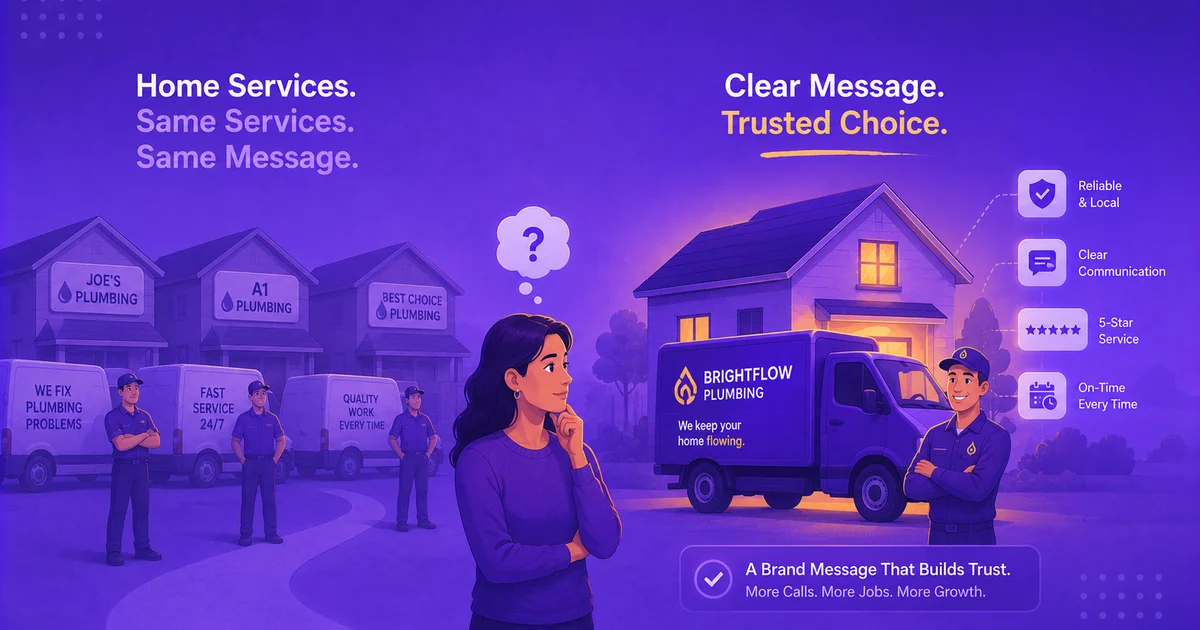
Home service companies face a unique challenge in today's market. When your HVAC system dies on the hottest day of summer or your water heater floods the basement at midnight, homeowners don't have time for marketing fluff. They need real solutions from trustworthy professionals who can show up, fix the problem, and stand behind their work. Yet most home service marketing sounds exactly the same: "trusted local experts," "family-owned," "licensed and insured." This generic approach doesn't just fail to connect with stressed homeowners—it actively undermines trust by making every company sound interchangeable.
Home service brand messaging succeeds when it addresses the specific trust mechanics homeowners actually use to evaluate contractors: phone answering speed, arrival window precision, pricing transparency, cleanup standards, and enforceable warranties. Generic messaging that relies on vague promises of "quality" or "excellence" fails because it doesn't help homeowners distinguish between legitimate operators and bad actors in a category where 28% of customers have had negative experiences.
The Trust Crisis in Home Services
The home services industry operates in a fundamentally different environment than most other professional services. When homeowners search for an accountant or lawyer, they typically have weeks or months to research and compare options. When they need emergency plumbing or HVAC repair, they often have hours.
This compressed decision-making window creates unique brand messaging requirements. Trust signals that work in other industries often fall flat because homeowners under stress need specific, verifiable proof points, not aspirational language about company values.
The challenge is compounded by the presence of bad actors. Storm chasers, unlicensed operators, and companies that abandon jobs mid-project have created a buyer's market where skepticism is the default. Homeowners approach every contractor interaction expecting to be oversold, overcharged, or abandoned.
Why "Licensed and Insured" Isn't Enough
Nearly every home service company leads with "licensed and insured" as their primary differentiator. The problem? This baseline requirement tells homeowners nothing useful about quality, reliability, or accountability.
What homeowners actually want to know:
- License specifics: What's your license number, and how can I verify it online?
- Insurance details: What coverage limits do you carry, and will you add me as an additional insured?
- Bond information: Are you bonded, and what does that protect me against?
- Complaint history: Have you been disciplined by the state board or Better Business Bureau?
Generic messaging skips these details in favor of meaningless phrases. The result? Every contractor sounds identical, forcing homeowners to make decisions based on price alone—exactly the opposite of what quality operators want.
The Cost of Generic Messaging
When home service companies rely on templated marketing language, they create several specific problems that directly impact their ability to win and retain customers.
Commoditization by Default
Generic messaging turns every service call into a price comparison. When your marketing sounds like everyone else's, homeowners have no framework for evaluating quality differences. They default to choosing the lowest bid, which often means choosing the contractor most likely to cut corners or abandon the job.
Research from the Elevate Skilled Trades Study shows that 88% of homeowners say clear pricing is their top trust signal, and 70% would pay more to avoid surprise costs. Yet most home service marketing focuses on vague quality claims rather than pricing transparency.
Consider two plumbing companies in the same market. Company A says they provide "quality service at fair prices." Company B says they charge "$89 for the service call, applied to any work performed, with flat-rate pricing provided before any work begins." Which message helps a stressed homeowner make a decision?
Lost Competitive Advantage
Many home service companies have genuine differentiators that get buried under generic messaging. Family ownership spanning multiple generations, technicians who stay with customers for years, same-day emergency availability, or comprehensive warranties become invisible when wrapped in standard industry language.
A roofing company that has operated under the same family ownership for 40 years and has never been acquired shouldn't sound the same as a private equity platform company operating under a local name. But when both companies describe themselves as "family-owned" without specifics, homeowners can't tell the difference.
Reduced Referral Potential
Homeowners refer contractors based on specific experiences, not general impressions. "They showed up exactly when they said they would," "The final price matched the estimate to the penny," or "They fixed what three other companies couldn't" are the kinds of details that drive word-of-mouth recommendations.
Generic messaging doesn't give satisfied customers the language they need to explain why someone should hire you over the competition. When your brand messaging focuses on vague benefits, even happy customers struggle to articulate what made their experience different.
What Makes Home Service Branding Different
Home service brand messaging must address unique buyer psychology that doesn't exist in other professional services categories. Understanding these differences is crucial for developing messaging that actually converts.
The Emergency vs. Planned Purchase Split
Unlike most service categories, home services serve two completely different buyer mindsets within the same business. Emergency customers need immediate help and prioritize availability, speed, and reliability. Planned purchase customers have time to research and prioritize value, quality, and warranty terms.
Your brand messaging needs to speak to both audiences effectively:
Emergency messaging priorities:
- Phone answering guarantee ("We answer 24/7, not an answering service")
- Response time commitment ("Same-day service guaranteed")
- Immediate availability proof ("3 trucks in your area right now")
Planned purchase messaging priorities:
- Detailed pricing information ("Free estimates include written scope and timeline")
- Quality indicators ("All technicians factory-certified with 5+ years experience")
- Long-term protection ("Written warranty covers parts and labor for 5 years")
Many companies make the mistake of using emergency language for planned purchases or planned purchase language for emergencies. The result is messaging that serves neither audience well.
The Physical Presence Factor
Home service providers work inside customers' homes, often when family members are present. This creates trust requirements that don't exist for service providers who work remotely or in their own offices.
Effective home service branding addresses this dynamic directly:
- Team identification: Photos and names of actual technicians, not stock photos
- Background verification: Clear statements about employee screening and training
- Respect for property: Specific cleanup and protection standards
- Professional presentation: Uniforms, marked vehicles, and identification protocols
Generic messaging often ignores these concerns entirely, missing opportunities to differentiate on factors that matter enormously to homeowners considering letting strangers into their homes.
The Scammer Differentiation Requirement
The presence of storm chasers, unlicensed operators, and companies that abandon jobs creates an obligation for legitimate operators to differentiate themselves explicitly. This means addressing bad actor patterns directly rather than hoping customers will figure out the difference.
Effective differentiation messaging includes:
- Local permanence proof: "Same location for 15 years, same phone number"
- Licensing transparency: "License #12345, verified with state board"
- Payment protection: "No payment due until work passes final inspection"
- Warranty enforcement: "Warranty honored by ownership, not manufacturer"
Companies that excel in home service branding make these distinctions clear upfront rather than burying them in fine print or hoping customers will ask the right questions.
Building Authentic Brand Messaging
Authentic home service brand messaging starts with identifying the specific operational advantages that distinguish your company from competitors. This means moving beyond industry-standard claims to find the concrete details that matter to customers.
Operational Specificity Over Generic Claims
Instead of claiming to be "reliable," describe exactly what reliability looks like in your operation:
- Scheduling precision: "15-minute arrival windows, with text notifications"
- Communication standards: "Photos and explanation before any work begins"
- Problem resolution: "Same technician returns if any issues arise within 30 days"
Instead of promising "quality work," specify what quality means:
- Material standards: "All materials backed by manufacturer warranty"
- Workmanship details: "Code-compliant installation with photo documentation"
- Inspection process: "Third-party inspection available at customer request"
Proof Points That Actually Matter
Home service customers evaluate credibility differently than customers in other professional services. The proof points that matter most are specific and verifiable:
Financial stability indicators:
- Years in business under current ownership
- Better Business Bureau rating and complaint history
- State licensing board complaint record
- Local business license and physical address
Operational capability proof:
- Number of trucks and technicians
- Average response time data
- Customer satisfaction scores with methodology
- Manufacturer certifications with certification numbers
Accountability mechanisms:
- Written warranty terms and coverage details
- Insurance coverage limits and carrier information
- Bonding information and claim process
- Process for handling customer concerns
These concrete details build trust more effectively than testimonials or awards because customers can verify them independently.
Voice and Tone That Reflects Real Expertise
Home service brand voice should sound like it comes from someone who actually does the work, not from a marketing department. This means using technical accuracy while maintaining accessibility.
Technical confidence without jargon:
- "We size HVAC systems using Manual J load calculations" (specific, verifiable)
- "Our installations meet ENERGY STAR certification standards" (concrete benefit)
- "All electrical work includes AFCI protection where required by code" (compliance specificity)
Problem-solving focus:
- "We diagnose before we replace" (process clarity)
- "Repair costs are credited toward replacement if needed within 30 days" (customer protection)
- "We explain what we found and what it means for your system" (education commitment)
Understated confidence:
Rather than claiming to be "the best" or "premier," effective home service messaging demonstrates competence through specificity. "We've been fixing what other companies can't since 1987" tells a story that resonates more than "excellence you can trust."
Common Messaging Mistakes That Kill Conversion
Home service companies make predictable messaging mistakes that undermine their credibility and reduce conversion rates. Avoiding these patterns is essential for effective brand communication.
The "Everything to Everyone" Trap
Many home service companies try to serve every possible customer need, leading to messaging that sounds scattered and unfocused. A plumbing company that advertises drain cleaning, water heater replacement, bathroom remodeling, and emergency service sounds less credible than one that focuses on specific expertise areas.
Focused messaging wins:
- "Emergency plumbing repair specialists—available 24/7"
- "Complete HVAC replacement and service—residential and light commercial"
- "Roofing and gutter systems—storm damage and planned replacement"
Scattered messaging loses:
- "Complete home services—plumbing, electrical, HVAC, roofing, and more"
- "Your one-stop shop for all home improvement needs"
- "From small repairs to major renovations—we do it all"
Focus communicates expertise. Trying to be everything suggests you're not particularly good at anything.
Meaningless Superlatives and Industry Cliches
Certain phrases appear so frequently in home service marketing that they've become meaningless to customers. Using them signals lazy messaging and reduces credibility.
Phrases to retire:
- "Trusted local experts" (says nothing specific)
- "Your comfort is our priority" (every HVAC company says this)
- "We treat your home like our own" (creates liability concerns)
- "Going above and beyond" (undefined promise)
- "Peace of mind" (abstract benefit)
Specific alternatives:
- "Licensed master plumbers with 10+ years experience"
- "Same-day service with 2-hour arrival windows"
- "Written estimates valid for 30 days"
- "Clean-up included—we remove all debris"
- "5-year warranty on all installation work"
Price Avoidance That Backfires
Many home service companies avoid mentioning pricing in their marketing, defaulting to "call for quote" for everything. This approach often backfires because price transparency is the number one trust signal for home service customers.
Smart pricing communication includes:
- Service call fees: "Diagnostic fee: $89, applied to repair cost"
- Flat rate structures: "No hourly billing—you know the cost before we start"
- Price ranges for common services: "Water heater replacement: $1,200-$2,800 depending on unit"
- What's included: "Price includes materials, labor, permit, and cleanup"
Companies that provide pricing transparency convert better than those that make customers call to learn basic cost information.
Implementation Strategies That Work
Effective home service brand messaging requires consistent implementation across every customer touchpoint. This means aligning your marketing messages with operational reality and training staff to deliver on brand promises.
Phone Scripts That Match Brand Messaging
The first phone conversation often determines whether a potential customer hires you. Your phone scripts should reinforce brand messaging while gathering information efficiently.
Effective opening:
"Good morning, this is Sarah at Johnson Plumbing. I understand you have a plumbing issue. Can you tell me what's happening so I can get the right technician to your home?"
Information gathering:
"I'm sending Mike, one of our licensed master plumbers. He'll be there between 2 and 2:30 PM today, and I'll text you when he's 15 minutes away. The diagnostic fee is $89, and if you decide to proceed with repairs, that fee is applied to your total."
Brand reinforcement:
"Mike will explain exactly what he finds and provide written pricing before starting any work. Do you have any questions about our process?"
Vehicle and Uniform Messaging
Branded vehicles and uniforms serve as mobile billboards that should reinforce key brand messages. But many companies waste this opportunity with generic designs that don't communicate competitive advantages.
Effective vehicle messaging:
- Company name and founding year
- Primary service focus
- Contact information and response commitment
- Key differentiator (24/7 availability, same-day service, etc.)
Missed opportunities:
- Generic slogans without specific meaning
- Too much information that can't be read quickly
- No contact information or unclear phone numbers
- Claims that can't be verified (like licensing status)
Digital Presence Alignment
Your website, Google Business Profile, and social media should tell a consistent story that matches your marketing messages. This means using the same language, emphasizing the same differentiators, and providing the same level of detail across platforms.
Google Business Profile optimization:
- Service descriptions that match website language
- Photos of actual technicians and completed work
- Response templates that reinforce brand voice
- Regular posts about specific services and capabilities
Website content alignment:
- Service pages that provide pricing information
- About page that explains company history and ownership
- Team photos with names and credentials
- Clear contact information and response commitments
The goal is creating a seamless experience where customers encounter the same brand messages and proof points regardless of how they interact with your company.
What the Data Says
88% of homeowners say clear pricing is the single biggest trust signal when choosing a contractor (Elevate Skilled Trades Study, 2025). This makes pricing transparency more important than testimonials, awards, or years in business for building initial credibility.
28% of homeowners who hired a contractor in the last five years had a problem (JW Surety Bonds, 2025). The most common complaint was "left the job unfinished," cited by 31% of homeowners with negative experiences. This data explains why completion guarantees and performance bonds resonate strongly with potential customers.
60% of homeowners make a hiring decision within 72 hours of starting their search (Service Direct, 2022). The compressed decision-making timeline means brand messaging must communicate key differentiators immediately, not build to them gradually.
26% of inbound calls to home service contractors go unanswered (Service Direct, 2022). For many homeowners, "did not pick up" equals "did not exist," making phone responsiveness a crucial brand differentiator that should be prominently featured in messaging.
70% of homeowners say they would pay more to avoid surprise costs (Elevate Skilled Trades Study, 2025). This willingness to pay for transparency creates opportunities for companies that communicate pricing clearly to command premium rates.
Home Service Brand Messaging FAQs
Q: How specific should I be about pricing in my marketing materials?
Include service call fees, general price ranges for common services, and what's included in your pricing. You don't need exact quotes, but homeowners want to know if they're looking at $200 or $2,000 for common repairs before they call.
Q: Should I mention competitors in my marketing?
Focus on differentiating from bad actor patterns rather than naming specific competitors. Address storm chasers, unlicensed operators, or companies that don't pull permits without naming names.
Q: How do I prove I'm actually local and not a national chain using a local name?
Include your founding year, physical address, and owner names prominently. Mention local landmarks, neighborhood knowledge, or community involvement that only genuine local operators would have.
Q: What's the biggest messaging mistake home service companies make?
Using generic industry language that makes every company sound identical. "Licensed and insured" or "quality work" doesn't help customers choose between competitors.
Q: How often should I update my brand messaging?
Review messaging annually and update when you add services, change ownership, or when competitive landscape shifts. Emergency contact information and response times should be accurate in real-time.
Key Takeaways
- Specificity beats generic claims: Replace "licensed and insured" with license numbers, insurance limits, and bond amounts that customers can verify independently.
- Address both emergency and planned purchase customers: Use different messaging strategies for customers who need immediate help versus those researching planned replacements.
- Price transparency builds trust faster than testimonials: 88% of homeowners cite clear pricing as their top trust signal, making it more important than awards or years in business.
- Differentiate from bad actors explicitly: Address storm chaser patterns, licensing requirements, and payment protection directly rather than hoping customers will figure out the difference.
- Operational details matter more than aspirational language: Describe exactly what reliability, quality, and customer service look like in your specific operation rather than making vague promises.
How Your Brand Blueprint Can Help with This
The Brand Blueprint's Credibility, Proof & Transformation section helps home service companies identify and articulate the specific operational advantages that actually matter to customers. Instead of generic quality claims, you get messaging frameworks built around verifiable proof points like response times, licensing details, and warranty terms. The Competitive Messaging & Gap Audit section analyzes how your competitors position themselves and identifies the specific language patterns that make everyone sound the same—then helps you break free from industry clichés with messaging that reflects your real operational strengths.
Ready to put this into practice? BrandBlueprint.ai builds your complete brand messaging strategy—including the section that covers exactly what we talked about here.