
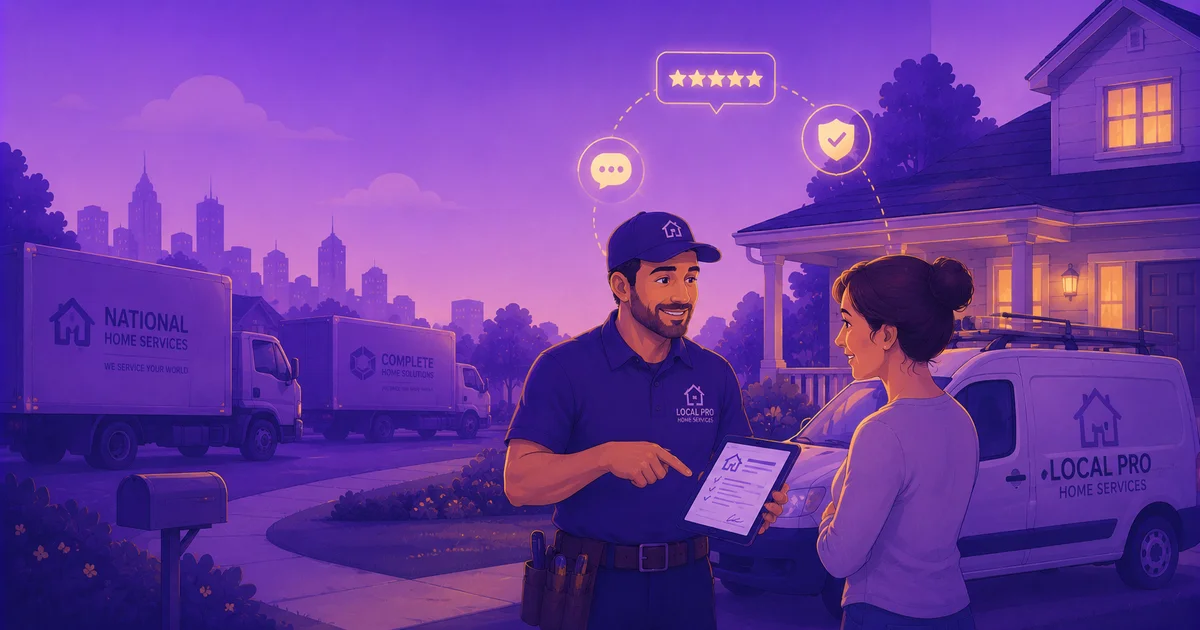
Walk-in customers see two plumbing trucks parked outside a local supply store. Both have "licensed and insured" painted on the side. Both drivers wear polo shirts with company logos. One truck belongs to a PE-backed regional platform operating under a local-sounding name. The other belongs to a genuine family operation that's been fixing pipes in this neighborhood for fifteen years. Without a clear brand strategy, customers can't tell the difference until it's too late.
Small home service companies need brand strategy just as much as enterprise businesses because clear messaging is what separates legitimate operators from storm chasers, builds trust faster than credentials alone, and turns emergency calls into long-term customer relationships in an industry where 60% of homeowners make hiring decisions within 72 hours of starting their search.
The Numbers Tell the Story
The home services market generates $543 billion annually in the U.S., but most of that revenue flows to companies that can't explain what makes them different beyond "quality work" and "customer service." Meanwhile, small operations with focused messaging are seeing outsized results. Vern's Plumbing, a local operation, achieved a 53% revenue increase and 22.9x ROAS after implementing personality-driven messaging that positioned them as "Plumbing Heroes."
The skilled trades shortage means homeowners increasingly judge companies on whether they can actually staff the job, not just sell it. With 480,000+ unfilled HVAC jobs alone according to West Monroe's 2025 research, brand messaging that addresses reliability and follow-through wins more business than craft credentials.
What Brand Strategy Actually Means for Home Services
Brand strategy for a single-truck operation isn't about logos or letterhead. It's about having clear, specific answers to the questions homeowners ask when their water heater dies at 9 PM on a Sunday.
Your Positioning Statement
This isn't "We're the best plumber in town." It's "We're the plumber you call when the other guys can't fix it" or "Same-day repairs with a two-year warranty on all parts and labor." Vague positioning gets you lost in a sea of yellow pages listings. Specific positioning gets you remembered and referred.
Your Service Promise
Generic companies say "We show up when we say we will." Strategic companies say "We text you when we're 15 minutes away, and if we're more than 10 minutes late, your service call is free." The difference is measurable accountability versus empty promises.
Your Proof Points
Instead of "licensed and insured," try "Licensed master plumber #47829, bonded for $25,000, 18 years at this address." Homeowners are learning to ask for specifics because storm chasers and fly-by-night operators have made "licensed and insured" meaningless.
Your Differentiation
Every HVAC company claims to be family-owned. Strategic companies say "Third-generation family business, never been approached for acquisition, same phone number since 1987." The specificity cuts through the noise.
Why Emergency Services Need Strategy Most
Home service calls happen under stress. Your water heater fails, your AC dies in July, your roof starts leaking during a storm. In these moments, homeowners make fast decisions based on limited information. Brand strategy is what helps you win those decisions.
Emergency buyers follow a predictable pattern. They search "emergency plumber near me" or "24 hour HVAC repair." They scan the first few results looking for signals of legitimacy and availability. They call the first number that looks trustworthy and actually answers the phone.
26% of inbound calls to home service contractors go unanswered, according to Service Direct's 2022 Call Performance Report. For most homeowners, "did not pick up" equals "did not exist." But answering the phone is just table stakes. What you say when you answer determines whether you get the job.
A strategic operator answers: "Johnson Plumbing, this is Mike, we can have someone there in 45 minutes. What's going on with your plumbing today?" A tactical operator answers: "Johnson Plumbing" and waits. The difference in conversion rates is dramatic.
The Trust Equation That Actually Matters
Homeowners use a simple trust equation when evaluating contractors: Credibility + Reliability + Safety = Trustworthiness. Brand messaging directly impacts all three variables.
Credibility comes from specific proof, not general claims. "We've been serving this neighborhood since 1987" beats "We're trusted local experts." A founding year under the same ownership tells a story that generic language cannot.
Reliability gets demonstrated through operational specifics. "We guarantee arrival within our scheduled 2-hour window" creates more confidence than "We respect your time." When you make your standards measurable, you separate yourself from operators who can't deliver consistency.
Safety shows up in how you handle the business relationship. "We pull permits for all electrical work" signals code compliance. "We carry $2 million liability coverage" indicates serious business practices. "All our technicians are employees, not subcontractors" addresses a common homeowner concern about who's actually in their house.
Competing Against the Big Platforms
Private equity has been rolling up home service companies since 2022, often keeping local names after acquisition. This creates a positioning opportunity for genuinely independent operators, but only if you make the distinction clear.
Don't just say "family-owned." Say "Third-generation family business, never been sold, never will be." Don't just say "local." Say "All our technicians live within 20 minutes of our shop." Don't just say "personalized service." Say "Same technician visits the same customers year after year."
The PE-backed platforms win on phone coverage and marketing budget. Independent operators win on accountability and absence of upsell quotas. Make that trade-off explicit in your messaging.
A regional platform's technician has a quota to hit. Your technician has a reputation to protect in the neighborhood where his kids go to school. That's a meaningful difference, but only if you communicate it clearly.
Case Studies in Strategic Messaging
Small home services companies are achieving remarkable results with focused messaging strategies. One plumber increased leads by 300% and revenue by 150% in the first year by shifting from generic "quality service" messaging to specific "Same-Day Plumbing Fixes" positioning.
An HVAC company saw 250% growth in booked jobs after implementing messaging that addressed the specific pain point of system diagnosis: "We diagnose the real problem before we quote you a solution." This positioned them against competitors who lead with replacement sales instead of honest troubleshooting.
A landscaper achieved 4x ROI on Google Ads by narrowing their messaging from "full-service lawn care" to "Weed-Free Lawns Guaranteed." The specificity attracted customers who had that exact problem and were willing to pay premium rates for a solution guarantee.
These aren't enterprise companies with marketing departments. They're single-truck operations that got clear about what they do differently and communicated it consistently across all touchpoints.
Where Your Brand Strategy Lives
Your messaging strategy touches every customer interaction. It's not just marketing material. It's operational consistency across all the ways customers experience your company.
Your Google Business Profile listing is often the first impression. Instead of "Quality HVAC service since 1995," try "Residential HVAC repair and replacement, 24-hour emergency service, license #AC-2847, serving Johnson County." The specificity builds trust immediately.
Your truck wrap becomes a neighborhood advertisement. "Emergency Plumbing 24/7" tells people what you do. "Licensed Master Plumber #47829, Serving This Neighborhood Since 1987" tells people why they should call you.
Your phone script sets the tone for every customer relationship. Train your CSR to answer with your positioning statement built in: "Miller Electric, this is Sarah. We can have an electrician there this afternoon. What's the electrical issue you're dealing with?"
Your written estimates become sales tools when they clearly explain your process. Instead of line items and totals, include a paragraph about your warranty terms, cleanup standards, and what happens if something goes wrong.
The Maintenance Plan Advantage
Recurring revenue changes everything for home service companies. Maintenance plan members convert to replacement work at 3 to 4 times the rate of one-time customers. But selling maintenance requires messaging that frames it correctly.
Don't position maintenance as savings. Position it as protection, predictability, and priority access. "HVAC Maintenance Plan: Priority scheduling, guaranteed pricing, and first-right-of-refusal if your system fails during a heat wave."
The messaging difference matters because homeowners don't buy maintenance to save money. They buy it to avoid emergencies and get peace of mind. Frame your maintenance plan around anxiety reduction, not cost reduction.
A strategic maintenance plan message: "Members get next-day scheduling even during our busiest seasons." A tactical message: "Save 15% on all repairs." The first one sells relationships. The second one sells discounts.
Seasonal Messaging Strategy
Home service demand follows predictable seasonal patterns. Your brand messaging should anticipate and address seasonal customer mindsets.
Spring messaging focuses on prevention: "Schedule your AC tune-up before the first heat wave." Summer messaging addresses urgency: "AC died? We stock the parts to fix it today." Fall messaging emphasizes preparation: "Furnace maintenance before the heating season." Winter messaging handles emergencies: "No heat? We guarantee same-day service."
The same company, the same services, but the messaging matches where customers are mentally. A customer researching spring maintenance has different concerns than a customer whose heat failed in January.
Seasonal messaging also helps with search engine optimization. "AC repair during heat wave" gets different search volume than "furnace maintenance before winter." Align your content calendar with seasonal search patterns.
Review and Reputation Strategy
Reviews are part of your brand strategy, not just a reputation management afterthought. 88% of homeowners say clear pricing is the single biggest trust signal when choosing a contractor according to the Elevate Skilled Trades Study, but reviews that mention specific operational details rank second.
A generic 5-star review: "Great service, very professional." A strategic review: "Showed up exactly when they said they would, explained every step of the repair, cleaned up completely, and honored their quoted price exactly."
Train your team to ask for reviews that mention your differentiators. If your competitive advantage is arrival-window precision, ask satisfied customers to mention punctuality. If your advantage is cleanup standards, ask them to mention how you left their home.
Don't just collect reviews. Curate them to reinforce your positioning. Reply to reviews in a way that reinforces your brand message. Thank customers for mentioning the specific operational details that set you apart.
What the Data Says
- 32% conversion rate from postcard campaigns: Home services companies using targeted messaging on direct mail saw 32% conversion rates from phone inquiries, proving that clear value propositions work across all channels.
- 5x average ROAS for small operations: Small home services businesses implementing focused digital branding strategies achieved 5x average return on ad spend, compared to generic messaging approaches.
- 22.9x ROAS for strategic positioning: Vern's Plumbing achieved 22.9x return on ad spend after implementing personality-driven messaging that positioned them as local heroes rather than generic service providers.
- 300% lead increase with specific messaging: One plumber increased leads by 300% in the first year by replacing generic "quality service" messaging with specific "Same-Day Plumbing Fixes" positioning.
- 60% make decisions within 72 hours: Service Direct's 2022 research shows 60% of homeowners make hiring decisions within 72 hours of starting their search, making clear initial messaging critical for conversion.
Common Questions About Home Services Brand Strategy
Q: Does brand messaging really matter for a single-truck operation?
Yes, brand messaging matters more for small operations because you can't compete on marketing budget or name recognition. Clear positioning helps you win the trust equation faster than larger competitors who rely on generic messaging.
Q: How do I differentiate when all contractors offer the same basic services?
Focus on how you deliver the service, not what service you deliver. Arrival-window precision, warranty terms, cleanup standards, and technician consistency are all differentiators that customers can evaluate and choose.
Q: Should I mention that I'm family-owned if everyone else does too?
Only if you can be specific about it. "Family-owned" is wallpaper. "Third-generation family business, same ownership since 1987, never been sold" tells a story that creates genuine differentiation.
Q: What's the difference between brand strategy and marketing strategy?
Brand strategy defines what you stand for and how you're different. Marketing strategy defines how you reach customers. You need clear brand positioning before you spend money on marketing channels.
Q: How often should I update my brand messaging?
Your core positioning should remain consistent for years. Tactical messaging gets updated seasonally or when market conditions change. Don't confuse customers by constantly changing what you stand for.
Key Takeaways
- Brand strategy for home services companies is about operational specificity, not marketing fluff. Your competitive advantage comes from how you deliver service, not what services you deliver.
- Emergency service buyers make fast decisions under stress. Clear, specific messaging helps you win those decisions by building trust faster than credentials alone.
- Positioning yourself against PE-backed platforms requires making genuine independence explicit. Don't just say "family-owned," prove it with founding years, local ownership, and accountability measures.
- Maintenance plans become profit centers when positioned as protection and priority access rather than cost savings. Frame recurring services around anxiety reduction, not discount pricing.
- Reviews and reputation management reinforce brand strategy when customers mention the specific operational details that differentiate you from generic competitors.
How Your Brand Blueprint Can Help with This
The Brand Blueprint's Brand Messaging section builds your core positioning framework, while the Brand Profile & Content Pillars section translates that positioning into consistent messaging across trucks, websites, phone scripts, and customer touchpoints. The Credibility, Proof & Transformation section helps you articulate specific proof points that separate legitimate operators from storm chasers and platform competitors.
Ready to put this into practice? BrandBlueprint.ai builds your complete brand messaging strategy -- including the section that covers exactly what we talked about here.