
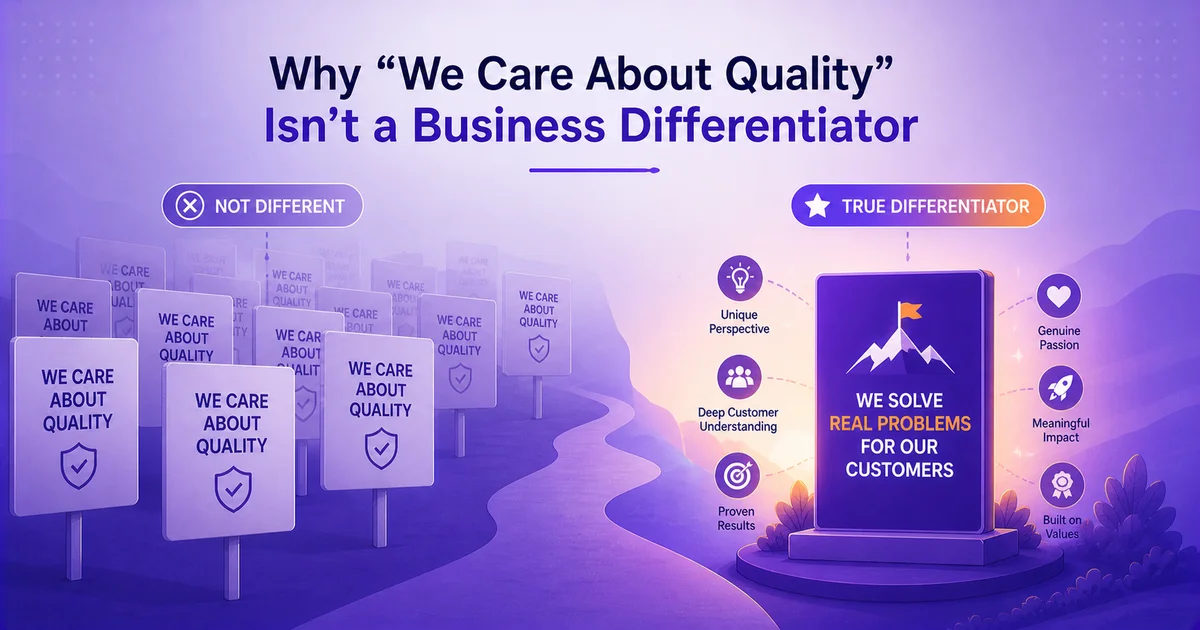
Every business wants to stand out, but most fall into the same trap. They lead with quality promises, superior service claims, and excellence guarantees. Meanwhile, their competitors are saying exactly the same things. When everyone claims to care about quality, nobody actually stands apart.
Quality isn't a differentiator because it's become table stakes. Only 5% of brands are considered unique to customers, despite heavy marketing spend focused on quality claims. True differentiation requires positioning around specific customer identities, problems, and transformations that competitors can't replicate.
The harsh reality is that quality keeps you in the game but doesn't get you chosen. It's the price of admission, not the reason to buy. Here's why your business needs to move beyond quality messaging and what actually works instead.
The Quality Claims Problem in Small Business Marketing
Walk through any industry and you'll hear the same refrain. Law firms promise "zealous advocacy." Restaurants boast "fresh ingredients." Software companies guarantee "reliable solutions." Marketing agencies claim "proven results."
These statements might be true, but they're also completely forgettable. Generic messaging commoditizes businesses, forcing price-based competition and eroding margins. When customers can't distinguish between options based on unique value, they default to the lowest price.
Consider how this plays out in practice. A potential client researches accounting firms and finds five websites that all promise:
- "Accurate bookkeeping"
- "Timely tax preparation"
- "Excellent customer service"
- "Years of experience"
Without any meaningful distinction, that client will likely choose based on cost or convenience. Your expertise, processes, and genuine care become irrelevant because you've positioned yourself identically to every competitor.
The problem runs deeper than just ineffective marketing. Quality is expensive and hard to sustain because it requires consistent processes, reliable suppliers, and no shortcuts. Many businesses claim quality but cut corners on materials, training, or follow-up, turning their promises into empty words.
What Makes a Real Business Differentiator
Effective differentiation solves a specific problem for a specific type of customer in a specific way that competitors can't or won't match. It's not about being better at the same thing everyone else does. It's about being the only solution for a particular need.
Target a specific customer identity. Instead of serving "businesses that need marketing help," position yourself as "the marketing partner for family-owned manufacturers who've never worked with an agency." This immediately separates you from generalist competitors and speaks directly to customers who see themselves in that description.
Own a unique viewpoint. Rather than claiming "we deliver results," stake out a position like "most marketing fails because it talks about features instead of customer transformations." This viewpoint shapes everything you create and attracts people who agree with your perspective.
Focus on transformation, not transaction. Don't just promise better service. Paint a picture of what life looks like after working with you. What specific problems disappear? What new possibilities open up? How does their business or personal situation fundamentally change?
Lululemon exemplifies this approach. The brand positions itself as premium activewear for wellness lifestyle and community, not just high-quality fabric. Customers buy into an identity and transformation, not technical specifications about moisture-wicking materials.
The Systems Behind Sustainable Quality
If you choose to compete on quality, understand what you're signing up for. True quality requires daily disciplines like defined service metrics covering speed, empathy, and problem-solving capabilities.
Quality means:
- Documented processes that produce consistent results
- Regular training to maintain standards
- Measurement systems that catch problems early
- Supplier relationships that support your commitments
- Investment in tools and technology that enable excellence
Most businesses fail here because they confuse intentions with systems. Wanting to deliver quality isn't the same as building the infrastructure to deliver it consistently. They make promises their operations can't support, then wonder why customer satisfaction drops over time.
Excellence is also fragile. Businesses often achieve initial success, then assume it's permanent. They stop investing in the systems that created quality in the first place. Standards slip gradually, but customer expectations remain high.
Moving Beyond Generic Positioning
If everyone talks quality, it doesn't set your brand apart. You need to dig deeper for a legitimate position that stands for one clear thing in customers' minds.
Start by examining what you actually do differently, not what you do better. Look at:
Your process. Do you approach projects in a fundamentally different way? A web design firm might position around "websites built through customer interviews, not creative guesswork" while competitors focus on visual design awards.
Your specialty. What narrow focus gives you advantages others lack? An accounting firm that only works with restaurants understands industry-specific challenges that generalists miss.
Your philosophy. What do you believe about your industry that others don't? A business coach might position around "growth through systems, not hustle" in a market full of motivation-focused competitors.
Your customer's journey. What unique path do you take clients through? A financial advisor might specialize in "wealth transition for business owners planning exits" rather than general financial planning.
The goal is owning one unique idea in prospects' minds. When they think of that specific need or approach, your name should be the only one that comes to mind.
Business Differentiation Tips That Actually Work
Real differentiation often comes from combinations rather than single factors. Here's how to build a unique selling proposition that competitors can't easily copy:
Combine unexpected elements. A fitness trainer who specializes in "strength training for busy executives using hotel gym equipment" merges audience, method, and constraint in a way that's hard to replicate.
Address the unspoken problem. Most customers have concerns they don't voice directly. A contractor might position around "renovation projects that actually finish on time and budget" because everyone assumes construction runs late and over cost.
Take a contrarian stance. Challenge industry assumptions that everyone else accepts. A marketing consultant might build a practice around "profitable businesses that never use social media" while competitors chase follower counts.
Focus on the after-effect. Instead of describing what you do, describe what becomes possible. A business systems consultant doesn't just "improve operations" but "gives owners their evenings and weekends back."
Consider how this works in practice. Two running shoe brands compete in the same market. Brand A promotes "premium quality materials and construction." Brand C differentiates with "shoes for trail runners needing grip on loose terrain", targeting specific users with specific needs. Brand C wins despite potentially inferior materials because they solve a precise problem for a defined audience.
Common Differentiation Mistakes to Avoid
Many businesses try to differentiate but make predictable errors that undermine their efforts:
Being too broad. "We serve small businesses" isn't positioning. Neither is "helping people achieve their goals." The wider your target, the weaker your appeal to any individual prospect.
Focusing on inputs instead of outputs. Customers don't care about your 20 years of experience or advanced certifications. They care about what those credentials produce for them specifically.
Copying successful competitors. If another business succeeds with a particular position, that space is taken. You need your own territory, not a me-too version of their strategy.
Making claims you can't support. Positioning creates expectations you must consistently meet. If you claim to be "the fastest response team in the city," you better answer calls in minutes, not hours.
Changing positions frequently. Differentiation requires consistency over time. Customers need repeated exposure to your unique position before it takes hold. Switching messages every quarter confuses rather than clarifies.
The key is finding the intersection between what you do best, what customers need most, and what competitors ignore or handle poorly. That sweet spot becomes your differentiating position.
What the Data Says
- Only 5% of brands are considered unique to customers: Despite heavy marketing spend focused on quality claims, the vast majority of brands fail to achieve meaningful differentiation in customers' minds.
- Generic messaging commoditizes businesses and forces price-based competition: When companies use identical positioning around quality and service, customers have no basis for choice except cost, eroding profit margins across entire industries.
- Quality requires expensive, consistent systems that many businesses can't sustain: True quality demands documented processes, regular training, measurement systems, and ongoing investment that most companies underestimate.
- Effective differentiation targets specific segments with unique viewpoints competitors can't replicate: Successful positioning focuses on particular customer types and specific approaches rather than broad quality promises.
Common Questions About Business Differentiation
Q: How do you differentiate when your industry is commoditized?
Look for underserved segments or unaddressed problems within your industry. Even in highly commoditized markets, specific customer types have unique needs that generalist competitors ignore. Focus on those niches and build your entire approach around serving them exceptionally well.
Q: What if our quality actually is superior to competitors?
Superior quality can be part of your differentiation, but only if you can prove it in specific, measurable ways that matter to customers. Instead of claiming "higher quality," specify "materials that last 40% longer" or "processes that reduce errors by 75%" with documentation to support those claims.
Q: How long does it take for differentiation to impact business results?
Genuine differentiation typically shows results within 3-6 months of consistent implementation, but building strong market position takes 12-18 months of sustained messaging and delivery. The key is maintaining your unique position long enough for customers to associate it with your brand.
Q: Can small businesses compete on differentiation against larger competitors?
Small businesses often have advantages in differentiation because they can specialize more narrowly and move faster than large competitors. While big companies serve broad markets with general solutions, smaller businesses can own specific niches with tailored approaches that larger players can't economically match.
Key Takeaways
- Quality claims fail as differentiators because every competitor makes them, forcing customers to choose based on price instead of unique value.
- Real differentiation comes from targeting specific customer identities, addressing particular problems, and offering unique transformations that competitors can't or won't match.
- Sustainable quality requires expensive systems, documented processes, and ongoing investment that many businesses underestimate when making quality promises.
- Effective positioning combines unexpected elements, addresses unspoken problems, or takes contrarian stances that create unique market territory.
- The goal is owning one clear idea in customers' minds so when they think of that specific need, your business is the only solution they consider.
How Your Brand Blueprint Can Help with This
Your Brand Blueprint's Competitive Messaging & Gap Audit section identifies exactly where your competitors cluster their messaging and reveals white space opportunities for unique positioning. It analyzes the language saturating your market and provides strategic recommendations for differentiated messaging that sets you apart. The Brand Messaging section then builds your core framework around these unique positioning elements rather than generic quality claims.
Ready to put this into practice? BrandBlueprint.ai builds your complete brand messaging strategy -- including the section that covers exactly what we talked about here.