
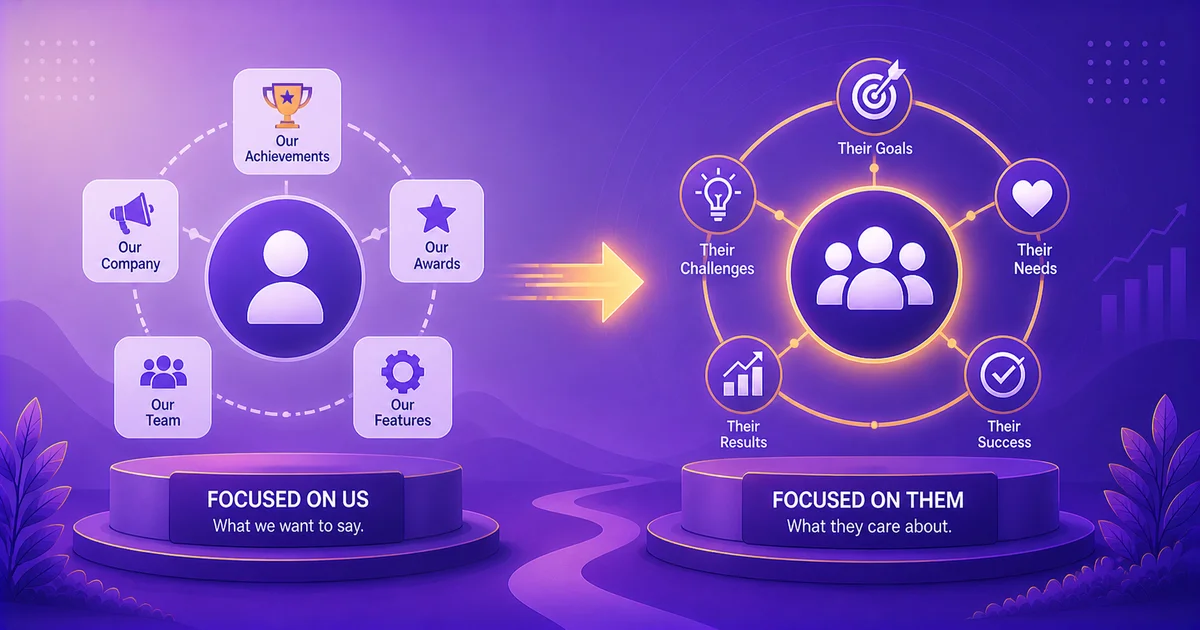
Most business owners approach brand messaging like they're writing a resume. They list achievements, rattle off features, and highlight their credentials. But here's the uncomfortable truth: your customers don't care about your story. They care about their own. The most powerful brand strategy shifts the spotlight entirely away from what you've built and focuses laser-sharp attention on who your customer becomes when they work with you.
The best brand strategy transforms customers into the hero of their own story, positioning your business as the guide that helps them achieve their goals and become the person they want to be. This customer-centric approach builds deeper loyalty and drives stronger business results than traditional company-focused messaging.
The Fatal Flaw in Most Brand Messaging
Walk through any company website and you'll see the same pattern everywhere. "We are the leading provider..." "Our award-winning team..." "Founded in 1995, we have over 25 years of experience..." It reads like a company's dating profile, desperately trying to impress by listing accomplishments.
This approach fails because it misunderstands the fundamental psychology of decision-making. When people buy something, they're not just purchasing a product or service. They're buying a better version of themselves. They're investing in who they want to become.
Consider how Apple revolutionized technology marketing. Apple didn't win by talking about processor speeds or technical specifications. They won by making customers feel like creative innovators who "think different." When someone bought a Mac, they weren't just buying a computer. They were joining a community of artists, entrepreneurs, and rebels who challenged the status quo.
Nike understood this principle from the beginning. Their brand messaging doesn't focus on shoe technology or athletic wear quality. Instead, Nike positions customers as athletes who overcome obstacles and achieve greatness. "Just Do It" isn't about Nike's products. It's about the customer's potential.
Why Customer Transformation Drives Brand Success
Research from Harvard Business Review reveals that brands delivering multiple value elements grow 2.5x faster than competitors. The highest-performing brands don't just solve functional problems. They enable emotional transformation and help customers reach self-actualization.
The study identifies four levels of customer value:
- Functional value solves basic problems. Your accounting software processes invoices. Your gym has equipment. Your consulting firm provides expertise.
- Emotional value creates positive feelings. Your service makes customers feel confident, secure, or accomplished.
- Life-changing value enables significant personal improvement. Your coaching program helps clients build leadership skills. Your design services transform how customers see their business.
- Self-actualization value helps customers become who they aspire to be. This is where the strongest brand connections happen.
IKEA exemplifies this transformation-focused approach. They don't just sell furniture. They enable customers to become savvy home designers who create beautiful, personalized spaces on any budget. When you shop at IKEA, you're not just buying a bookshelf. You're becoming someone who can transform any space into a reflection of your personality and values.
The Guide vs. Hero Framework in Brand Strategy
Seth Godin identifies this shift perfectly when he writes about avoiding the "trophy hunting" mentality in business. Companies that treat customers like trophies to be won miss the deeper opportunity to make customers the heroes of their own transformation story.
In this framework, your business isn't the hero. You're the wise guide who helps the hero complete their journey. Think Gandalf to Frodo, Mr. Miyagi to Daniel LaRusso, or Yoda to Luke Skywalker. The guide has knowledge, tools, and experience. But the hero gets the transformation and the victory.
This changes everything about how you communicate:
Instead of "We have 20 years of experience," try "You'll have decades of proven strategies working in your favor."
Instead of "Our innovative platform delivers results," try "You'll become the kind of leader who makes data-driven decisions with confidence."
Instead of "We're the award-winning choice," try "Join hundreds of entrepreneurs who've transformed their industries."
The difference is subtle but profound. One approach makes your company the center of attention. The other makes your customer the star while positioning you as their trusted guide.
What Transformation-Focused Messaging Looks Like
Starbucks provides a masterclass in transformation-focused brand messaging. They don't position themselves as just another coffee shop. Starbucks creates "the third place" between home and work where customers become more productive, creative, and connected versions of themselves.
When someone works from Starbucks, they're not just buying coffee. They're accessing an identity as someone who values quality, community, and the kind of focused energy that comes from being around other ambitious people. Starbucks customers become members of a productive, inspired community.
This positioning influences everything from store design to product naming to seasonal campaigns. Every touchpoint reinforces the customer's transformation from someone who just needs caffeine to someone who belongs in this aspirational community.
Your transformation messaging should answer three critical questions:
- Who is your customer before they find you? What challenges do they face? What do they struggle with? What kind of person are they in their current situation?
- Who do they become after working with you? How do they feel differently? What new capabilities do they have? How do others perceive them differently?
- What's the bridge between these two states? This is where your product or service fits. You're not the destination. You're the vehicle for their transformation.
Building Your Customer-Centric Brand Messaging Strategy
Creating transformation-focused brand messaging requires a fundamental shift in how you think about your value proposition. Start by auditing your current messaging against the hero vs. guide framework.
Review your website, sales materials, and social media content. Count how many statements start with "We" versus "You." Look for transformation language versus feature language. Most businesses discover they're talking about themselves 80% of the time.
Next, map your customer's transformation journey. Interview recent clients about their experience. Ask specific questions about how they felt before finding you, what changed during your working relationship, and how they see themselves differently now.
Look for emotional shifts, not just functional outcomes. A business consultant might help clients increase revenue, but the real transformation is helping them become confident leaders who make strategic decisions without second-guessing themselves.
Document the language your customers use to describe their transformation. These exact phrases become the foundation of your transformation-focused messaging. When customers tell you they went from "overwhelmed and scattered" to "focused and strategic," that language belongs in your brand messaging.
Michael Ward writes about authentic brand strategy, noting that "the most credible voice in your brand ecosystem is never yours. It's the person you served." Your customer's transformation stories become your most powerful marketing content.
The Competitive Advantage of Transformation-Focused Branding
In a marketplace where B2B buyers spend 83% of their journey researching independently, transformation-focused brand messaging creates a sustainable competitive advantage. Features can be copied. Pricing can be matched. But the emotional connection that comes from helping customers become heroes is much harder to replicate.
When customers see themselves as the hero of their transformation story, they develop deeper loyalty to the guide who helped them get there. This emotional connection translates directly into business results. Brands with strong emotional connections outperform competitors by 20% in sales.
Consider two financial advisors with identical credentials and similar fees. The first talks about their certifications, years of experience, and investment philosophy. The second focuses on helping clients become confident decision-makers who build wealth for their families' futures.
The first advisor is selling financial services. The second is selling transformation into a more secure, empowered version of who the customer wants to be. Which message resonates more deeply with someone worried about retirement planning?
This transformation focus also influences how customers talk about your brand to others. When customers see themselves as heroes in a transformation story, they naturally want to share that story. They become advocates because your success is intertwined with their identity.
Common Mistakes in Customer-Centric Brand Messaging
Many businesses attempt transformation-focused messaging but stumble into predictable traps. The biggest mistake is making superficial changes without shifting the underlying perspective.
Simply swapping "we" statements for "you" statements isn't enough. "We deliver results" becomes "You get results" but both statements still focus on functional outcomes rather than personal transformation.
Another common error is promising transformations that feel disconnected from the actual service. A tax preparation service claiming to help clients "become financial visionaries" stretches credibility. The transformation must feel authentic and directly connected to what you actually deliver.
Some businesses overcomplicate the transformation by promising multiple different identity shifts. Focus on one primary transformation that naturally flows from your core service. A marketing consultant might help clients become confident communicators, strategic thinkers, or growth-focused leaders, but trying to promise all three dilutes the message.
Brand strategy experts warn that without a solid framework, "your brand's image can become fragmented, inconsistent, and ultimately ineffective." Transformation-focused messaging requires consistency across every customer touchpoint.
Measuring the Impact of Transformation-Focused Branding
The success of customer-centric brand messaging shows up in both quantitative and qualitative metrics. Track traditional business metrics like conversion rates, customer lifetime value, and referral rates, but also monitor transformation-specific indicators.
Customer testimonials and case studies become richer when they focus on transformation rather than just outcomes. Instead of "increased revenue by 30%," look for stories like "went from reactive firefighting to strategic planning" or "transformed from overwhelmed founder to confident CEO."
Social media engagement often increases when content focuses on customer transformation rather than company achievements. Posts about customer success stories and transformation journeys typically generate more comments and shares than posts about company news or product features.
Sales conversations change when your team can articulate customer transformation clearly. Prospects respond differently to "become the kind of leader who scales successfully" compared to "our consulting services help you grow your business."
Monitor how customers describe their experience working with you. When customers naturally use transformation language in reviews and referrals, your messaging is working. When they default to describing features and outcomes, there's room to strengthen the transformation focus.
What the Data Says
- Brands delivering multiple value elements grow 2.5x faster than competitors (2019) — Transformation-focused brands tap into higher levels of customer value beyond functional benefits.
- B2B buyers spend 83% of their journey researching independently — Customer-centric messaging influences perception during the critical early research phase.
- Brands with emotional connections outperform by 20% in sales (2021) — Transformation-focused branding builds the emotional bonds that drive revenue growth.
- Purpose-driven brands grow 4.1x faster (2019) — Brands focused on customer transformation naturally align with purpose-driven growth.
Customer-Centric Brand Strategy FAQs
Q: How do you identify what transformation your customers actually want?
Interview recent customers about their before and after experience. Ask how they felt before finding you and how they see themselves differently now. Look for emotional language and identity shifts, not just functional outcomes.
Q: What if your service doesn't seem transformational enough for this approach?
Every service enables some form of transformation, even if it's small. A cleaning service helps customers become people who live in beautiful, organized spaces. An accountant helps business owners become confident financial decision-makers. Focus on the emotional shift, not the scale.
Q: How often should you update your transformation-focused messaging?
Review your customer transformation messaging annually as you gather more customer stories and insights. The core transformation usually stays consistent, but the language and examples should evolve based on actual customer experiences.
Q: Can B2B companies use transformation-focused messaging effectively?
Absolutely. B2B transformation focuses on professional identity and business outcomes. A marketing agency might help CMOs become strategic leaders who drive growth. A software company might help IT directors become efficiency experts who enable company-wide productivity.
Key Takeaways
- Shift from company-focused to customer-focused messaging — Position customers as the hero of their transformation story and your business as the guide who helps them succeed.
- Focus on emotional and identity transformation, not just functional benefits — Customers buy better versions of themselves, not just products or services.
- Use customer language to describe their transformation journey — Interview customers about their before and after experience and incorporate their exact words into your messaging.
- Maintain consistency across all touchpoints — Transformation-focused messaging must be reinforced in every customer interaction, from website copy to sales conversations to onboarding materials.
- Measure success through both quantitative metrics and transformation-specific indicators — Track traditional business metrics alongside customer testimonial quality and transformation-focused engagement.
How Your Brand Blueprint Can Help with This
A Brand Blueprint's 360 View section creates the detailed customer profile you need to understand their desired transformation, while the Brand Messaging section develops the core framework for positioning customers as heroes in their own success stories. The Credibility, Proof & Transformation section specifically captures the "life after" experience your customers gain from working with you.
Ready to put this into practice? BrandBlueprint.ai builds your complete brand messaging strategy — including the section that covers exactly what we talked about here.