
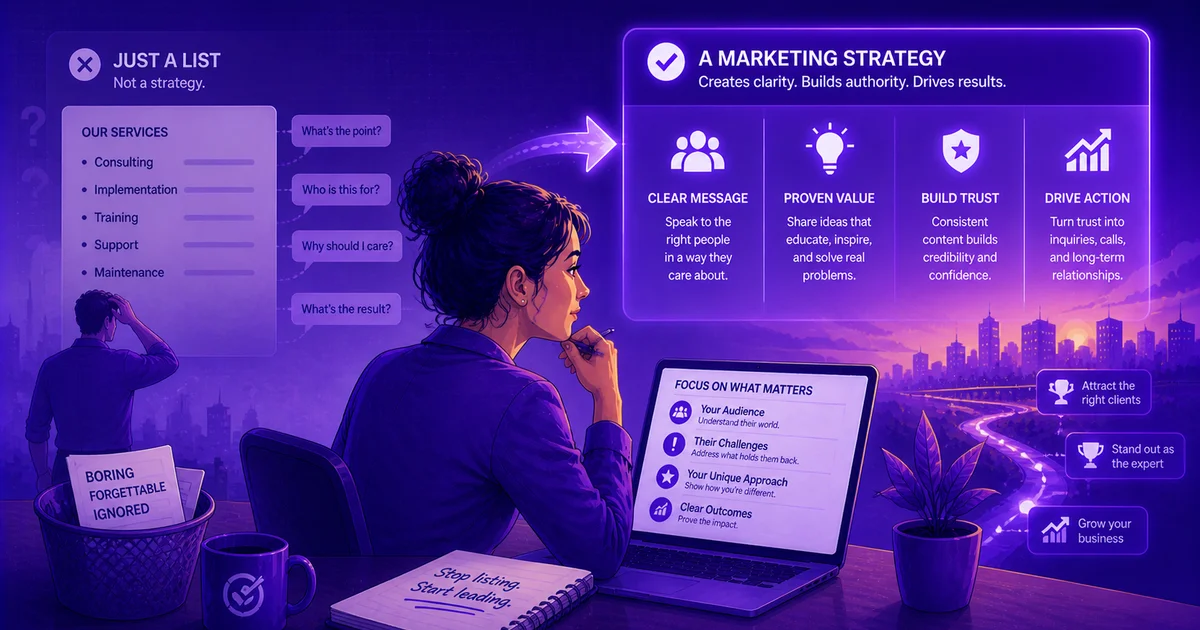
Most business owners confuse activity with strategy. They list their services on a website, post occasionally on social media, and wonder why prospects aren't lining up. This approach treats marketing like a catalog instead of a conversation with real people who have real problems to solve.
Listing services without a strategic framework is like having a business card with no phone number. It tells people what you do but gives them no reason to care and no clear path to take action. True marketing strategy bridges the gap between what you offer and why your specific audience should choose you over every other option available.
The difference between listing and strategizing isn't just semantic. It's the difference between hoping someone stumbles across your business and engineering a system that consistently attracts the right people at the right time.
The Fatal Flaw in the Service List Approach
When you open your website and see a neat list of services, you're looking at the business equivalent of a restaurant menu with no descriptions, no prices, and no indication of what makes each dish special. It's information without context, features without benefits, and offerings without outcomes.
This approach fails for three critical reasons. First, it assumes prospects already understand why they need your specific services. Second, it provides no emotional connection or compelling reason to choose you. Third, it offers no clear next step for interested prospects to take.
Consider how this plays out in real customer interactions. A potential client visits your website, sees "Consulting Services," "Training Programs," and "Implementation Support," then clicks away within seconds. They learned what you do but gained no insight into how you solve their specific problems or what their life looks like after working with you.
The service list approach also creates internal confusion within your organization. Without a strategic framework, your sales team doesn't know which services to emphasize, your marketing team can't create compelling campaigns, and your content creators produce generic material that resonates with no one.
Marketing strategies with clear goals drive effective customer acquisition, while aimless service listings leave prospects confused about your value proposition.
What Happens When Strategy Is Missing
The absence of marketing strategy creates a ripple effect throughout your entire business operations. Teams work in silos, messaging becomes inconsistent, and resources get wasted on activities that generate little to no return on investment.
Inconsistent messaging across departments becomes the norm when there's no strategic foundation. Your blog content targets one audience while your advertising speaks to a completely different group. Your sales team makes promises your service delivery can't keep, and your customer service representatives can't explain why your approach differs from competitors.
Resource misallocation follows naturally from strategic confusion. Marketing budgets get spread across too many platforms without clear success metrics. Content gets produced without understanding which topics actually drive qualified leads. Advertising campaigns run simultaneously with conflicting messages and competing calls to action.
Lost emotional connections represent perhaps the biggest cost of strategy-free marketing. People make buying decisions based on feelings, then justify those decisions with logic. Service lists appeal only to the logical brain while completely ignoring the emotional drivers that actually motivate purchase decisions.
Without strategy, your business operates reactively instead of proactively. You respond to immediate demands rather than building systematic approaches that create predictable growth over time. This reactive approach keeps you constantly busy while making little progress toward meaningful business objectives.
Research shows that businesses without marketing strategies experience confused brand perception and wasted marketing budgets due to uncoordinated departmental efforts.
The Strategy Alternative: Engineering Traction Instead of Hoping for Luck
Real marketing strategy transforms random business activities into systematic approaches that generate predictable results. Instead of hoping prospects will discover your services, strategy creates multiple touchpoints that guide people from initial awareness through final purchase and beyond.
Strategy begins with understanding your specific audience at a granular level. This goes far beyond basic demographics to include psychographic details, pain points, buying behaviors, and decision-making processes. You need to know not just who your customers are, but how they think, what keeps them awake at night, and what success looks like in their world.
From this foundation, effective strategy maps out the complete customer journey from first contact through repeat business. Each touchpoint serves a specific purpose in moving prospects closer to purchase while building trust and demonstrating value along the way.
- Content strategy becomes purposeful when guided by clear objectives. Instead of creating random blog posts or social media updates, every piece of content addresses specific customer questions at particular stages of the buying process. A home improvement contractor might create videos answering first-time buyer questions, then offer free consultations as the logical next step.
- Lead generation systems replace hope-based marketing with engineered outcomes. These systems include lead magnets that attract qualified prospects, email sequences that nurture relationships over time, and clear conversion paths that guide people toward purchase decisions.
- Measurement and optimization ensure continuous improvement rather than repeating unsuccessful activities. Strategy includes specific metrics that indicate progress toward business objectives, allowing for data-driven adjustments that improve results over time.
Businesses with defined marketing strategies are 313% more likely to report success compared to those operating without strategic frameworks.
How Leading Brands Think Beyond Service Lists
Major brands never lead with service lists because they understand that emotional connection drives purchase decisions more than feature comparisons. These companies invest heavily in narrative strategies that position their offerings within larger stories about customer transformation and lifestyle enhancement.
Apple exemplifies strategic thinking over service listing. Their marketing never begins with technical specifications or feature comparisons. Instead, Apple creates narratives around innovation, creativity, and personal empowerment. Their advertising shows people using technology to accomplish meaningful goals rather than explaining what their devices can do. This approach justifies premium pricing while building fierce customer loyalty.
Nike employs similar strategic thinking with their "Just Do It" campaign framework. Rather than describing athletic equipment features, Nike creates inspirational content that connects with athletes' aspirations and challenges. Their strategy generates consistent leads through content that motivates and inspires rather than informs and educates.
Coca-Cola shifted from product-focused marketing to experience-based campaigns like "Share a Coke," which personalized their messaging and built emotional connections with consumers. This strategic approach drove 2% sales growth in a flat market by focusing on relationships rather than beverage features.
Starbucks focuses on creating a "third place" experience between home and work rather than listing coffee varieties and brewing methods. Their marketing strategy emphasizes community, comfort, and connection, fostering repeat visits and customer loyalty through targeted social media and mobile app strategies.
These brands succeed because they understand that people buy solutions to problems, not services or products. Their marketing strategies address emotional needs, paint pictures of desired outcomes, and create clear paths for prospects to experience transformation.
Building Your Strategic Foundation
Developing effective marketing strategy requires systematic thinking about business objectives, customer needs, and competitive positioning. This process begins with clearly defined goals that drive all subsequent marketing decisions and activities.
- Start with specific business objectives that marketing can directly influence. Instead of vague goals like "increase awareness," define measurable outcomes like "generate 50 qualified leads per month" or "increase average transaction value by 25%." These objectives provide clear direction for all marketing activities and enable meaningful performance measurement.
- Map the complete customer journey from initial problem awareness through repeat purchase and referral generation. Understand what questions prospects ask at each stage, what information they need to move forward, and what obstacles typically prevent them from taking action. This journey mapping reveals content opportunities and conversion optimization possibilities.
- Develop messaging frameworks that address customer needs rather than business capabilities. Your core message should clearly articulate the problem you solve, the outcome you deliver, and why your approach differs from available alternatives. This messaging becomes the foundation for all marketing communications across every channel and touchpoint.
- Create content pillars that support your messaging strategy while providing consistent value to your target audience. These pillars ensure content variety while maintaining strategic focus. A business consultant might build content around industry trends, operational efficiency, and growth strategies, with each piece designed to demonstrate expertise while addressing prospect concerns.
- Design lead generation systems that attract qualified prospects and move them systematically toward purchase decisions. These systems include valuable lead magnets, nurturing sequences, and clear conversion processes that guide people from initial interest to final purchase.
Content marketing generates over three times as many leads as traditional marketing while costing 62% less, making it a critical component of effective strategy.
The Implementation Reality
Strategy without execution produces no results, but execution without strategy wastes resources and generates inconsistent outcomes. The most effective approach combines strategic thinking with systematic implementation that builds momentum over time.
Begin implementation with high-impact activities that generate immediate feedback while building toward longer-term objectives. This might mean creating one piece of strategic content per week while simultaneously optimizing your website for clearer conversion paths. Small, consistent actions compound over time to create significant business results.
Measure what matters by tracking metrics that directly connect to business objectives rather than vanity metrics that look impressive but don't drive revenue. Focus on lead quality, conversion rates, customer lifetime value, and return on marketing investment rather than follower counts or website traffic volume.
Iterate based on data rather than assumptions or personal preferences. Regular analysis of marketing performance reveals which activities generate the best results and which need adjustment or elimination. This data-driven approach ensures continuous improvement rather than repeating unsuccessful activities.
Maintain consistency across all marketing channels and touchpoints while adapting messages for platform-specific audiences. Your core strategic framework should remain constant while tactical execution varies based on channel requirements and audience expectations.
Scale successful activities rather than constantly trying new approaches. Once you identify marketing activities that generate consistent results, invest more resources in expanding those successes before exploring additional opportunities.
Statistics show that businesses earn an average of $5 for every $1 spent on marketing, but only when that spending follows strategic frameworks rather than random activity.
What the Data Says
Businesses with marketing strategies are 313% more likely to report success compared to those without strategic frameworks (HubSpot), demonstrating the critical importance of strategic thinking over random marketing activities.
49% of businesses lack a defined marketing strategy according to Forbes research, leading to stalled growth and missed opportunities in competitive markets where strategic competitors gain significant advantages.
Content marketing generates 126% more leads than businesses using only traditional marketing approaches (Crush Your Social), while requiring 62% less investment than conventional advertising methods.
Businesses earn $5 for every $1 spent on strategic marketing (Crush Your Social), but only when marketing follows systematic approaches rather than random posting or service listing.
Content marketing costs 62% less than traditional marketing while generating three times as many leads (Demand Metric), making strategic content creation one of the most cost-effective marketing approaches available.
Common Questions About Service Business Marketing Strategy
Q: How long does it take to see results from strategic marketing versus just listing services?
Strategic marketing typically shows initial results within 30-60 days as improved messaging clarifies value propositions and better content attracts qualified prospects. Service listing approaches rarely generate measurable improvements because they don't address customer motivations or provide clear next steps.
Q: What's the biggest mistake businesses make when moving from service lists to strategy?
The most common error is trying to be everything to everyone instead of focusing on specific customer segments with clear problems. Effective strategy requires choosing your ideal customer and tailoring all messaging to address their specific needs, even if it means turning away less ideal prospects.
Q: Can small businesses with limited budgets still implement strategic marketing?
Strategic thinking costs nothing but time and actually makes limited budgets more effective by focusing resources on activities that generate the best returns. A clear strategy helps small businesses compete against larger competitors by being more targeted and relevant to specific audiences.
Q: How do you know if your current marketing approach is strategic or just activity?
Strategic marketing has clear objectives, defined target audiences, consistent messaging, and measurable results that connect to business goals. If you can't explain exactly who your marketing targets, what action you want them to take, and how you measure success, you're probably just doing activities.
Q: What's the first step in transitioning from listing services to strategic marketing?
Start by clearly defining your ideal customer's biggest problem and how their life improves after working with you. This customer transformation becomes the foundation for all strategic messaging and content creation, moving focus from what you do to what customers achieve.
Key Takeaways
- Service listings tell prospects what you do but give them no compelling reason to choose you over competitors, while strategic marketing addresses customer problems and desired outcomes.
- Marketing strategy creates systematic approaches for attracting qualified prospects and guiding them through clear conversion paths rather than hoping random activities generate results.
- Leading brands like Apple, Nike, and Starbucks focus on customer transformation and emotional connection rather than feature lists, enabling premium pricing and fierce customer loyalty.
- Effective strategy begins with specific business objectives and detailed customer journey mapping, ensuring all marketing activities serve clear purposes in moving prospects toward purchase decisions.
- Implementation requires consistent execution with data-driven optimization, focusing resources on high-impact activities that generate measurable returns rather than spreading efforts across random marketing activities.
How Your Brand Blueprint Can Help with This
Your Brand Blueprint directly addresses this challenge through its Brand Messaging and Messaging Systems sections, which transform service lists into compelling customer-focused narratives. The Brand Profile & Content Pillars section ensures your marketing strategy has clear direction and consistent themes that resonate with your target audience instead of generic service descriptions.
Ready to put this into practice? BrandBlueprint.ai builds your complete brand messaging strategy -- including the section that covers exactly what we talked about here.