
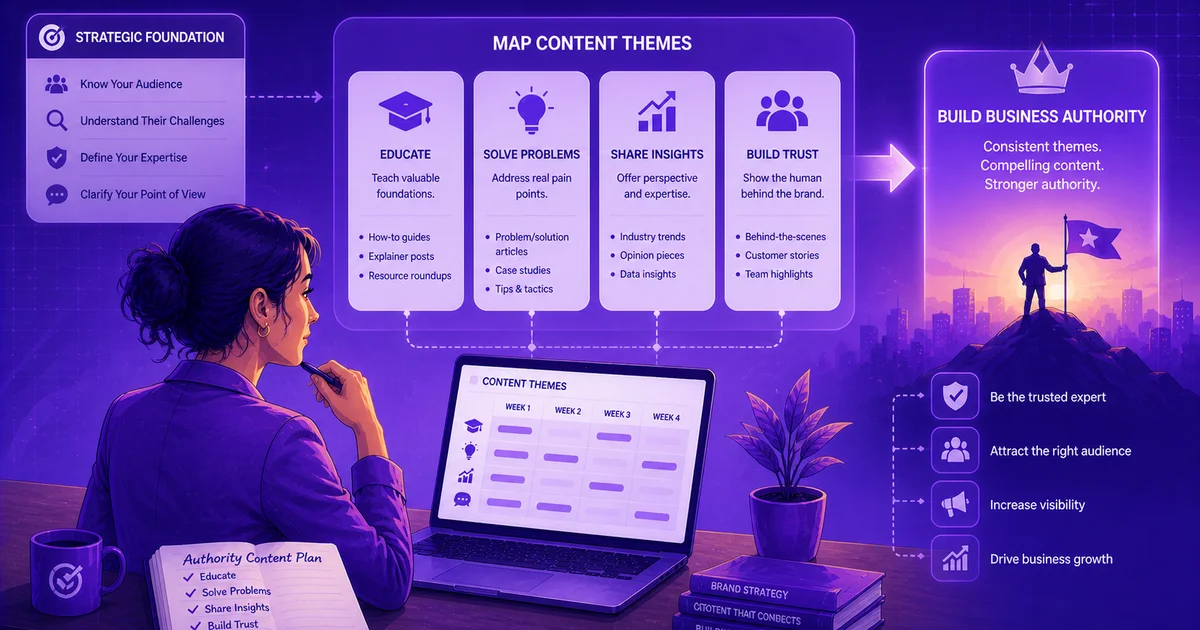
Every brand needs a clear roadmap for what to talk about, when to talk about it, and why it matters to their audience. Without that roadmap, you end up posting random content that doesn't build toward any meaningful goal. Content strategy basics start with understanding how to organize your messaging around themes that actually serve your business objectives.
Content pillars are the core themes or topics that form the foundation of your content strategy. They help you create consistent, focused messaging across all channels while ensuring every piece of content serves a specific purpose in your overall brand framework. Most businesses perform best with 4-6 well-defined pillars that balance audience interests with business expertise.
What Content Pillars Actually Do for Your Business
Think of content pillars as chapters in a book. Each chapter covers a distinct topic, but they all work together to tell your brand's complete story. These themes become the organizing principle that keeps your content focused while giving you enough variety to stay interesting.
Content pillars serve three critical functions. First, they prevent you from running out of ideas. When you know your core themes, you always have a starting point for new content. Second, they build authority in specific areas rather than trying to be everything to everyone. Third, they create consistency that helps audiences recognize and remember your brand.
The strongest content strategies use pillars as both creative inspiration and strategic constraints. They give you freedom to explore different content types within each theme while keeping everything tied to your business goals.
The Three Types of Content Pillars That Actually Work
Not all content serves the same purpose, and your pillars should reflect that reality. The most effective brand framework uses three distinct types of content pillars: core content that establishes your expertise, cluster content that explores subtopics in depth, and promotional content that drives business outcomes.
Core content pillars deliver foundational information your audience needs. These are your "always useful" topics that demonstrate expertise and provide genuine value. For a financial advisor, a core pillar might be retirement planning fundamentals. For a marketing agency, it could be digital strategy basics.
Cluster content pillars dive deeper into specific aspects of your core themes. They let you explore nuances and address more specialized questions. If retirement planning is your core pillar, cluster content might cover 401(k) optimization, Social Security timing, or healthcare cost planning.
Promotional content pillars connect your expertise to your services without being purely sales-focused. This content shows how you solve problems rather than just describing what you do. The key is providing value while demonstrating capability.
This three-pillar approach ensures you're not just educating your audience or just selling to them. You're building relationships by delivering consistent value across different content needs.
How to Find Your Perfect Content Pillar Sweet Spot
The best content pillars live at the intersection of three things: what your audience cares about, what you're genuinely good at, and what supports your business goals. Most organizations find success with 4-6 pillars because this range provides enough variety without overwhelming your content creation process.
Start by listing everything your ideal clients ask you about. Look at your sales conversations, customer service tickets, and frequently asked questions. These reveal what your audience actually wants to understand.
Next, inventory your genuine expertise. What do you know that others don't? What problems do you solve better than anyone else? Your content pillars should showcase knowledge you can discuss confidently and authoritatively.
Finally, connect these topics to business outcomes. How does each pillar support your sales process? Does it demonstrate expertise that leads to inquiries? Does it address objections that come up in sales conversations? Every pillar should have a clear business purpose.
For example, HubSpot has built its content strategy around inbound marketing, SEO, sales enablement, and customer service. Each pillar demonstrates expertise in their software categories while educating their target audience. The pillars work together to position HubSpot as the complete solution for business growth.
Real Examples of Content Pillars in Action
Different industries approach content pillars differently, but the underlying principles remain the same. Looking at how successful brands structure their pillars reveals patterns you can adapt for your own business.
Nike centers their content strategy around inspiration and motivation, athlete stories, product innovation, and fitness tips. Each pillar aligns with their brand values of performance and empowerment while serving different audience needs. The inspiration content builds emotional connection, athlete stories provide social proof, innovation content showcases products, and fitness tips deliver practical value.
Peloton takes a similar but more specific approach with exercise routines, nutrition advice, mental wellness, and community challenges. Their pillars directly support user success while demonstrating the holistic value of their platform beyond just the equipment.
In the food and beverage space, Whole Foods uses educational recipes, community spotlights, behind-the-scenes sourcing stories, and wellness content. Each pillar reinforces their brand positioning around quality, community, and health while providing genuine value to their audience.
These examples show how content pillars should feel natural and interconnected rather than forced or disconnected. The strongest strategies make each pillar feel like an essential part of the brand story rather than arbitrary topic categories.
The Hierarchy That Makes Content Pillars Work
Effective content pillars work like a hierarchy, with broad themes at the top and specific topics underneath. Each main pillar should branch into 2-3 subtopics that let you create focused content without repeating yourself.
If you're a wellness coach, your pillars might include mental health, physical fitness, nutrition, and mindfulness. Under mental health, you could have subtopics like stress management, sleep optimization, and emotional resilience. Each subtopic gives you dozens of potential content pieces while staying clearly connected to the main theme.
This hierarchical approach prevents your content from becoming too scattered or too narrow. You can zoom in on specific issues when your audience needs detailed help, then zoom out to connect those details to bigger picture themes.
The hierarchy also helps with content planning. You can ensure you're covering all your pillars regularly while varying the specific angles and depth. Some content can stay high-level and accessible, while other pieces dive deep into specialized subtopics.
This structure particularly helps with SEO because you can target both broad keywords with your pillar content and long-tail keywords with your subtopic content. You build authority across an entire topic area rather than just individual keywords.
Common Content Pillar Mistakes That Hurt Your Strategy
Many businesses choose content pillars that sound good in theory but fail in practice. The most common mistake is selecting pillars based on what you think you should talk about rather than what your audience actually wants to hear about.
Another frequent error is making pillars too broad or too narrow. "Business success" is too broad to guide content creation effectively. "Tuesday morning productivity tips for remote workers" is too narrow to sustain long-term content creation. The right scope lets you create varied content while maintaining clear focus.
Some businesses also choose pillars that don't connect to their business goals. Educational content is valuable, but if none of your pillars demonstrate why someone should work with you specifically, your content won't drive business results.
A particularly damaging mistake is choosing pillars you're not qualified to discuss authoritatively. If you can't speak with genuine expertise and experience on a topic, don't make it a content pillar. Audiences can tell the difference between authentic knowledge and surface-level information.
Finally, many brands pick pillars and then ignore them when creating content. They post random thoughts, trending topics, or whatever seems interesting that day. This inconsistency undermines the authority and recognition that content pillars are supposed to build.
Building Your Content Pillar Framework
Start building your content pillar framework by conducting a content audit of what you've already created. Look for patterns in your most successful content. What topics generated the most engagement? What content led to business inquiries? These insights reveal pillars that already resonate with your audience.
Survey your existing customers about what content they find most valuable. Ask what questions they had before working with you and what information would help others in similar situations. Customer feedback often reveals pillar opportunities you might not have considered.
Analyze your competitors' content strategies, but don't copy them directly. Look for gaps where you could provide better, more comprehensive, or more authentic coverage of important topics. Your pillars should differentiate you rather than duplicate what others are already doing well.
Balance educational content with authority-building and community engagement across your pillars. You want to teach, establish expertise, and build relationships simultaneously. Each pillar doesn't need to do all three things, but your overall strategy should cover all three areas.
Test your pillar ideas by creating several pieces of content for each proposed theme. Can you easily generate multiple content angles? Do the topics naturally connect to your business expertise? Does each pillar attract the kind of audience you want to serve? Use this testing phase to refine your choices before committing to a full strategy.
Remember that content pillars should evolve with your business. As you develop new expertise or target new audiences, your pillars may need to shift. The key is maintaining consistency within each pillar while allowing the overall strategy to grow with your business needs.
What the Data Says
Most organizations use 4-6 content pillars to balance creativity with strategic focus, according to content strategy research. This range provides enough variety to keep content interesting without overwhelming content creation resources.
Educational content consistently ranks as the most sought-after content type in social media surveys, based on Q1 2026 Pulse Survey data. This reinforces the importance of making education a core component of your content pillar strategy.
Brands using structured content pillar strategies see improved SEO authority and sustained audience engagement compared to businesses posting random content, according to digital marketing analysis. The consistency helps search engines understand your expertise areas while building audience expectations.
Three-pillar content frameworks (education, authority-building, community engagement) provide the most balanced approach for businesses across industries, based on content marketing case studies. This structure ensures content serves multiple business objectives simultaneously.
Content Pillar Questions Answered
Q: How many content pillars should my business have?
Most businesses perform best with 4-6 content pillars. This range gives you enough variety to keep content interesting while maintaining focus and consistency. Fewer than 4 pillars can make your content feel repetitive, while more than 6 often spreads your efforts too thin and dilutes your authority in any single area.
Q: How often should I post content from each pillar?
Aim to cycle through your content pillars regularly rather than posting all your content from one pillar at once. A good approach is ensuring each pillar gets covered at least once every two weeks, with your strongest pillars appearing more frequently. The key is maintaining presence across all pillars while emphasizing your most important themes.
Q: Can I change my content pillars after I've started using them?
Yes, content pillars should evolve with your business. As you develop new expertise, target new audiences, or shift business focus, your pillars may need to change. The key is making deliberate changes rather than constantly shifting based on trends. Give each set of pillars at least 6-12 months to show results before making major adjustments.
Q: Should my content pillars be the same across all marketing channels?
Your core content pillars should remain consistent across channels, but the specific implementation can vary. LinkedIn content might focus more on industry insights while Instagram could emphasize behind-the-scenes content, but both should connect to your main pillar themes. This approach maintains brand consistency while optimizing for each platform's strengths.
Q: How do I know if my content pillars are working?
Track engagement metrics, website traffic, and business inquiries generated by content in each pillar. The most effective pillars will consistently produce content that resonates with your audience and supports business goals. Look for pillars that generate qualified leads, position you as an expert, and create ongoing conversation with your ideal customers.
Key Takeaways
- Content pillars should live at the intersection of your audience's interests, your expertise, and your business goals rather than being chosen arbitrarily or based on trends.
- The most effective strategies use 4-6 content pillars organized hierarchically, with each main pillar containing 2-3 subtopics that enable focused content creation without repetition.
- Successful content pillar frameworks balance three types of content: educational material that builds trust, authority-building content that demonstrates expertise, and community-focused content that creates engagement.
- Your content pillars should differentiate your brand rather than duplicate what competitors are already doing well, focusing on areas where you can provide unique value or perspective.
- Content pillars work best when they're treated as strategic constraints that guide content creation while providing enough flexibility to create varied, interesting content that serves multiple business objectives.
How Your Brand Blueprint Can Help with This
Your Brand Blueprint's Brand Profile & Content Pillars section creates this entire framework for you based on your specific business, expertise, and audience. It identifies the exact pillars that will position you as the authority in your market while ensuring every piece of content supports your business goals. Ready to put this into practice? BrandBlueprint.ai builds your complete brand messaging strategy -- including the section that covers exactly what we talked about here.