
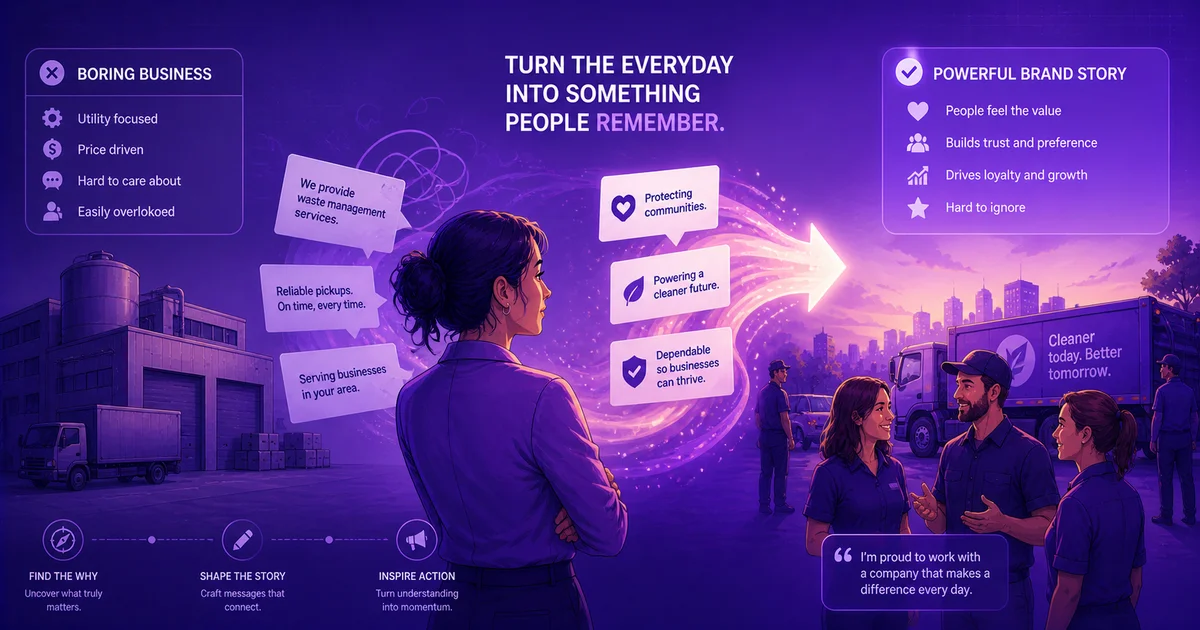
Most businesses convince themselves they don't have a story worth telling. You sell insurance, run a plumbing service, or manage an accounting firm, and you think your brand story ideas begin and end with "we provide quality service." But every successful business started somewhere, solved a problem someone else couldn't solve, or decided to do something differently. That's your brand story waiting to be told.
Building a compelling brand story for any business starts with uncovering the original problem that sparked your existence, the human moments that shaped your approach, and the specific transformation you create for clients. Even the most functional businesses have stories rooted in frustration, innovation, or a desire to serve people better.
Why "Boring" Businesses Actually Have the Best Stories
The most memorable brand stories often come from companies that seem unremarkable on the surface. Sara Blakely cut up her pantyhose because nothing fit right under white pants. That frustration became Spanx. Warby Parker's founders faced $700 replacement costs when a friend lost his glasses on a backpacking trip. That outrage became a billion-dollar eyewear company.
Your business exists because someone saw a gap, felt frustrated, or believed something could be done better. That original spark becomes the foundation for every piece of your brand messaging.
The challenge isn't finding your story. It's recognizing that your everyday reality contains the elements people connect with most: problems that needed solving, moments of doubt, breakthrough insights, and the decision to build something different.
Start with the Conflict That Created You
Every compelling story begins with tension. In your case, that tension is the problem that made you start your business in the first place. Building narratives around the conflict that caused you to start gives audiences the context they need to understand why your business matters.
The Original Problem
Think back to the moment before your business existed. What wasn't working? What gap did you notice that others missed? This doesn't have to be revolutionary. Sometimes the most powerful stories come from small frustrations that grew into big solutions.
Your Personal Stakes
Why did this problem matter to you specifically? Were you the customer who couldn't find what you needed? The employee who saw inefficiencies others ignored? The expert who knew there was a better way? Your personal connection to the problem makes your solution feel authentic rather than opportunistic.
The Decision Point
What made you decide to act instead of just complaining? This moment often reveals your business values better than any mission statement. It shows what you're willing to risk, what you believe strongly enough to bet on, and how you respond when something important isn't working.
Find Your "Why" Beyond Making Money
Defining a higher purpose people can relate to and support attracts more customers than focusing solely on what you sell. But this doesn't mean inventing a grand social mission if one doesn't exist naturally.
Your purpose might be as simple as making a complicated process easier, treating people better than they're used to, or bringing expertise to places that lack it. The key is identifying what drives you beyond profit and articulating it clearly.
Consider these approaches:
Fixing What's Broken
Maybe you started your business because an entire industry treats customers poorly, overcomplicates simple things, or ignores obvious improvements. Your purpose becomes restoring sanity to a broken system.
Making Excellence Accessible
Perhaps you saw high-quality service or products available only to a select few and decided to democratize access. Your purpose is bringing the best to everyone.
Humanizing the Mechanical
If you're in a field known for cold, transactional relationships, your purpose might be bringing personality, care, or genuine human connection back to the experience.
Transform Your Origin Story into Brand Messaging
Writing your brand origin story requires focusing on the human elements: who started it, why they cared, what early struggles revealed, and how challenges shaped your approach.
The Founder's Journey
Your personal story doesn't need drama to be compelling. It needs honesty. Share the real reasons you started, including the moments of uncertainty or the learning experiences that shaped how you operate.
Early Struggles as Proof Points
Sharing authentic setbacks helps audiences relate rather than portraying constant success from day one. These struggles often become the source of your competitive advantages.
If you spent months trying to find reliable suppliers, that experience probably made you better at vetting partners for clients. If you struggled with inefficient processes early on, you likely developed systems that now save customers time. Your obstacles became your expertise.
Breakthrough Moments
Identify the specific insights or decisions that changed everything. Maybe you realized that customers valued speed over perfection, or that explaining complex topics simply was more valuable than showcasing expertise. These moments reveal your business philosophy.
Team Stories That Add Depth
Including mini-stories of founders and employees enriches your overall narrative. Each person's background and motivations add credibility to your capabilities and humanity to your brand.
Feature the team member who joined because they believed in your mission, the expert who brought specialized knowledge, or the long-term employee whose loyalty demonstrates your culture. These individual stories prove that your values attract the right people.
Give Your Brand a Distinctive Personality
Giving your brand a personality like casual, serious, or helpful conveys authenticity and makes it relatable. This personality should reflect how you naturally interact with clients and what approach feels genuine to your team.
Match Your Natural Style
Your brand personality should align with how you actually work with clients. If you're naturally detail-oriented and thorough, embrace a meticulous, expert personality. If you simplify complex topics, develop a clear, educational voice. Fighting your natural tendencies creates inconsistency.
Stand Against Something
The strongest brand personalities take a position. Maybe you're against industry jargon that confuses clients, against one-size-fits-all solutions, or against rushing important decisions. Defining what you stand against often clarifies what you stand for.
Connect Problems to Transformation
Emphasizing unique benefits and telling why customers should care about the problem you're solving requires connecting your solution to real outcomes people experience.
Before and After States
Your brand story should paint a clear picture of life before and after working with you. This isn't just about features or services you provide, but about how people's situations improve.
The Frustration State
Describe the specific frustrations, inefficiencies, or anxieties your clients experience before finding you. Be detailed enough that prospects recognize themselves in the description.
The Resolution State
Show the concrete improvements clients experience. Better sleep because their insurance actually covers what they need. Faster growth because their marketing finally makes sense. More time with family because someone else handles the details properly.
Proof in Client Outcomes
Your transformation claims need evidence. Use specific client results, measurable improvements, or detailed case studies that demonstrate the change you create. This proof validates your story and shows that your approach delivers real value.
Make Your Unique Value Proposition Memorable
Using a simple phrase for your unique value helps people remember and repeat what you do. This phrase should capture both what you do and why it matters in terms anyone can understand.
Effective value propositions often follow patterns:
- Making [complex thing] simple for [specific people]
- Bringing [expert service] to [underserved market]
- Fixing what's broken with [specific industry or process]
The best phrases evoke an emotional response because they connect to a problem people actually experience.
Build Consistency Across All Touchpoints
Defining your brand's purpose first drives all story facets like tone once you clarify what you're really about. This purpose becomes the filter for every piece of content, every client interaction, and every business decision.
Website About Page
Your origin story belongs prominently on your About page, but it should also influence your service descriptions, team bios, and client testimonials. Every page should reinforce the same narrative themes.
Social Media Content
Your brand story provides endless content opportunities. Share behind-the-scenes moments that illustrate your values, highlight client transformations that prove your impact, and discuss industry observations that demonstrate your perspective.
Sales Conversations
Train your team to tell portions of your brand story during client conversations. The story of why you started helps prospects understand your motivation. Examples of early challenges show you've solved similar problems before. Client transformation stories prove you can deliver results.
What the Data Says
Storytelling drives brand consistency: Brand storytelling requires consistency and authenticity as essential elements that help audiences connect with your message across all touchpoints and interactions.
Purpose attracts customers: Companies that define a higher purpose people can relate to and support see increased customer attraction beyond just product features or competitive pricing.
Conflict creates connection: Audiences want to know what sparked the brand, making the original problem or struggle that led to starting the business a crucial story element that builds emotional engagement.
Authenticity beats perfection: Sharing authentic setbacks helps audiences relate more than portraying constant success, making honest struggles valuable components of compelling brand narratives.
Common Questions About Building Brand Stories
Q: How do I find my brand story if my business started for purely practical reasons?
Practical reasons often make the best stories. Focus on the specific problem you encountered, why existing solutions weren't good enough, and what drove you to create something better. Even mundane motivations reveal values and perspectives that differentiate your approach.
Q: Should my brand story focus more on me as the founder or on the business itself?
Balance both elements. Your personal motivation explains why the business exists and what drives its culture, while the business story shows how those motivations translate into client value. Use your founder story to establish credibility and the business story to demonstrate results.
Q: What if my business has multiple founders with different stories?
Combine your individual stories into a unified narrative about shared values or complementary strengths. Focus on what brought you together and how your different perspectives create a better solution for clients than any of you could provide individually.
Q: How specific should I be about struggles or challenges in my origin story?
Be specific enough to be credible but not so detailed that it undermines confidence. Share challenges that led to insights, improvements, or competitive advantages. Avoid anything that suggests ongoing problems or inability to execute effectively.
Key Takeaways
- Your brand story already exists in the original problem that sparked your business, the decisions that shaped your approach, and the transformation you create for clients.
- Start with the conflict or gap that made you act, then connect that motivation to the specific value you deliver today.
- Authentic struggles and setbacks make your story more relatable and often reveal the expertise that sets you apart from competitors.
- Your brand personality should match how you naturally work with clients and what approach feels genuine to your team and values.
- Connect every element of your story to concrete client outcomes and transformations rather than just listing features or capabilities.
How Your Brand Blueprint Can Help with This
Your Brand Blueprint's Brand Messaging section develops the core message framework and key ideas your business can own in its market, while the Brand Profile section creates detailed value statements and content pillars that bring your story to life. These sections transform your raw story elements into a cohesive messaging strategy you can use across every client touchpoint.
Ready to put this into practice? BrandBlueprint.ai builds your complete brand messaging strategy -- including the section that covers exactly what we talked about here.