
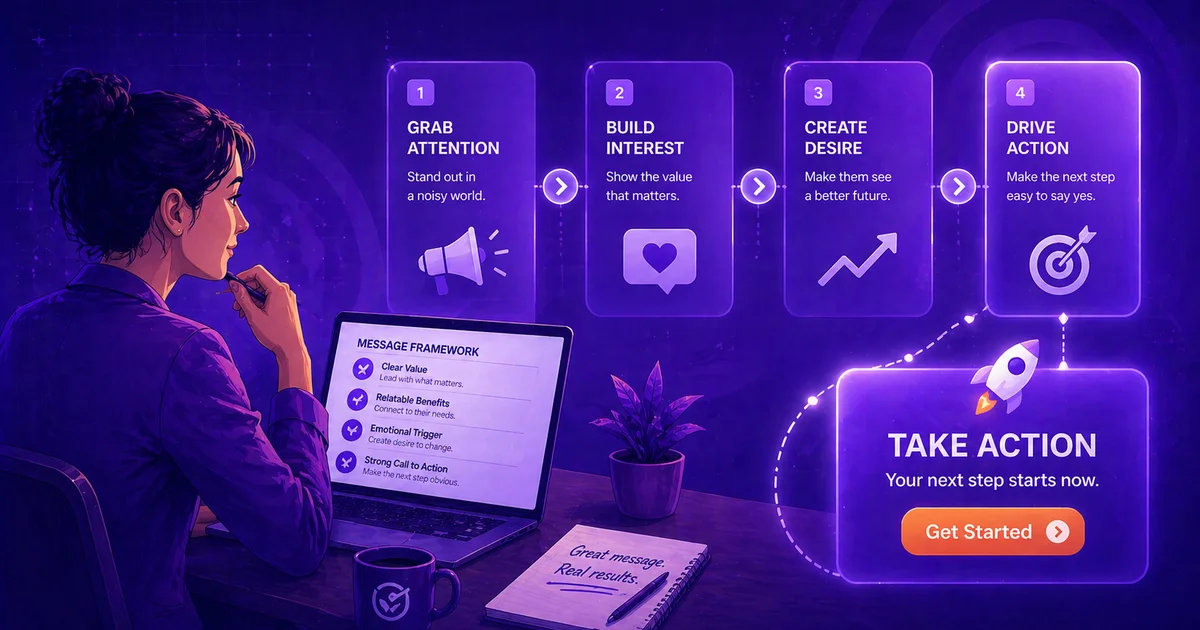
Most marketing messages fail because they ignore how the human brain actually processes and responds to information. When your audience sees your message, their brain goes through a complex filtering system that determines whether they'll scroll past or stop to engage. Understanding this psychological process can transform your persuasive business messages from noise into action-driving communication.
Messages that drive action work because they align with how your brain naturally makes decisions. Research shows that successful persuasive messages activate both reward-processing and social cognition areas of the brain, creating an emotional response that leads to logical justification for taking action.
How Your Brain Filters Messages in Three Stages
Your audience doesn't process every message they see. Instead, their brain operates like a sophisticated filtering system with three distinct levels.
The first level is attention filtering. Your brain constantly scans for threats, opportunities, and relevant information while discarding everything else. This cognitive filtering process determines whether your message even registers with your audience. Messages that break through this filter either signal danger, promise reward, or relate directly to something your audience is actively thinking about.
The second level involves processing through existing beliefs. Once a message captures attention, your brain compares it against what you already believe to be true. Messages that conflict too strongly with existing beliefs get rejected immediately. This is why revolutionary ideas often require careful introduction, while messages that slightly expand or build on existing beliefs gain faster acceptance.
The third level triggers emotional decision-making. Even when a message passes the first two filters, the final decision to act happens in the emotional centers of your brain. You make the emotional decision first, then use logic to justify that choice to yourself and others.
This three-stage process explains why purely logical marketing messages often fail. They may pass the attention filter and align with beliefs, but they don't trigger the emotional response needed for action.
The Neuroscience of Persuasive Messages
Recent neuroscience research reveals exactly what happens in your brain when you encounter an effective message. Scientists analyzed fMRI data from over 500 participants across 16 different studies examining ads, campaigns, and videos to understand what makes messages stick.
The research discovered two key brain regions that predict whether a message will drive action. First, reward-related brain activity lights up when you encounter messages that promise clear benefits or outcomes. Your brain essentially calculates whether the promised reward is worth the effort required to act.
Second, the mentalizing network activates when messages help you understand how others think and feel. This social processing allows you to imagine yourself in the situation the message describes and envision how taking action would affect your relationships and social standing.
What makes this research particularly valuable is its scope. The same brain patterns predicted message effectiveness across health campaigns, crowdfunding videos, and traditional advertisements. This suggests that effective persuasion works through universal psychological mechanisms rather than industry-specific tactics.
The implications for your messaging are profound. Messages that activate both reward processing and social cognition create a powerful combination that drives action across different contexts and audiences.
Creating Cognitive Gaps That Spark Curiosity
One of the most effective ways to capture attention involves creating what psychologists call cognitive gaps. These gaps highlight the difference between where your audience is now and where they want to be.
Effective cognitive gaps work by pointing out discrepancies your audience hasn't fully recognized. For example, instead of saying "Our software saves time," you might say "Most teams spend 3 hours per week on tasks that could be automated in 10 minutes." This approach creates awareness of a problem that feels both urgent and solvable.
The key is making the gap specific and measurable. Vague statements about "better results" don't create cognitive tension. But concrete comparisons between current state and desired outcome force your audience to confront the cost of inaction.
Apple mastered this technique with their "Think Different" campaign. Rather than listing computer specifications, they created a cognitive gap between conformity and creativity. The campaign suggested that most people settle for ordinary thinking, but Apple users break free from conventional limitations to achieve extraordinary results.
This approach works because your brain is wired to close information gaps. Once you notice a discrepancy between current and desired states, you feel compelled to resolve it. Messages that create cognitive gaps transform passive audiences into active problem-solvers seeking solutions.
The Emotional Triggers That Drive Immediate Action
Logic informs decisions, but emotions drive them. Research on persuasion psychology shows that specific emotional triggers consistently motivate action across different contexts and audiences.
Urgency creates immediate pressure to act by introducing time constraints or limited availability. Your brain interprets urgency as a threat to future opportunities, triggering a fight-or-flight response that prioritizes quick action over careful deliberation. Nike's "Just Do It" campaigns tap into this psychology by connecting fitness goals to immediate action rather than someday aspirations.
Fear motivates protective behavior when you perceive threats to health, security, or status. Fear appeals work best when they're paired with clear, achievable solutions. Messages that create fear without providing clear next steps often backfire by overwhelming your audience with anxiety.
Excitement generates anticipation and energy around potential outcomes. This emotion works particularly well for product launches, new opportunities, or significant improvements to existing situations. The key is connecting excitement to tangible benefits rather than abstract possibilities.
Empathy builds connection by demonstrating understanding of your audience's struggles and aspirations. Dove's "Real Beauty" campaigns succeed because they acknowledge genuine insecurities while offering solutions that feel authentic and achievable.
The most effective messages often combine multiple emotional triggers. For instance, a message might use empathy to build connection, urgency to motivate quick action, and excitement to make the outcome feel rewarding.
Building Trust Through Social Proof and Credibility
Trust serves as the foundation for all persuasive communication. Without trust, even the most compelling messages fail to drive action because your audience questions whether you can deliver on your promises.
Social proof reduces perceived risk by showing that others like your audience have already benefited from taking action. Your brain uses other people's behavior as a shortcut for making decisions, especially when those people seem similar to you in relevant ways.
The most effective social proof comes from people your audience can identify with. Generic testimonials from unnamed customers carry less weight than specific stories from people in similar situations facing comparable challenges. When Patagonia shares stories from environmental activists using their products, they're not just selling outdoor gear; they're providing social proof for people who share those values.
Credibility stems from two factors: perceived expertise and trustworthy intent. Your audience needs to believe you know what you're talking about and that you're not trying to deceive them. Research on communicator credibility shows that both components are necessary for effective persuasion.
Building credibility requires demonstrating knowledge through specific insights, data, or experience while also showing that your recommendations serve your audience's interests rather than just your own. Two-sided messages that acknowledge potential drawbacks or limitations often increase credibility because they demonstrate honesty and balanced thinking.
For example, Patagonia's "Don't Buy This Jacket" campaign enhanced credibility by prioritizing environmental values over immediate sales. This counterintuitive approach built trust that ultimately drove more purchases because customers believed the company shared their values.
Making Messages Easy to Process and Remember
Cognitive fluency determines how easily your brain can process and remember information. Messages that are hard to understand or remember rarely drive action, regardless of how compelling their content might be.
Simple language increases cognitive fluency by reducing the mental effort required to understand your message. This doesn't mean dumbing down your content; it means choosing clear, direct words over complex jargon. Your audience's brain interprets easy-to-process information as more trustworthy and important than difficult-to-understand content.
Familiar concepts and frameworks also improve cognitive fluency. When you connect new ideas to things your audience already understands, you reduce the cognitive load required to grasp your message. This is why analogies and metaphors work so effectively in persuasive communication.
Repetition and consistency reinforce key messages while building recognition and trust. However, the repetition needs to feel natural rather than forced. Varying your word choice while maintaining consistent core messages helps avoid sounding repetitive while still building familiarity.
Visual hierarchy and formatting also affect cognitive fluency. Breaking up long text blocks, using headers to organize information, and highlighting key points makes your message easier to scan and understand. Your audience should be able to grasp your main points even if they only skim your content.
Targeting Messages to Specific Emotional States
Different audiences respond to different emotional appeals depending on their current situation and mindset. Understanding personal emotions and biases allows you to craft messages that resonate with specific psychological states.
People in problem-awareness stages respond well to messages that validate their frustrations and offer hope for solutions. They need empathy and understanding before they're ready to consider specific options. Messages that jump directly to product features often feel tone-deaf to audiences still processing their challenges.
Solution-seeking audiences want clear comparisons and specific benefits. They've moved past problem recognition and are actively evaluating options. These audiences respond to detailed information, social proof from similar customers, and clear explanations of how your solution addresses their specific needs.
Decision-ready prospects need confidence and urgency. They've done their research and are ready to act but may need final reassurance or motivation to move forward. Messages for this audience should focus on risk reduction, immediate benefits, and clear next steps.
The same message can feel perfectly targeted to one audience and completely irrelevant to another, even when they have the same basic need. Understanding where your audience sits in their decision-making process allows you to craft messages that feel timely and relevant rather than premature or obvious.
Learning from Brands That Get Psychology Right
Successful brands consistently apply psychological principles in their messaging, creating communication that feels natural while driving measurable results.
Apple's messaging strategy demonstrates how social proof and aspiration work together. Their advertisements rarely focus on technical specifications. Instead, they show creative professionals, innovators, and artists using Apple products to achieve remarkable outcomes. This approach activates the brain's social processing networks by helping potential customers imagine themselves as part of a creative community.
The "Think Different" campaign specifically targeted people who saw themselves as nonconformists or creative thinkers. By associating their products with famous innovators and rebels, Apple created social proof that appealed to customers' desired identity rather than their current situation.
Nike's approach combines multiple emotional triggers in a single cohesive message. "Just Do It" creates urgency around fitness goals while acknowledging the emotional struggles that prevent people from taking action. Their campaigns often feature real people overcoming genuine obstacles, providing both inspiration and social proof.
The psychological power comes from connecting immediate action to long-term transformation. Rather than selling shoes or athletic wear, Nike sells the emotional outcome of becoming someone who doesn't make excuses.
These examples work because they understand their audience's psychological state and craft messages that activate the right emotional and social responses. They don't just communicate product benefits; they tap into fundamental human drives and desires.
What the Data Says
Pooled fMRI data from over 500 participants showed that reward and social brain activity predicts advertising effectiveness across health campaigns, crowdfunding projects, and video content, demonstrating universal psychological mechanisms behind persuasion (Penn Today, 2024).
Three-level cognitive filtering determines whether marketing messages reach their intended audience, with most messages failing because they don't account for attention filtering, belief processing, and emotional decision-making stages (PlanLeft, 2024).
Emotional triggers like urgency, fear, excitement, and empathy drive faster purchase decisions than logical appeals alone, with emotions leading to quick action that people later justify with rational thinking (Francesco Pecoraro, 2024).
Two-sided messages that acknowledge potential drawbacks persuade skeptical audiences more effectively than one-sided promotional content because they enhance perceived credibility and trustworthiness (Martin Roll).
Social proof from similar others reduces perceived risk and increases action rates by showing that people like your audience have already achieved positive outcomes (Build Grow Scale).
Common Questions About Persuasive Messaging Psychology
Q: How do you know which emotional triggers will work best for your specific audience?
Test different emotional approaches with small segments of your audience and measure response rates. Pay attention to the language your audience uses when describing their challenges and goals, then mirror those emotional states in your messaging. People in crisis respond to urgency and fear, while people exploring options respond better to excitement and possibility.
Q: Can you use too much psychology in your marketing messages?
Yes, when psychological techniques feel manipulative or artificial, they backfire by damaging trust. The most effective approach uses psychology to communicate more clearly and authentically rather than to trick people into taking action. Focus on understanding your audience's genuine needs and crafting messages that serve their interests.
Q: How long does it take to see results from psychologically-informed messaging changes?
Simple changes like adjusting emotional tone or adding social proof can show results within days or weeks. More comprehensive changes that align your entire message strategy with psychological principles typically show significant improvement within 30-90 days, depending on your audience size and message frequency.
Q: Do psychological principles work the same way across different industries and audiences?
Core psychological mechanisms like social proof, emotional triggers, and cognitive fluency work universally, but their specific applications vary significantly. B2B audiences respond differently than consumers, and different industries have unique trust-building requirements. The principles remain consistent while tactics adapt to context.
Key Takeaways
- Your audience's brain filters messages through three stages: attention filtering, belief processing, and emotional decision-making, so effective messages must work at all three levels to drive action.
- Neuroscience research shows that messages activating both reward processing and social cognition areas of the brain consistently drive action across different contexts and audiences.
- Creating cognitive gaps between current and desired states sparks curiosity and motivation by highlighting specific discrepancies your audience hasn't fully recognized.
- Emotional triggers like urgency, empathy, and excitement drive immediate action, while social proof and credibility build the trust foundation necessary for long-term persuasion.
- Making messages easy to process through simple language, familiar concepts, and clear formatting increases both comprehension and action rates.
How Your Brand Blueprint Can Help with This
Your Brand Blueprint's Messaging Systems section provides frameworks that incorporate these psychological principles into your everyday communication. It includes the StoryBrand framework specifically designed to align with how your audience's brain processes information, plus additional messaging systems that activate emotional triggers and social proof mechanisms. The Buyer's Journey section maps your messaging to your audience's psychological state at each decision stage, ensuring your communication feels timely and relevant rather than pushy or premature.
Ready to put this into practice? BrandBlueprint.ai builds your complete brand messaging strategy -- including the section that covers exactly what we talked about here.