
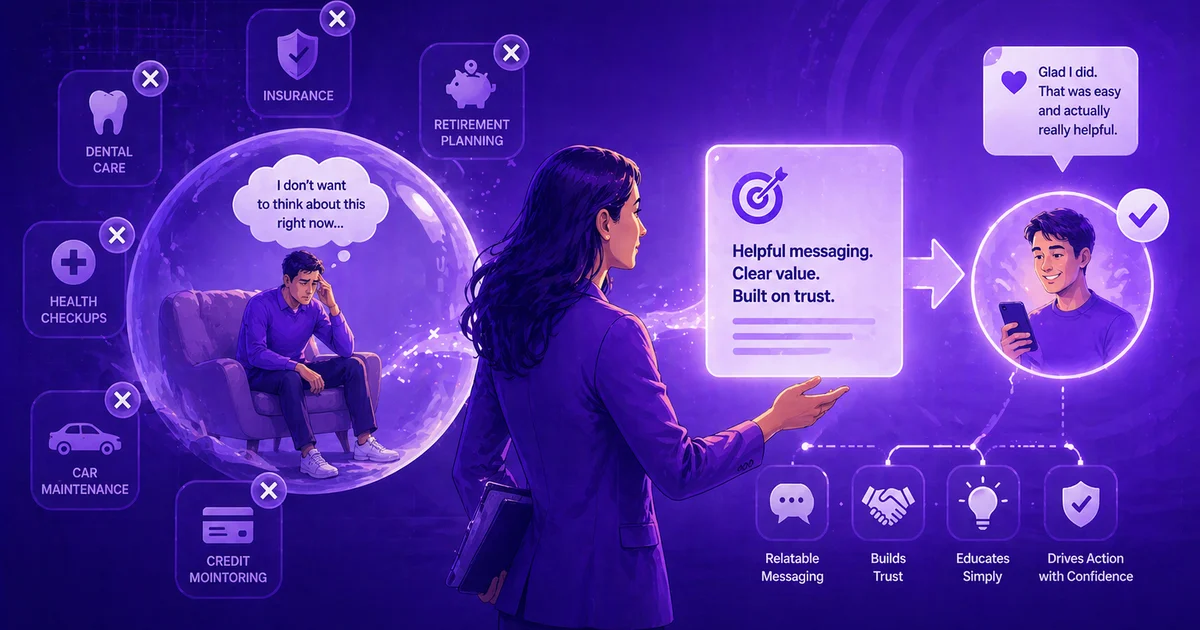
When customers actively avoid thinking about what you sell, traditional marketing approaches fall flat. Whether you're selling insurance, tax services, compliance software, or any other "necessary evil," your messaging needs to work differently. The psychology behind customer avoidance creates unique challenges that require specific copy strategies.
Pain points marketing works exceptionally well for avoided services because it taps into prospect theory, where people feel losses more intensely than equivalent gains. Instead of leading with benefits, successful copy for these services amplifies the pain of inaction, making the avoided decision feel more urgent than continued procrastination.
Why People Avoid Certain Services
Customer psychology around avoided services operates on predictable patterns. Prospect theory research shows that people overweight small probabilities by about three times their actual likelihood, especially when considering potential losses. This explains why someone might avoid buying insurance despite knowing they need it, or postpone implementing compliance systems despite regulatory requirements.
The avoidance stems from several psychological factors. First, these services often represent acknowledgment of problems people prefer not to face. Nobody wants to think about getting sued, having a medical emergency, or failing an audit. Second, the benefits feel abstract and distant while the costs feel immediate and concrete.
TurboTax understood this psychology early. Instead of promoting the joy of filing taxes, their messaging focuses on pain relief: "Maximize your refund, minimize hassle." Their advertisements typically show frustrated people surrounded by paperwork, then the relief of using their software. They're selling escape from an unpleasant necessity, not the necessity itself.
Loss aversion plays a massive role here. Research indicates that the coefficient of loss aversion typically runs around 2.25, meaning losses hurt about twice as much as equivalent gains feel good. Your copy should exploit this by framing inaction as a guaranteed loss rather than action as a potential gain.
The Pain-First Copy Framework
Effective service business messaging for avoided services follows a specific sequence that acknowledges customer reluctance while building urgency. Start with the pain they're already experiencing, amplify the consequences of inaction, then position your service as the path to relief rather than another burden.
Lead with Recognition
Your opening should immediately acknowledge what prospects are thinking. Don't pretend enthusiasm exists where it doesn't. QuickBooks doesn't open with "Love managing your finances!" Instead, they use messaging like "Stop chasing receipts" that recognizes the frustration small business owners feel with financial administration.
This recognition creates instant rapport. When someone feels understood, they're more likely to continue reading. Your prospect thinks, "Finally, someone gets it," rather than feeling like you're trying to sell them something they don't want.
Amplify Current Pain
Once you've acknowledged their situation, make the current pain more vivid. Customer pain points research shows that addressing these pain points effectively differentiates your marketing by positioning products as solutions rather than additional obligations.
Don't just mention the pain; quantify it where possible. Instead of "compliance is difficult," try "compliance delays cost companies an average of 20% more in project timelines." Specific numbers make abstract problems feel concrete and urgent.
Grammarly excels at this technique. They don't sell proofreading; they sell avoiding embarrassing errors. Their messaging amplifies the pain of sending important communications with mistakes, making their service feel essential rather than optional.
Position Relief, Not Features
After amplifying the pain, position your service as relief rather than listing features. People don't want your product; they want the outcome it provides. Advertising psychology research confirms that customers don't care about bells and whistles, they want the outcome your service delivers.
Frame your service as the end of their current frustration. Insurance companies that succeed don't sell policies; they sell peace of mind. Tax services don't sell preparation; they sell getting it over with correctly. Compliance software doesn't sell features; it sells sleeping better knowing you're protected.
Copy Strategies That Work
Use Fear of Missing Out on Pain Relief
Traditional FOMO focuses on missing positive opportunities. For avoided services, flip this to fear of missing out on ending current pain. "Don't spend another busy season drowning in tax paperwork" works better than "Get organized for tax season."
This approach acknowledges that your prospects are already in pain and positions your service as the escape route. The urgency comes from avoiding prolonged suffering rather than missing a limited-time benefit.
Make the Status Quo Expensive
Help prospects calculate the true cost of avoiding your service. Process pain point analysis shows that productivity pain points result in customers wasting time and achieving less than they ideally would. Make this waste tangible in your copy.
Break down what continued avoidance actually costs. If you sell project management software, don't just say it improves efficiency. Calculate: "Teams using spreadsheets for project tracking waste 2.5 hours per week on status updates. That's $3,250 annually per team member at a $50/hour rate."
Create Urgency Through Consequences
Build urgency by making the consequences of delay feel immediate and specific. Instead of generic warnings, paint a picture of exactly what happens when people continue avoiding the decision.
Slack understood this when targeting teams drowning in email. Rather than promoting collaboration features, they focused on the mounting email overload and missed communications that teams experience. Their messaging made continuing with email feel unsustainable.
Industry-Specific Applications
Professional Services
Law firms, accounting practices, and consulting services often face prospect avoidance because people associate them with problems or complex situations. Your copy should position engagement as simplification rather than complication.
Instead of "comprehensive legal services," try "stop losing sleep over contract disputes." Rather than "full-service accounting," use "finally understand where your money goes." The shift from service description to problem resolution changes the entire conversation.
Insurance and Financial Services
These industries epitomize avoided services because they require people to confront uncomfortable possibilities. Successful messaging in these sectors focuses on control and certainty rather than coverage details.
Life insurance companies that thrive don't sell death benefits; they sell the peace of mind that comes from knowing your family is protected. Financial advisors don't sell investment management; they sell confidence about retirement security.
Technology and Software
B2B software sales often face avoidance when the technology addresses problems teams prefer not to acknowledge. IT security, compliance software, and backup solutions all fall into this category.
Successful tech companies in these spaces lead with the pain of status quo rather than feature lists. They make the current situation feel unsustainable before introducing their solution as the obvious next step.
Testing and Refining Your Approach
Monitor Emotional Response
Track how prospects respond to different pain amplification levels. Too little and they remain complacent; too much and they become overwhelmed and shut down. The sweet spot varies by industry and audience sophistication.
Test different pain intensity levels in your subject lines, headlines, and opening paragraphs. Use engagement metrics to find the level that motivates action rather than avoidance.
A/B Test Problem vs. Solution Focus
Split test campaigns that lead with problems against those that lead with solutions. For avoided services, problem-focused copy typically outperforms solution-focused messaging, but the specific ratio varies.
Document which problems generate the strongest response for your particular service. Not all pain points carry equal motivational weight, and the most obvious problems aren't always the most motivating ones.
Measure Beyond Immediate Response
Track long-term engagement, not just initial clicks. Avoided services often have longer sales cycles because prospects need time to overcome their resistance. Your copy should be optimized for sustained engagement rather than quick conversions.
Monitor how different messaging approaches affect the quality of leads generated. Copy that generates urgent responses might attract panic-driven prospects who aren't ideal long-term clients.
What the Data Says
- Loss aversion coefficient averages 2.25, meaning losses hurt about twice as much as equivalent gains feel good, making pain-focused messaging more effective than benefit-focused copy for avoided services.
- People overweight small probabilities by approximately 3 times their actual likelihood according to prospect theory research, explaining why avoided services must address perceived risks rather than statistical realities.
- Productivity pain points cause measurable time waste, with teams using inefficient processes losing hours weekly that can be quantified in copy to create urgency.
- Marketing efforts without strategy feel disjointed and produce inconsistent results at best, highlighting how avoided marketing decisions compound into larger business problems.
Common Questions About Marketing Avoided Services
Q: How do you balance urgency with avoiding scare tactics?
Focus on consequences that prospects already know exist rather than manufacturing fears. Amplify existing concerns rather than creating new anxieties, and always provide a clear path to resolution.
Q: Should you acknowledge customer reluctance directly in your copy?
Yes, acknowledging reluctance builds trust and rapport. Prospects appreciate honesty about their situation and are more likely to engage when they feel understood rather than manipulated.
Q: How long should the pain amplification section be?
Long enough to make inaction feel expensive, but short enough to avoid overwhelming prospects. Typically 2-3 specific pain points with quantified consequences work better than extensive lists.
Q: What's the difference between pain points marketing and fear-based marketing?
Pain points marketing addresses existing frustrations prospects already experience, while fear-based marketing manufactures anxieties. Focus on relieving current pain rather than creating new fears.
Q: How do you know if your pain amplification is too strong?
Monitor engagement drop-off rates and lead quality. If prospects engage initially but don't follow through, or if you're attracting panic-driven prospects, dial back the intensity.
Key Takeaways
- Lead with pain recognition rather than service benefits to build immediate rapport with reluctant prospects
- Quantify the cost of inaction to make abstract problems feel concrete and urgent
- Position your service as relief from current frustration rather than an additional obligation
- Use loss aversion psychology by framing continued avoidance as guaranteed loss rather than action as potential gain
- Test different pain amplification levels to find the sweet spot that motivates without overwhelming
How Your Brand Blueprint Can Help with This
The Brand Blueprint's 360 View and pain points analysis help you identify exactly what your prospects are avoiding and why, while the Buyer's Journey section maps the specific concerns prospects have at each stage of overcoming their resistance. Together, these sections give you the psychological insights needed to craft copy that transforms avoidance into engagement.
Ready to put this into practice? BrandBlueprint.ai builds your complete brand messaging strategy -- including the section that covers exactly what we talked about here.