
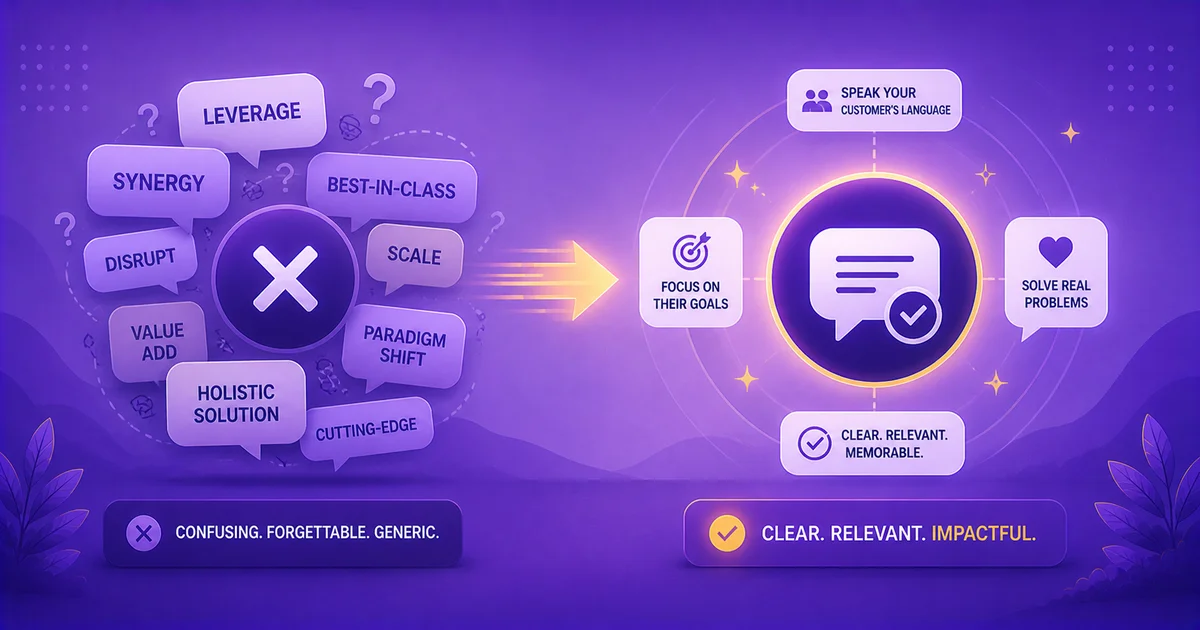
Marketing teams spend countless hours crafting copy, yet most consumers tune out the moment they see "synergistic solutions" or "next-generation innovation." Your messaging strategy faces a critical choice: speak like a human being, or disappear into the noise of corporate-speak that dominates every industry.
Plain language marketing consistently outperforms jargon-heavy messaging because it connects directly with how people think and make decisions. When you strip away buzzwords and speak conversationally, you create immediate trust, reduce cognitive load, and make it effortless for prospects to understand exactly what you offer.
Why Jargon Kills Your Marketing Results
Your prospects don't wake up thinking about "best-in-class solutions" or "revolutionary paradigm shifts." They wake up with specific problems that need solving. When your marketing copy sounds like it was written by a committee of consultants, you create an immediate barrier between your message and your audience's attention.
Research from the Corporate Executive Board found that customers who encounter jargon-heavy marketing materials are 40% less likely to make a purchase decision. The cognitive effort required to decode business buzzwords literally exhausts potential buyers before they understand what you're selling.
Consider how most B2B websites describe their services. Instead of saying "We help restaurants increase revenue," they write "We deliver transformative customer experience optimization solutions for hospitality industry stakeholders." The second version sounds impressive to internal teams but means nothing to restaurant owners drowning in daily operations.
This disconnect happens because marketing teams often mirror the language they hear in boardrooms and industry publications. What feels professional internally becomes a barrier externally. Your customers don't share your industry vocabulary, and forcing them to learn it just to understand your value proposition is a losing strategy.
The Real Cost of Corporate Speak
Reduced Comprehension Leads to Lost Sales
When prospects can't quickly understand what you do, they move on to competitors who communicate more clearly. A study by the Nielsen Norman Group tracked eye movements of web users encountering jargon-heavy content. Users spent an average of 37% less time reading paragraphs filled with business buzzwords compared to plain language alternatives.
Trust Erosion Through Perceived Manipulation
Buzzwords often signal to consumers that you're trying to hide something or oversell. Terms like "revolutionary," "game-changing," and "cutting-edge" have become red flags that trigger skepticism rather than interest. Consumers have learned to associate marketing jargon with inflated claims and disappointing results.
Message Dilution Across Touchpoints
Every buzzword you use weakens your core message. When your website talks about "synergistic solutions," your sales team mentions "best-of-breed platforms," and your marketing emails promote "next-generation innovation," you're not reinforcing a consistent brand voice. You're creating confusion about what you actually do.
Competitive Disadvantage in Attention Economy
Your prospects see dozens of marketing messages daily. The brands that cut through the noise are those that speak like real humans about real problems. While your competitors debate whether to call their service "transformative" or "disruptive," you could be explaining exactly how you save customers time or money.
How to Write Effective Marketing Copy Without Jargon
Start every piece of marketing content by defining your audience's actual problem in their own words. Interview recent customers and document the exact phrases they use to describe their challenges. These customer interviews reveal the language gap between your internal vocabulary and external reality.
Replace every abstract concept with specific benefits. Instead of "optimize your workflow," write "cut your project completion time by 30%." Instead of "enhance user experience," write "make it easier for customers to find what they need." Concrete outcomes always beat conceptual improvements.
Test the grandmother principle: If you can't explain your service to someone's grandmother in simple terms, your marketing copy is too complex. This doesn't mean dumbing down your message; it means clarifying your value proposition until it's impossible to misunderstand.
Build your messaging around customer outcomes rather than internal features. Your CRM system might have "advanced analytics capabilities," but your customers care about "seeing which leads are most likely to buy." Frame every feature in terms of what it lets customers do or achieve.
Write like you're having a conversation with one person, not addressing a crowd. Use "you" and "your" liberally. Ask questions that prospects are actually thinking. Address objections directly instead of hoping buzzwords will overwhelm doubts.
The Brands Getting Plain Language Right
Some companies have built entire marketing strategies around conversational, jargon-free communication. These brands consistently outperform competitors who rely on corporate speak.
Mailchimp transformed email marketing by rejecting the technical jargon that dominated the space. Instead of "automated drip campaigns" and "segmentation algorithms," they talk about "sending the right message to the right people at the right time." Their conversational tone helped them capture market share from technically superior but harder-to-understand competitors.
Dollar Shave Club disrupted an entire industry by speaking directly to frustrated customers. Their launch video didn't mention "precision-engineered blade technology" or "revolutionary shaving systems." It said, "Our blades are f*ing great." This plain-spoken approach generated millions of views and immediate customer acquisition.
The fitness app MyFitnessPal grew to over 200 million users by avoiding fitness industry jargon. Instead of "comprehensive nutritional optimization platforms," they simply say "track what you eat." Their straightforward messaging appeals to regular people who want to lose weight, not fitness enthusiasts who speak in macronutrients and metabolic windows.
Breaking Free from Industry Echo Chambers
Every industry develops its own vocabulary that insiders consider normal but outsiders find impenetrable. Marketing teams absorb this language through trade publications, conferences, and competitor analysis. Breaking free requires deliberate effort to step outside industry norms.
Audit your current marketing materials for words that only industry insiders use. Create a "banned words" list that includes the most overused buzzwords in your space. Force yourself to rewrite key messages without using any of these terms.
Spend time with customers outside formal interviews. Listen to how they describe their challenges in casual conversations. Pay attention to the words they never use – these are probably the buzzwords cluttering your marketing copy.
Study brands outside your industry that communicate clearly. What can you learn from how a restaurant describes its food or how a local service business explains its benefits? Often, the best messaging inspiration comes from completely different sectors.
Making the Transition Without Losing Authority
Many companies resist plain language because they worry about appearing unprofessional or losing credibility. This fear assumes that complexity equals expertise, but the opposite is true. True expertise means explaining complex concepts in simple terms.
Medical professionals who can explain procedures to patients without medical jargon demonstrate deeper understanding than those who hide behind technical terms. The same principle applies to marketing. Your ability to communicate value simply shows mastery of your subject matter.
Start by identifying your core value proposition in one clear sentence. What's the main problem you solve, and what's the main benefit customers receive? Once you can state this clearly without jargon, everything else becomes easier to simplify.
Replace industry-specific terms with universal concepts your audience already understands. "Customer acquisition cost" becomes "how much it costs to get a new customer." "Conversion optimization" becomes "getting more visitors to take action." "Brand awareness metrics" become "measuring how many people know your company."
Building Your Jargon-Free Messaging Foundation
Effective plain language marketing starts with understanding exactly who you're talking to and what they care about. This means moving beyond demographic data to understand emotional drivers and daily frustrations.
Map out your customer's day and identify where your solution fits. What are they doing when they realize they need what you offer? What words would they use to describe this moment to a friend? Build your messaging around this natural language.
Create message hierarchies that lead with benefits, not features. Your headline should answer "What's in it for me?" in customer language. Supporting points can add detail, but never at the expense of clarity. Every paragraph should make your value proposition clearer, not more complicated.
Test your messaging with people who match your target audience but don't work in your industry. Their questions and reactions will reveal assumptions you've made about shared knowledge. If they can't immediately understand what you do and why it matters, your messaging needs more work.
What the Data Says
- Customers encountering jargon-heavy marketing materials are 40% less likely to make a purchase decision according to Corporate Executive Board research, demonstrating the direct sales impact of unclear communication.
- Users spend 37% less time reading paragraphs filled with business buzzwords compared to plain language alternatives, per Nielsen Norman Group eye-tracking studies from 2023.
- 73% of consumers say they're more likely to buy from brands that communicate in plain, understandable language rather than corporate jargon, based on Edelman Trust Barometer findings.
- Marketing messages written at an 8th-grade reading level generate 58% more engagement than those requiring college-level comprehension, according to Content Marketing Institute analysis.
- B2B buyers spend only 17% of their time meeting with potential suppliers, making clear, jargon-free messaging critical for the 83% of research time they spend consuming content independently, per Gartner research.
Frequently Asked Questions About Plain Language Marketing
Q: How do I maintain authority while using simple language?
Authority comes from solving real problems effectively, not from using impressive vocabulary. Explain complex solutions in simple terms, provide specific examples, and let your results speak for themselves.
Q: Won't simplified messaging make my service seem basic or cheap?
Premium brands often use the simplest language because they're confident in their value. Apple doesn't describe "revolutionary tactile interface optimization" – they say their products are "simple to use." Clarity signals confidence, not cheapness.
Q: How do I know if my marketing language is too complex?
Read your copy out loud to someone unfamiliar with your industry. If they can't immediately understand what you do and why it matters, simplify further. Also test the reading level using tools like Hemingway Editor.
Q: Should I avoid all industry terminology completely?
Use industry terms only when your audience uses them naturally. If you're selling to CFOs, "cash flow" is appropriate. If you're selling to restaurant owners, "point-of-sale system" works better than "integrated payment processing solution."
Q: How often should I review my messaging for jargon creep?
Audit your marketing materials quarterly. Jargon creeps in gradually as teams absorb industry language. Regular reviews help maintain conversational tone and prevent drift back into corporate speak.
Key Takeaways
- Replace abstract buzzwords with specific, measurable benefits that prospects can immediately understand and evaluate.
- Build messaging around customer outcomes rather than internal features, using the exact language customers use to describe their problems.
- Test all marketing copy with people outside your industry to identify assumptions about shared knowledge and vocabulary.
- Study how successful brands in other industries communicate clearly, and adapt their conversational approaches to your messaging strategy.
- Create banned word lists for your industry's most overused buzzwords and force yourself to find clearer alternatives.
How Your Brand Blueprint Can Help with This
Your Brand Blueprint's Brand Messaging section develops your core message framework using customer language rather than industry jargon, while the Brand Profile & Content Pillars section establishes clear, conversational content themes that cut through competitive noise. Together, these sections ensure your entire messaging strategy speaks directly to customer needs without corporate speak barriers.
Ready to put this into practice? BrandBlueprint.ai builds your complete brand messaging strategy -- including the section that covers exactly what we talked about here.