
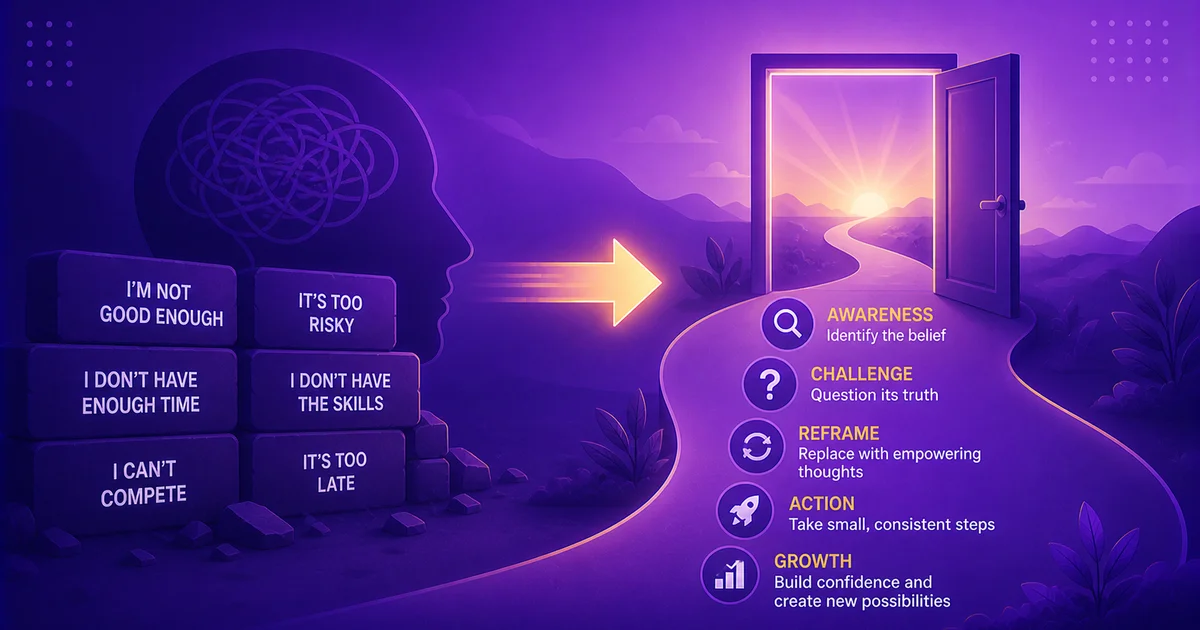
Your prospects are one click away from leaving your website, and you might not even know why. They want what you're selling, they need it, and they can afford it. But something invisible stops them cold. That something is often a limiting belief lurking in their mind, whispering that your solution won't work for them specifically.
Limiting beliefs are deeply held assumptions that restrict what your prospects think is possible for themselves. In marketing, these mental blocks create invisible barriers between your message and your sale, causing qualified buyers to hesitate, rationalize, or click away despite genuine interest in your product or service.
When Nike launched "Just Do It," they weren't just selling shoes. They were attacking the limiting belief that athletic achievement belonged only to elite athletes. When Peloton shows real users of all fitness levels succeeding, they're dismantling the belief that "I'm not fit enough to start working out." These brands understand that addressing mental blocks matters as much as describing product features.
The Hidden Psychology Behind Buyer Hesitation
Most businesses focus on logical objections like price, features, or timing. But the real barriers often run deeper. Your prospects carry invisible scripts about what's possible for someone "like them." These beliefs form from past failures, social conditioning, or fear of judgment.
Identifying limiting beliefs requires looking beyond surface resistance. When someone says "I can't afford it," they might actually believe "People like me don't deserve nice things." When they claim "I don't have time," the real belief could be "I always fail at following through."
The coaching industry has developed sophisticated techniques for uncovering these hidden beliefs. Business owners can adapt these same methods to understand what really stops their prospects from buying.
How To Spot Customer Limiting Beliefs
Negative Self-Talk Patterns
Listen to the language your prospects use about themselves. Phrases like "I'll never be able to" or "I'm just not built for this" reveal deeper mental frameworks. These statements often stem from past failures that have calcified into permanent identity beliefs.
A fitness coach might hear "I've tried everything and nothing works for me." This isn't really about past diet programs. It's a belief that the person is somehow uniquely broken or different from everyone else who succeeds.
Resistance Disguised as Logic
Prospects often dress limiting beliefs in rational-sounding objections. "Your program is probably too advanced for someone like me" sounds reasonable, but it masks the belief "I'm not capable of learning new things."
Excuse Manufacturing
When prospects generate multiple reasons why something won't work, they're often protecting a core belief from being challenged. The person who lists ten reasons why they can't start a business isn't really concerned about permits and paperwork. They believe "I'm not the type of person who succeeds at business."
Self-Sabotage Stories
Pay attention to patterns in how prospects describe past attempts. "I always quit after a few weeks" or "Something always comes up" suggests beliefs about their own consistency or worthiness of success.
The Four Types of Limiting Beliefs That Stop Sales
Customer limiting beliefs typically fall into four categories, each requiring different messaging approaches.
Capability Beliefs: "I Can't Do This"
These beliefs question personal ability or intelligence. Common variations include "I'm not tech-savvy enough," "I'm not creative," or "I don't have what it takes." Capability beliefs often stem from educational experiences or early career setbacks.
Salesforce addresses this directly by showing CRM success stories from teams with no technical background. They demonstrate that complexity isn't the user's problem to solve.
Worthiness Beliefs: "I Don't Deserve Success"
Worthiness beliefs sabotage purchase decisions even when prospects can afford your solution. They manifest as choosing cheaper alternatives, delaying decisions, or finding reasons why "now isn't the right time."
These beliefs often sound like: "Other people deserve coaching, but I should be able to figure this out myself," or "I shouldn't spend money on myself when the kids need things."
Safety Beliefs: "This Is Too Risky"
Safety beliefs aren't about financial risk alone. They encompass fear of judgment, failure, or standing out. A prospect might think "If I hire a business coach and still fail, everyone will know I'm incompetent."
Headspace combats safety beliefs by normalizing meditation struggles. Their messaging acknowledges that everyone's mind wanders, removing the fear of "doing it wrong."
Possibility Beliefs: "This Won't Work for Me"
These beliefs acknowledge that your solution works for others but create exceptions for the prospect's situation. "That strategy works for people with more time/money/connections than me."
Possibility beliefs require the most nuanced approach because prospects aren't rejecting your competence. They're rejecting their own uniqueness as a positive factor.
Techniques for Addressing Mental Blocks in Your Messaging
Use Inclusive Success Stories
Instead of featuring only dramatic transformations, show smaller wins from people who match your prospect's starting point. If your prospect thinks "I could never run a marathon," show someone who started by walking to the mailbox.
Peloton's strategy of featuring riders at every fitness level directly counters the "I'm not fit enough" limiting belief. Their community testimonials create permission for beginners to start where they are.
Acknowledge the Belief Directly
Sometimes the most powerful approach is naming the limiting belief explicitly. "Maybe you're thinking this won't work because you've tried similar programs before and given up."
This technique works because it demonstrates understanding rather than dismissal. When prospects feel heard, they become more open to alternative perspectives.
Reframe the Narrative
Help prospects shift from "I can't" to "I'm learning how to." This subtle language change transforms a fixed identity into a growth process.
Instead of accepting "I'm not good with money," guide them toward "I'm developing better money habits." The second version implies capability and progress rather than permanent limitation.
Address Belief Origins
Ask questions that reveal where limiting beliefs originated. "When did you first start feeling that way?" or "What happened that made you believe that about yourself?"
Understanding origins helps prospects recognize that past experiences don't predict future outcomes. A bad experience with one business coach doesn't mean all coaching is ineffective.
Creating Messaging That Overcomes Buyer Hesitation
Your marketing copy needs to do more than describe benefits. It must actively counter the specific limiting beliefs your audience carries.
Start by listing the most common limiting beliefs your prospects express during sales conversations. Look for patterns in objections, delays, and reasons people give for not moving forward.
Next, craft messaging that directly addresses each belief category:
For capability beliefs, emphasize learning support rather than expertise requirements. "No experience necessary" works better than "Perfect for experts."
For worthiness beliefs, normalize self-investment and emphasize universal deserve-ness. "You've spent years helping others. Now it's time to invest in yourself."
For safety beliefs, reduce perceived risk through guarantees, trial periods, or step-by-step processes. Show that failure isn't catastrophic and success doesn't require perfection.
For possibility beliefs, use specific social proof from similar situations. If your prospect is a busy parent, show results from other busy parents, not just general testimonials.
The Language That Breaks Through Mental Barriers
Certain words and phrases consistently trigger limiting beliefs, while others help dissolve them.
Avoid language that implies exclusivity or elite status unless your brand specifically targets high achievers. Words like "master," "expert," or "advanced" can activate capability beliefs in prospects who don't identify with those labels.
Instead, use inclusive language that meets people where they are. "Whether you're just starting out or looking to refine your approach" acknowledges different experience levels without making anyone feel excluded.
Replace absolute statements with growth-oriented language. Instead of "You need to be consistent," try "As you develop more consistent habits." The second version assumes progress rather than demanding perfection.
Common limiting beliefs include phrases like "There is never enough" or "I don't have what it takes." Your messaging should counter these specific thought patterns with evidence-based alternatives.
When Limiting Beliefs Become Brand Opportunities
Smart brands build their entire positioning around dissolving specific limiting beliefs. This creates deeper market connection than feature-based messaging alone.
Nike's "Just Do It" campaign became iconic because it addressed the universal limiting belief that athletic achievement requires special talent or perfect conditions. The message gives permission to start imperfectly.
Headspace built their brand around making meditation accessible to people who believe "I can't meditate because my mind is too busy." Their short sessions and progress tracking prove that meditation works even for restless minds.
These brands succeed because they understand their customers' internal dialogue better than their competitors do. They've identified the specific beliefs that prevent action and built messaging systems that consistently counter those beliefs.
Measuring the Impact of Belief-Based Messaging
Track metrics that reveal belief-shift effectiveness, not just conversion rates. Look at time spent on key pages, email engagement with belief-addressing content, and the types of questions prospects ask during sales calls.
If your messaging successfully addresses limiting beliefs, you should see longer website sessions, higher email open rates on vulnerability-based subject lines, and more qualified leads asking implementation questions rather than capability questions.
Monitor the language prospects use when they do convert. Customers who overcome limiting beliefs often express surprise at their results: "I never thought I could do this" or "This worked even though I was skeptical."
What the Data Says
While the research sources provided don't include specific statistics about limiting beliefs in marketing contexts, the coaching and personal development industries have documented several key insights about how these mental blocks operate:
Negative self-talk patterns emerge consistently across different client populations, with phrases like "I'll never be able to" serving as reliable indicators of deeper limiting beliefs that stem from past failures and calcified experiences.
Resistance often disguises itself as logical objections when clients generate multiple rational-sounding reasons why solutions won't work, typically protecting core beliefs from being challenged rather than addressing genuine practical concerns.
Belief origins significantly impact behavior patterns as understanding where limiting beliefs originated helps people recognize that past experiences don't necessarily predict future outcomes, making them more open to new possibilities.
Reframing language creates measurable mindset shifts when people move from fixed statements like "I can't" to growth-oriented phrases like "I'm learning how to," transforming permanent identity beliefs into development processes.
Common Questions About Customer Limiting Beliefs
Q: How can you identify limiting beliefs in prospects who don't explicitly express them?
Look for patterns in language, behavior, and decision-making. Prospects with limiting beliefs often use absolute language ("never," "always," "can't"), make excuses that seem disproportionate to the actual obstacle, or express interest but consistently delay action without clear reasons.
Q: What's the difference between a genuine objection and a limiting belief?
Genuine objections are specific, addressable concerns about price, timing, or features. Limiting beliefs are broader assumptions about what's possible for the person specifically. "Your service costs too much" is an objection. "People like me don't spend money on services like this" is a limiting belief.
Q: Can addressing limiting beliefs in marketing feel manipulative or pushy?
When done authentically, addressing limiting beliefs feels supportive rather than manipulative. The key is genuine empathy and evidence-based reassurance rather than pressure tactics. Focus on expanding possibilities rather than creating urgency.
Q: How do you know if your messaging successfully addresses limiting beliefs?
Monitor engagement metrics like time on page, email open rates for vulnerability-based content, and the quality of questions prospects ask. Successfully addressing limiting beliefs typically results in more qualified leads asking "how" questions rather than "whether" questions.
Key Takeaways
- Limiting beliefs create invisible barriers between your message and your sale, causing qualified prospects to hesitate or leave despite genuine interest in your solution.
- The four main types of limiting beliefs that stop sales are capability beliefs ("I can't do this"), worthiness beliefs ("I don't deserve success"), safety beliefs ("This is too risky"), and possibility beliefs ("This won't work for me").
- Effective messaging addresses limiting beliefs through inclusive success stories, direct acknowledgment of common mental blocks, narrative reframing from fixed to growth mindsets, and social proof from similar situations.
- Language choices significantly impact belief activation, with inclusive, growth-oriented phrases helping dissolve mental barriers while exclusive or absolute language can trigger resistance.
- Successful brands like Nike and Headspace built their positioning around dissolving specific limiting beliefs, creating deeper market connection than feature-based messaging alone.
How Your Brand Blueprint Can Help with This
Your Brand Blueprint's 360 View and Buyer's Journey sections work together to map the specific limiting beliefs your prospects carry at each stage of their decision-making process. The 360 View captures the psychographics and pain points that reveal underlying mental blocks, while the Buyer's Journey identifies exactly when and how these beliefs surface as prospects move toward a purchase.
Ready to put this into practice? BrandBlueprint.ai builds your complete brand messaging strategy -- including the section that covers exactly what we talked about here.