
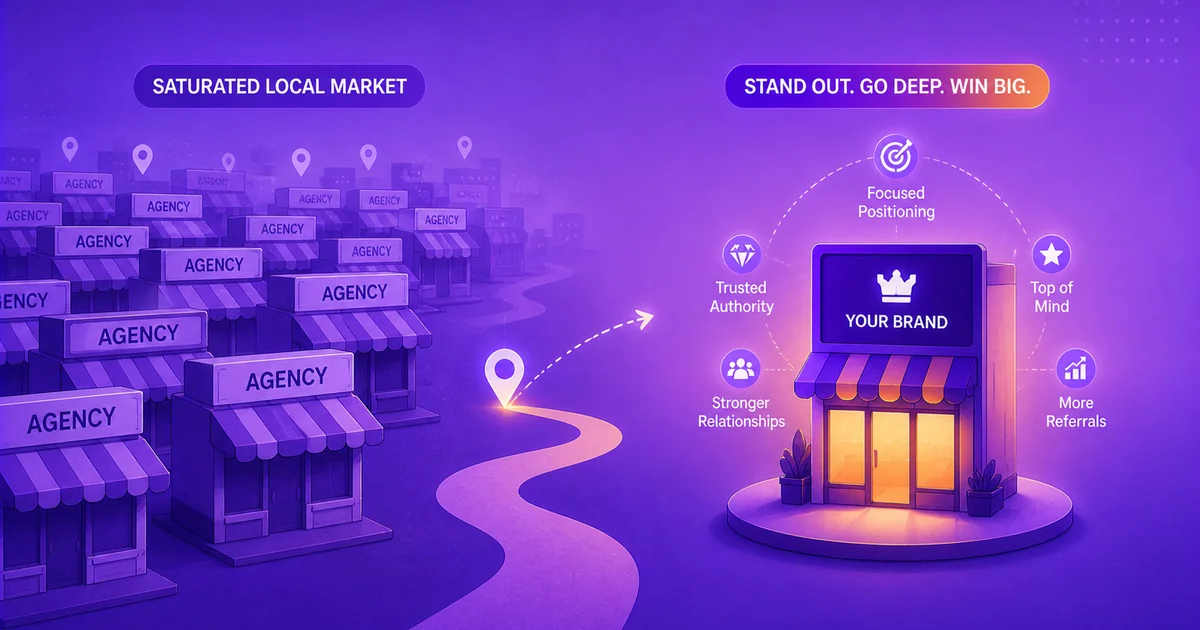
When every coffee shop on your block looks the same and competing service providers flood search results, breaking through requires more than hope. Your competitors are all claiming to be "the best" while fighting for the same keywords and customers. The question isn't whether you'll face local market competition -- it's how you'll rise above it.
Standing out in a saturated local market requires a strategic approach that combines differentiated brand messaging, optimized local SEO techniques, and authentic community engagement to create meaningful separation from competitors rather than competing solely on price or proximity.
The Real Challenge: Everyone's Playing the Same Game
Most service providers approach local competition like a popularity contest. They copy what successful competitors do, chase the same Google rankings, and hope louder marketing will win the day. This creates a race to the bottom where businesses compete primarily on price while their messaging becomes increasingly generic.
The companies that break free understand something different: saturation creates opportunity for those willing to stand apart rather than blend in. Instead of fighting harder in the same space, they create their own space where direct comparison becomes impossible.
ServiceTitan demonstrates this perfectly. Rather than competing with generic "HVAC software" companies, they built their brand around being the complete solution for home service professionals. Their local SEO strategy focuses on specific industry terms like "HVAC SEO" and "plumbing marketing" -- niches where they can dominate rather than dilute their message across broad categories.
Own Your Position Before You Optimize for Search
Define What Makes You Irreplaceable
Your differentiation strategy starts with identifying what you can own in your market. This goes deeper than services offered or years in business. What transformation do your clients experience that they can't get elsewhere? What approach do you take that fundamentally differs from standard industry practice?
Consider how Angi separated itself from generic contractor directories. Instead of just listing service providers, they built their brand around verified reviews and guaranteed work. This positioning allowed them to charge premium rates while customers happily paid for the peace of mind that traditional directories couldn't provide.
Your position needs to be specific enough that prospects immediately understand why you're different and broad enough that it encompasses your core services. "We're the marketing agency that actually understands construction" works better than "we provide great service" because it creates clear boundaries around who you serve and why you're uniquely qualified.
Build Your Message Around Client Outcomes
Once you've defined your position, your messaging should focus relentlessly on the specific outcomes clients achieve when working with you. Generic benefit statements like "increased efficiency" or "better results" don't differentiate because every competitor can make the same claims.
Instead, get specific about the transformation. If you're a financial advisor, don't talk about "comprehensive planning." Talk about how your clients sleep better knowing their retirement is protected even if the market crashes. If you run a landscaping company, don't emphasize "quality work." Emphasize how homeowners feel proud to host gatherings in their transformed outdoor spaces.
This outcome-focused messaging becomes the foundation for all your marketing content. Every blog post, social media update, and client conversation reinforces the same core transformation. Over time, prospects begin to associate that specific outcome with your business rather than your category.
Master Local SEO Without Generic Tactics
Perfect Your Google Business Profile Foundation
Your Google Business Profile serves as the command center for local visibility. But most businesses treat it like a basic directory listing instead of a powerful marketing tool. Comprehensive profile optimization requires completing every available field with strategic information that reinforces your brand position.
Start with your business description. Instead of listing services generically, emphasize your unique approach and ideal client. If you're a dental practice specializing in anxious patients, lead with that specialization. Include your physical address, local phone number, and specific service hours in clean, easily readable text.
Photos make the biggest visual impact on your profile. Upload your logo, clear storefront images, and photos that showcase your work in action. For service businesses, this means showing your team at work, completed projects, and happy clients. Update these regularly to keep your profile fresh and engaging.
Google Posts function like social media updates directly within your business profile. Use them to share recent projects, answer common questions, announce special offers, or highlight client testimonials. These posts appear in search results and help prospects understand what makes your business different before they ever visit your website.
Develop Location-Specific Content That Serves Your Community
Generic location pages that simply swap city names don't fool Google or prospects. Effective local content provides genuine value to people in specific areas while naturally incorporating local keywords that reflect how your community actually searches.
Create content around local events, regulations, or challenges that affect your target clients. A roofing company might write about how local weather patterns affect different roofing materials. A marketing consultant could analyze successful local businesses and extract lessons for other entrepreneurs in the area.
Localized landing pages should include neighborhood names, local landmarks, and area-specific considerations. Instead of "plumbing services in Dallas," try "pipe repair for historic Highland Park homes" or "water pressure solutions for uptown Dallas condos." These specific phrases match how locals actually describe their needs and locations.
Build Authentic Community Connections
Become a Recognized Local Authority
Authority in saturated markets comes from consistent, helpful presence in your community. This means showing up regularly in places where your ideal clients gather -- both online and offline. Join local business groups, participate in community events, and contribute meaningfully to local discussions.
The key is providing value without immediately pitching your services. Answer questions in local Facebook groups, write helpful articles for community newsletters, or speak at local events about topics related to your expertise. Over time, people begin to see you as the go-to expert in your field.
Thumbtack built massive local authority by creating comprehensive profiles for service providers in hundreds of cities. Their approach focuses on detailed service descriptions, verified reviews, and location-specific information that helps both providers and customers make informed decisions.
Leverage Client Success Stories as Social Proof
Nothing cuts through market saturation like genuine testimonials from local clients that prospects can relate to. Collect detailed success stories that go beyond generic praise to explain specific problems solved and results achieved.
The most powerful testimonials include the client's name, photo, and specific details about their situation. "Sarah from downtown helped us increase revenue by 40% in six months" carries more weight than "great service, highly recommend." When possible, include before-and-after photos, specific metrics, or other concrete evidence of the transformation.
Share these stories across all your marketing channels -- website, social media, Google Posts, and in-person conversations. Reviews significantly impact local rankings, so actively request them from satisfied clients through follow-up emails and direct requests after successful projects.
Price Your Value, Not Your Desperation
When everyone else competes on price, charging appropriately for your value becomes a differentiator itself. Prospects often assume that higher prices mean better quality, especially for services where the outcome matters more than the cost.
Instead of lowering prices to match competitors, raise your standards for the clients you accept. Be selective about projects, charge for consultations, and require commitments that demonstrate serious intent. This positioning attracts clients who value expertise over bargains and are willing to pay for the specific outcomes you provide.
Communicate your pricing philosophy clearly in your marketing. Explain why your approach costs more and why clients consider it worthwhile. This transparency attracts the right prospects while repelling those who aren't good fits for your business model.
Create Systems That Scale Your Differentiation
Develop Repeatable Processes That Deliver Consistent Outcomes
Your competitive advantage means nothing if you can't deliver it consistently as you grow. Document the specific steps, tools, and methods that create the results your clients value. This ensures every client receives the same high-quality experience regardless of which team member serves them.
Create templates, checklists, and standard operating procedures for your most important client interactions. This might include initial consultation processes, project kickoff meetings, progress reporting systems, or follow-up sequences. The goal is to systematize excellence so your differentiation doesn't depend on perfect execution from individual team members.
Build Referral Systems That Amplify Your Reach
Satisfied clients become your most powerful marketing channel in saturated local markets. Their personal recommendations carry more weight than any advertising because prospects trust people they know more than businesses they don't.
Create formal referral systems that make it easy for happy clients to share your services. Provide referral cards, create shareable content they can post on social media, or offer incentives for successful referrals. The easier you make it for clients to recommend you, the more referrals you'll receive.
Follow up with referred prospects quickly and mention the mutual connection early in your conversation. This immediate credibility boost helps you stand out from competitors who don't have that personal introduction.
What the Data Says
60% of mobile customers contact a business directly from local search results, highlighting how crucial it is to optimize your local online presence for immediate prospect engagement. (Squarespace Local SEO Guide)
Local Services Ads appear above the maps pack, organic results, and regular paid ads, giving service businesses premium visibility for location-based searches like "plumbers near me" or "contractors nearby." (Explore Digital SEO Mistakes)
Google favors the most highly reviewed local businesses in rankings, making consistent review generation and management essential for local search visibility and credibility. (BDC Local Search Guide)
Local Market Competition FAQs
Q: How long does it take to see results from local SEO efforts?
Most businesses see initial improvements in local search visibility within 2-3 months of consistent optimization efforts. However, significant ranking improvements and increased customer inquiries typically develop over 6-12 months as Google recognizes your authority and relevance in local search results.
Q: Should I try to rank for the same keywords as my biggest competitors?
Instead of competing directly for oversaturated keywords, focus on more specific, niche-related terms that reflect your unique positioning. Target long-tail keywords that include your specialty, neighborhood, or specific client type to attract more qualified prospects with less competition.
Q: How important are online reviews compared to other local SEO factors?
Online reviews serve dual purposes in local markets -- they directly influence Google's local ranking algorithm and heavily impact prospect decision-making. Businesses with consistent 4+ star ratings typically outrank competitors with similar SEO optimization but fewer or lower-quality reviews.
Q: What's the biggest mistake service businesses make when trying to stand out locally?
The most common mistake is copying successful competitors instead of developing unique positioning. This creates a crowded middle ground where businesses compete mainly on price rather than value, making it difficult for prospects to differentiate between options.
Q: How do I compete with businesses that have been established much longer?
Focus on areas where established competitors may be complacent -- modern technology, updated service methods, superior customer experience, or underserved market segments. Newer businesses can often move faster and adapt more quickly to changing customer preferences.
Key Takeaways
- Position your business around specific client outcomes and transformations rather than generic service categories to create meaningful differentiation from competitors
- Optimize your Google Business Profile completely with strategic descriptions, regular photo updates, and Google Posts that reinforce your unique value proposition
- Develop location-specific content that serves your community's actual needs while naturally incorporating local search terms prospects use
- Build authentic local authority through consistent community engagement and detailed client success stories that demonstrate real results
- Price your services based on the value you provide rather than matching competitor prices, attracting clients who prioritize outcomes over cost
How Your Brand Blueprint Can Help with This
Your Brand Blueprint's Competitive Messaging & Gap Audit section identifies exactly where your competitors are vulnerable and where you can claim uncontested market space. It analyzes the competitive landscape, reveals messaging gaps, and provides specific language recommendations that separate you from the pack. The Brand Profile & Content Pillars section then builds your unique positioning into consistent content that reinforces your differentiation across all local marketing channels.
Ready to put this into practice? BrandBlueprint.ai builds your complete brand messaging strategy -- including the section that covers exactly what we talked about here.