
Most businesses pour their marketing budget into talking to people who are already convinced they need what you sell. That's like opening a restaurant and only advertising to people already sitting in your dining room. Meanwhile, the vast majority of your potential customers exist in earlier stages of awareness, scrolling past your content because it doesn't speak to where they are right now.
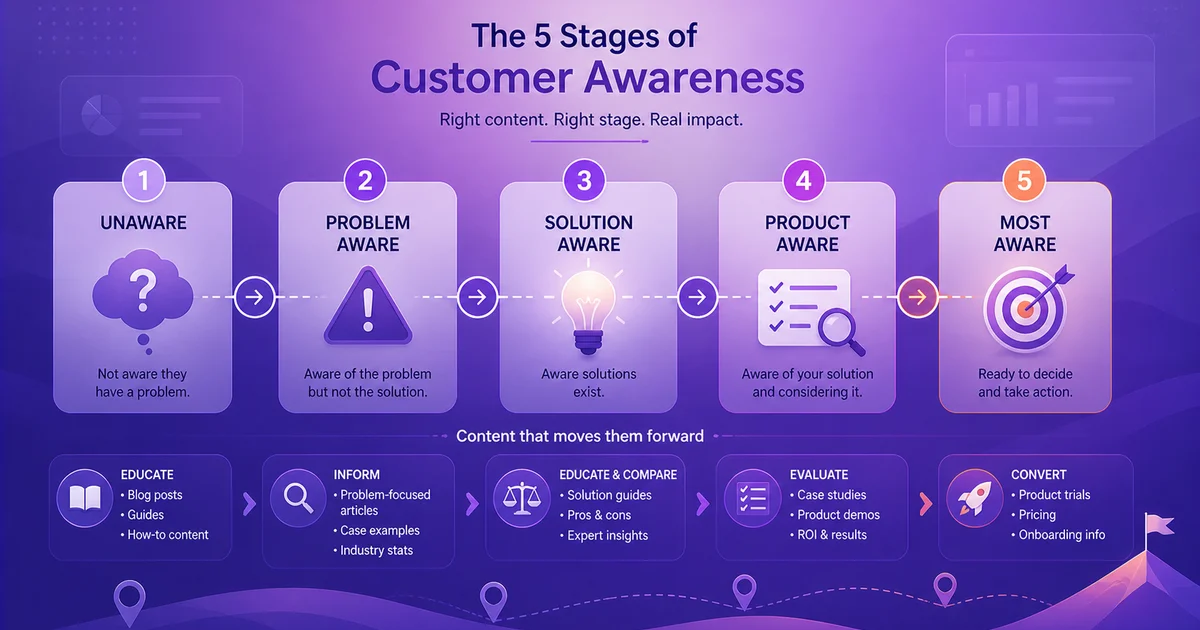
Customer awareness stages represent five distinct mindsets your prospects move through before making a purchase: Unaware, Problem Aware, Solution Aware, Product Aware, and Most Aware. Creating targeted content for each stage allows you to reach and convert prospects at every point in their journey, rather than missing 80% of your potential market by only speaking to ready-to-buy customers.
The companies that understand this framework don't just capture more customers — they build stronger relationships from the very first touchpoint. Here's how to create content that meets prospects exactly where they are.
Why Most Businesses Miss the Mark on Customer Awareness
Walk through any company's content library and you'll find the same pattern. Blog posts about "Why Choose Us." Case studies highlighting happy customers. Detailed product comparisons. Pricing pages with clear calls to action.
All of this content targets people who already know they have a problem and are actively shopping for solutions. But according to awareness stage research, Stage One (Unaware) represents the largest untapped market for most businesses.
Think about your own buying behavior. Before you bought your last car, you probably spent months in various awareness stages. Maybe you first noticed your current car needed more frequent repairs (Problem Aware). Then you researched whether to buy new, used, or lease (Solution Aware). You compared specific models and brands (Product Aware) before finally choosing where to buy (Most Aware).
Each stage required different information and different emotional appeals. The content that convinced you to consider buying wasn't the same content that convinced you which specific car to choose.
Your customers follow the same pattern. Yet most businesses create content as if everyone is already at the Product Aware stage, ready to compare features and prices.
The Hidden Cost of Single-Stage Marketing
When you only create content for late-stage prospects, you're not just missing early-stage customers. You're making your entire sales process harder.
Late-stage prospects often have shorter consideration periods, higher price sensitivity, and less brand loyalty. They're comparing you directly against competitors on spreadsheets and feature lists. Early-stage prospects, by contrast, can develop strong preferences for your brand long before they're ready to buy.
Consider the difference between someone who discovers your ergonomic office chair brand while researching "why my back hurts at work" versus someone who finds you while searching "best office chairs under $500." The first prospect may not buy for six months, but when they do, they're more likely to choose you because you helped them understand their problem. The second prospect is ready to buy this week, but they're going to choose based primarily on price and features.
Stage 1: Unaware — Creating Your Future Customers
Unaware prospects don't know they have a problem you can solve. They're not searching for your product category. They're not reading buying guides or comparison articles. They're living their lives, experiencing symptoms or challenges they haven't yet connected to a solution.
This is where most businesses give up too quickly. It's expensive to reach unaware prospects through paid advertising. It takes time to see results from content marketing. The conversion timeline is measured in months, not days.
But this is also where the biggest opportunities exist.
Content That Works for Unaware Prospects
Educational content about symptoms and consequences performs best with unaware audiences. Instead of talking about your solution, focus on the problems your solution solves.
For example, if you sell project management software, don't create content about "choosing the right project management tool." Create content about "why projects fail" or "signs your team is overwhelmed." If you sell financial planning services, write about "early warning signs of retirement shortfalls" rather than "how to choose a financial advisor."
The key is connecting everyday experiences to larger patterns and consequences. Customer awareness research emphasizes that unaware prospects need education on symptoms before they can recognize they need solutions.
Story-driven content works particularly well for this stage. Share customer stories that start with recognizable situations. "Sarah's small marketing agency was growing fast, but she noticed her team was working longer hours just to keep up with basic tasks." The story then reveals how those symptoms connected to a larger problem worth solving.
Industry trend content helps unaware prospects see their situation in context. "Why 73% of Remote Teams Struggle with Project Visibility" positions a common experience as part of a broader business challenge.
Distribution Strategies for Unaware Audiences
Social media works better than search marketing for reaching unaware prospects, since they're not actively searching for solutions. LinkedIn articles, Facebook posts, and Twitter threads can surface your content to people scrolling through their feeds.
Guest posting on industry publications your prospects already read gets your content in front of people who aren't looking for your solution but trust the publication they're already following.
Email newsletters that provide value beyond your product category build audiences of unaware prospects over time. A financial advisor might send weekly emails about general business trends that occasionally touch on financial planning topics.
Stage 2: Problem Aware — Building Trust Through Understanding
Problem Aware prospects know they have an issue, but they don't yet know what type of solution might help. They're researching their symptoms and looking for explanations, not products.
This stage is about building trust through demonstration of expertise. Your goal isn't to sell your solution yet. It's to become the trusted source your prospects turn to for understanding their problem.
Content Approaches for Problem Aware Prospects
Diagnostic content helps prospects better understand their specific situation. Quizzes, assessments, and self-evaluation tools work well here. "Is Your Team Productivity Problem Actually a Communication Problem?" or "Calculate How Much Money Your Inventory Process Is Costing You."
Framework content gives prospects vocabulary and structure for thinking about their problem. "The 4 Types of Cash Flow Problems" or "3 Stages of Team Growth Challenges" help prospects categorize their specific situation within a larger framework.
According to small business awareness research, moving customers between stages requires "connection and trust" through value-driven content. Problem Aware content builds this trust by showing you understand their situation better than they do.
Research-backed content demonstrates expertise while educating prospects. Share industry studies, survey results, and trend data that help prospects understand how common their problem is and what typically causes it.
The Psychology of Problem Aware Messaging
Problem Aware prospects often feel frustrated or concerned about their situation. They want reassurance that their problem is solvable and that they're not alone in facing it.
Your content tone should be empathetic and authoritative. Acknowledge the challenge they're facing, validate that it's a real problem worth addressing, and demonstrate that solutions exist without immediately pitching yours.
Avoid content that minimizes their problem or suggests it's easy to solve. Problem Aware prospects are looking for someone who takes their challenge seriously and understands its complexity.
Stage 3: Solution Aware — Inspiring Hope and Possibility
Solution Aware prospects understand their problem and know that solutions exist, but they're not sure which type of solution is right for them. They're researching different approaches and trying to understand their options.
This stage is about education and inspiration. Your prospects are learning about solution categories, not specific products or brands yet.
Building Solution Category Awareness
Comparison content between solution types works well for Solution Aware prospects. "In-House vs. Outsourced vs. Hybrid Marketing Teams: Pros and Cons" or "Traditional Accounting Software vs. Cloud-Based Solutions: What's Right for Your Business."
Notice these comparisons are between solution categories, not specific products. You're helping prospects understand their options at the category level.
Success story content shows what's possible when the problem is solved. Share stories about businesses that solved similar problems, focusing on the transformation and results rather than the specific solution details. Customer awareness strategies recommend inspiring hope with stories at this stage.
Process content explains how different types of solutions work. "How Business Coaching Actually Works" or "The Digital Marketing Agency Process: What to Expect" help prospects understand what it would be like to pursue different solution paths.
Addressing Solution Hesitations
Solution Aware prospects often have concerns about whether any solution will actually work for their specific situation. They're worried about making the wrong choice or investing time and money in something that won't deliver results.
Your content should address these meta-concerns about solution categories rather than objections to your specific product. "Why Some Businesses Fail at CRM Implementation (And How to Avoid It)" or "What Makes Consulting Projects Successful vs. Wasteful."
This builds confidence in the solution category while positioning you as someone who understands both the opportunities and the risks.
Stage 4: Product Aware — Standing Out from Alternatives
Product Aware prospects know what type of solution they want and are now comparing specific options. They're reading reviews, requesting demos, and creating evaluation criteria.
This is where most businesses start their content efforts, but it's actually the most competitive stage. Your prospects are actively comparing you against alternatives, so your content needs to clearly communicate what makes you different and better.
Differentiation Content That Actually Differentiates
Behind-the-scenes content shows how you deliver results differently than competitors. "How We Cut Client Onboarding Time in Half" or "Why We Do Discovery Differently" give prospects insight into your unique process.
Most businesses try to differentiate on features or prices, but product awareness research shows this stage requires addressing objections directly through case studies and social proof.
Methodology content explains your specific approach and why it works better. "Our 3-Phase Brand Strategy Process" or "How We Guarantee Results in 90 Days" position your method as superior to standard industry approaches.
Client result content provides specific proof of your differentiation. Instead of generic case studies, create detailed stories that show how your unique approach delivered better outcomes than prospects could expect elsewhere.
Handling Comparison Shopping
Product Aware prospects are often creating spreadsheets and evaluation matrices to compare their options. Your content should make this easier, not harder.
Honest comparison content positions you as a trusted advisor rather than just another vendor. "How We Compare to [Alternative Approach]" or "When You Shouldn't Choose Us" builds credibility by acknowledging when alternatives might be better fits.
Decision framework content helps prospects evaluate all their options more effectively. "How to Choose Between Agencies vs. Freelancers vs. In-House Teams" positions you as an expert advisor while subtly highlighting the criteria where you excel.
Stage 5: Most Aware — Removing Final Obstacles
Most Aware prospects have decided they want your specific solution but haven't committed yet. They may need internal approval, budget allocation, or just final reassurance that they're making the right choice.
According to conversion tactics research, the Most-Aware stage benefits from incentives, discounts, and deals, but content still plays an important role in addressing final hesitations.
Content That Closes the Deal
Implementation content addresses concerns about what happens after purchase. "What to Expect in Your First 30 Days" or "How We Ensure Smooth Project Kickoffs" reassure prospects that they'll be supported through implementation.
ROI and timeline content provides specific expectations about results. "Typical Results Timeline for New Clients" or "How to Calculate Your ROI from This Investment" help prospects justify their decision internally.
Frequently asked questions content addresses the small concerns that can derail final decisions. Create comprehensive FAQ sections that cover pricing, contracts, guarantees, support, and any other common final-stage questions.
Social Proof at Decision Time
Most Aware prospects need confidence that others like them have been successful with your solution. They're past the general success stories from earlier stages and need specific, relevant proof points.
Customer spotlight content featuring clients in similar industries or situations provides relevant social proof. "How [Similar Company] Achieved [Specific Result]" works better than generic testimonials.
Recent results content shows ongoing success rather than historical case studies. "Q3 Client Results Roundup" or "This Month's Success Stories" demonstrate that your solution continues to work well for current clients.
Creating Your Multi-Stage Content Strategy
Building content for all five awareness stages requires a systematic approach. Most businesses try to create everything at once and burn out before seeing results.
Start by auditing your existing content to see which stages you're already covering. Most businesses will find they have plenty of Product Aware and Most Aware content but very little for earlier stages.
The 70-20-10 Content Distribution
Allocate your content creation efforts based on where your biggest opportunities exist:
- 70% of content for Stages 1-3 (Unaware, Problem Aware, Solution Aware). These stages have the largest audiences but the longest conversion timelines. Content here builds your future customer pipeline.
- 20% of content for Stage 4 (Product Aware). This content directly supports active prospects who are comparing options and need differentiation.
- 10% of content for Stage 5 (Most Aware). This content removes final obstacles for prospects who have already decided they want your solution.
This distribution assumes you already have some Product Aware content. If you're starting from scratch, you might initially focus more heavily on Stage 4 content to support immediate sales efforts while building your early-stage content library over time.
Content Repurposing Across Stages
The same core information can often be repurposed for different awareness stages by changing the angle and context.
A case study about a successful client project can become:
- Unaware content: "The Hidden Cost of Poor Project Communication" (focusing on the original problem)
- Problem Aware content: "How Communication Problems Kill Project Profitability" (exploring the business impact)
- Solution Aware content: "How Better Communication Systems Saved This Project" (introducing solution categories)
- Product Aware content: "Why We Chose [Specific Tool] for Client Communication" (explaining your specific approach)
This approach maximizes the value of your content creation efforts while ensuring each stage gets appropriate messaging.
What the Data Says
- Stage One (Unaware) represents the largest untapped market — Most businesses miss their biggest opportunity by only targeting late-stage prospects
- Moving customers between stages requires "connection and trust" through value-driven content — Early-stage content builds relationships that make later-stage conversion easier
- Product-Aware prospects need objection-handling through case studies and social proof — Generic feature comparisons aren't enough at this competitive stage
- People convert on their own timeline, not yours — Rushing prospects through stages reduces conversion rates rather than improving them
Common Questions About Customer Awareness Stages
Q: How do I know which awareness stage my prospects are in?
Look at their behavior and the questions they ask. Prospects consuming general educational content are likely Unaware, while those requesting demos or asking about pricing are Product Aware or Most Aware.
Q: Should I create content for all five stages at once?
Start with stages that align with your immediate business needs, then expand. If you need sales now, prioritize Product Aware content. If you're building long-term growth, start with Unaware and Problem Aware content.
Q: How long does it take prospects to move through all five stages?
This varies dramatically by industry and purchase complexity. Simple consumer products might see movement in days or weeks, while complex B2B solutions often take months or years.
Q: Can prospects skip stages or move backward?
Yes, the stages aren't always linear. Prospects can enter at any stage and sometimes need to step back to earlier stages when they encounter new information or complications.
Q: What's the biggest mistake businesses make with awareness stage marketing?
Focusing exclusively on late-stage prospects (Product Aware and Most Aware) while ignoring the larger early-stage audiences that represent future growth opportunities.
Key Takeaways
- Create content for all five customer awareness stages, not just prospects who are ready to buy immediately — Stage One represents your largest untapped market opportunity.
- Match your content approach to each stage's mindset: educate symptoms for Unaware, build trust through expertise for Problem Aware, inspire with possibilities for Solution Aware, differentiate clearly for Product Aware, and remove final obstacles for Most Aware.
- Use a 70-20-10 content distribution strategy, focusing most of your efforts on early-stage content that builds your future customer pipeline while maintaining support for active prospects.
- Repurpose core information across multiple stages by changing the angle and context rather than creating entirely new content for each awareness level.
- Remember that prospects move through stages on their own timeline — your job is to meet them where they are, not rush them where you want them to be.
How Your Brand Blueprint Can Help with This
Your Brand Blueprint includes detailed guidance for creating content across all customer awareness stages. The Buyer's Journey section maps out exactly how your prospects move toward a purchase and what messages resonate at each stage, while the Sales Tools section provides specific content strategies by awareness level. Rather than guessing what content to create, you'll have a clear roadmap for meeting prospects wherever they are in their journey.
Ready to put this into practice? BrandBlueprint.ai builds your complete brand messaging strategy — including the section that covers exactly what we talked about here.