
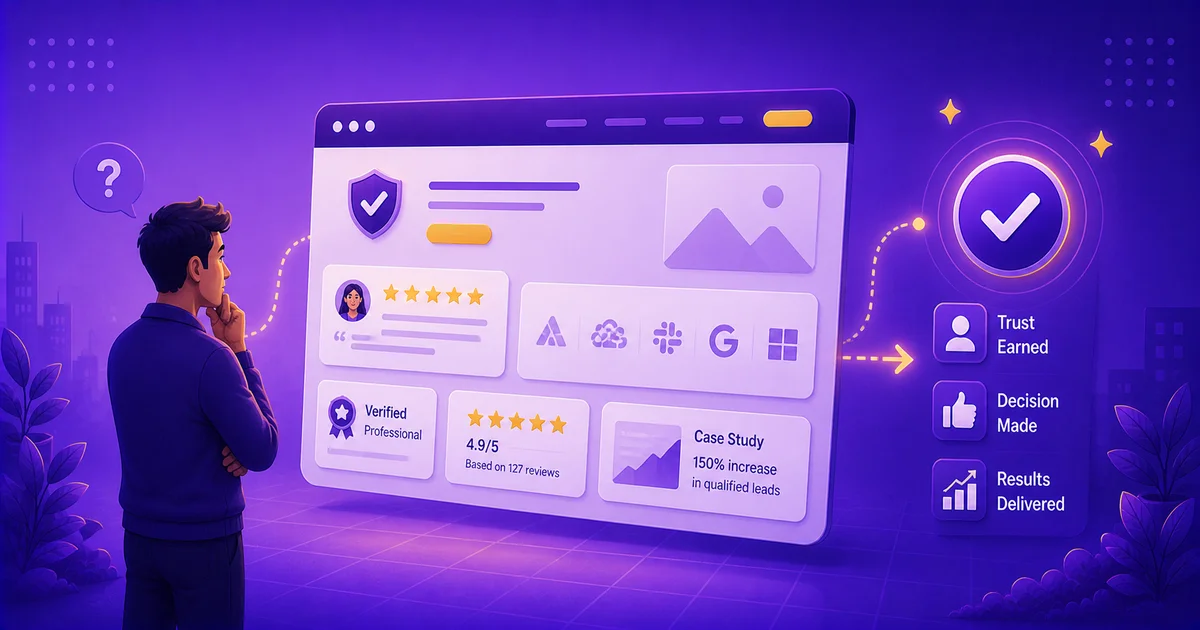
Your website has seconds to convince visitors they can trust you. Most prospects make trust decisions before they ever pick up the phone, read your testimonials, or explore your services. They scan for credibility signals that either reassure them or send them clicking away to a competitor. The businesses that master these trust-building elements convert more visitors without needing more traffic.
Building website trust requires strategic credibility signals that address visitor uncertainty before any direct contact. Effective trust-building combines clear positioning, authentic social proof, professional presentation, and transparent communication to reduce cognitive effort and increase conversion rates.
The Psychology Behind Website Trust Decisions
Visitors don't consciously analyze your credibility. Their brains make rapid assessments based on visual cues, messaging clarity, and social validation. Research shows users evaluate credibility early and abandon sites that create uncertainty, making those first few seconds critical for conversion.
Your prospects arrive with questions: "Who is this for? What problem do they solve? Why does it matter?" When your website forces visitors to work hard for answers, they leave. Clear positioning reduces this cognitive effort and builds immediate confidence.
Consider how Buffer approaches this challenge. Their homepage immediately positions them for social media marketers with clear value statements and embedded reviews from Google and Trustpilot. They use professional team photos instead of stock images and maintain consistent messaging across every page. This approach reassures visitors before they ever consider signing up for a trial.
The key insight: trust-building isn't about perfection. It's about removing doubt and uncertainty from the visitor experience.
Essential Credibility Signals That Actually Work
Professional Visual Presentation
Your website's visual credibility starts with speed and technical performance. Sites taking more than 3 seconds to load lose most visitors, creating an immediate impression of unreliability. Fast loading times suggest operational competence before prospects evaluate your actual services.
Visual consistency across pages prevents the doubt that comes from outdated or mismatched design elements. When Basecamp redesigned their site, they ensured every page reinforced their "Work doesn't work the way it used to" positioning with consistent typography, colors, and messaging hierarchy.
Avoid stock photos wherever possible. Real photos of your team, workspace, or work samples build authenticity that generic images can't match. Service businesses particularly benefit from showing actual equipment, completed projects, or behind-the-scenes operations rather than polished stock photography.
Authentic Social Proof Systems
Generic testimonials without names or context provide little credibility boost. Effective social proof includes specific details: names, companies, results, and ideally photos. Even small numbers of real testimonials outperform having none.
The most powerful testimonials tell transformation stories with measurable outcomes. Instead of "Great service!" use testimonials like "Sarah helped us streamline our hiring process and saved us 10 hours per week." Include job titles and company names when possible.
HubSpot excels at this approach by featuring detailed customer stories with metrics, challenges, and specific solutions. They combine written testimonials with video case studies and customer logos to create multiple layers of social validation.
For businesses with strong Google Reviews, embed them directly on your site with star ratings and reviewer names visible. Eighty five-star Google reviews provide significant conviction for service-based businesses.
Transparent Business Information
Your "About" page shouldn't be an afterthought. Visitors use it to assess legitimacy, values, and cultural fit. Share your company's history, team backgrounds, and operational approach without excessive personal details or corporate fluff.
Stripe demonstrates this effectively by clearly explaining their payment processing focus, showing team photos, and outlining their security measures. They answer the underlying question: "Can I trust this company with sensitive financial transactions?"
Include multiple contact methods to show accessibility. Phone numbers, email addresses, and chat options all signal openness to communication. Physical addresses build additional credibility for local or regional businesses.
Pricing and Service Transparency
Strategic Pricing Communication
Complete pricing secrecy often creates more anxiety than disclosure. You don't need to list every price point, but providing ranges or starting points helps qualified prospects self-select while deterring time-wasters.
Consider offering pricing "ballparks" that give prospects realistic expectations without committing to specific rates. "Website projects typically range from $5,000-$15,000 depending on complexity and timeline" helps visitors determine fit before scheduling calls.
Some businesses benefit from displaying their premium pricing upfront to attract serious buyers and filter out bargain hunters. This approach works particularly well for specialized professional services or luxury products.
Clear Service Descriptions
Vague service descriptions force prospects to guess about fit and value. Instead of "We help businesses grow," explain exactly what you do and for whom. "We help manufacturing companies reduce inventory costs through supply chain optimization" eliminates confusion.
Break down complex services into understandable components. If you offer marketing services, specify whether that includes strategy, execution, measurement, or all three. Clear boundaries prevent mismatched expectations and build confidence in your expertise.
Advanced Trust-Building Strategies
Content That Demonstrates Expertise
Publishing helpful content positions you as a knowledgeable resource rather than just another vendor. Blog posts, guides, and resources that solve actual problems build credibility before sales conversations begin.
The key is specificity. Generic business advice doesn't differentiate you. Industry-specific insights, detailed case studies, and actionable strategies demonstrate real expertise. This content also helps with search visibility, bringing in prospects who are actively researching solutions.
Third-Party Validation
Certifications, awards, and industry memberships provide external credibility markers. Display relevant credentials prominently without cluttering your design. A few meaningful certifications carry more weight than dozens of minor recognitions.
Client logos serve as powerful trust signals, especially for B2B services. Amazon, Shopify, and other recognizable brands on Stripe's homepage immediately communicate enterprise-level capability and trustworthiness.
Consistent Messaging Across Touchpoints
If prospects find you through cold outreach, advertising, or referrals, your website messaging must align with their prior exposure to your brand. Mismatched tone or positioning between initial contact and website creates doubt about authenticity.
This consistency extends to your social media profiles, email signatures, and any other customer touchpoints. A cohesive brand presentation reinforces professionalism and attention to detail.
Converting Trust Into Action
Trust-building means nothing without clear next steps. Place compelling calls-to-action above the fold and throughout your site using contrasting colors and action-oriented language. "Book a Free Consultation" or "Get Your Custom Quote" work better than generic "Contact Us" buttons.
For complex or expensive services, offer low-risk engagement options. Free consultations, assessments, or downloadable resources let prospects experience your expertise without major commitment. HubSpot's free tools strategy exemplifies this approach perfectly.
Consider the visitor's perspective at each stage of their journey. Early-stage researchers need educational resources. Ready-to-buy prospects need clear purchasing processes and quick response promises.
What the Data Says
- Sites taking more than 3 seconds to load lose most visitors - Technical performance creates immediate credibility impressions about operational competence.
- Users evaluate credibility early and abandon sites creating uncertainty - Trust decisions happen in seconds, not minutes, making first impressions critical.
- Real social proof like testimonials outperforms having none, even in small numbers - Authentic testimonials with specific details build more trust than generic praise.
- Clear positioning reduces cognitive effort by answering core visitor questions immediately - Visitors need to understand "Who is this for? What problem do they solve? Why does it matter?" without working for answers.
Common Questions About Building Website Trust
Q: How many testimonials do I need to build credibility?
Quality matters more than quantity for testimonials. Three to five detailed testimonials with names, results, and context work better than dozens of generic reviews. Focus on testimonials that address common concerns or objections your prospects have.
Q: Should I display pricing on my website?
It depends on your business model and market positioning. Service businesses often benefit from price ranges or starting points to help prospects self-qualify. Complex or custom services can use "investment levels" or "typical project ranges" instead of specific pricing.
Q: How important are professional photos versus stock images?
Real photos build significantly more trust than stock images, especially for service businesses. Visitors can spot stock photos easily, and they create disconnect between your actual business and generic imagery. Invest in quality photos of your actual team and work environment.
Q: What's the most important credibility signal for new businesses?
For new businesses without extensive testimonials or case studies, focus on transparent communication and professional presentation. Clear service descriptions, founder credentials, detailed "About" pages, and responsive customer service can build trust while you develop social proof.
Q: How do I build trust if I work from home or don't have a physical office?
Emphasize your expertise, credentials, and client results rather than physical location. Use professional headshots, showcase remote work capabilities as an advantage, and highlight your responsiveness and communication systems. Many successful businesses operate remotely while maintaining high credibility.
Key Takeaways
- Website trust develops within seconds through credibility signals like fast loading times, clear positioning, and authentic social proof rather than generic testimonials or stock imagery.
- Transparent communication about services, pricing ranges, and business operations reduces visitor uncertainty and helps qualified prospects self-select while filtering out poor fits.
- Real testimonials with specific names, results, and transformation stories build more credibility than numerous generic reviews, especially when combined with client logos and third-party validation.
- Consistent messaging across all touchpoints from initial contact through website experience prevents doubt about authenticity and reinforces professional competence.
- Clear calls-to-action with low-risk engagement options like free consultations or assessments convert trust into business opportunities without overwhelming hesitant prospects.
How Your Brand Blueprint Can Help with This
Building website trust requires more than scattered testimonials and professional photos. Your Brand Blueprint's Credibility, Proof & Transformation section creates a systematic approach to demonstrating value, while the Brand Messaging section ensures consistent positioning across every touchpoint. Together, these sections help you craft authentic credibility signals that address specific prospect concerns rather than generic trust-building efforts.
Ready to put this into practice? BrandBlueprint.ai builds your complete brand messaging strategy -- including the section that covers exactly what we talked about here.