
Your brand messaging determines whether prospects trust you or scroll past you.
It's the difference between building a business that resonates with your ideal customers and struggling to explain why anyone should choose you over the competition. The traditional route has been hiring a specialized agency, but that landscape is changing fast.
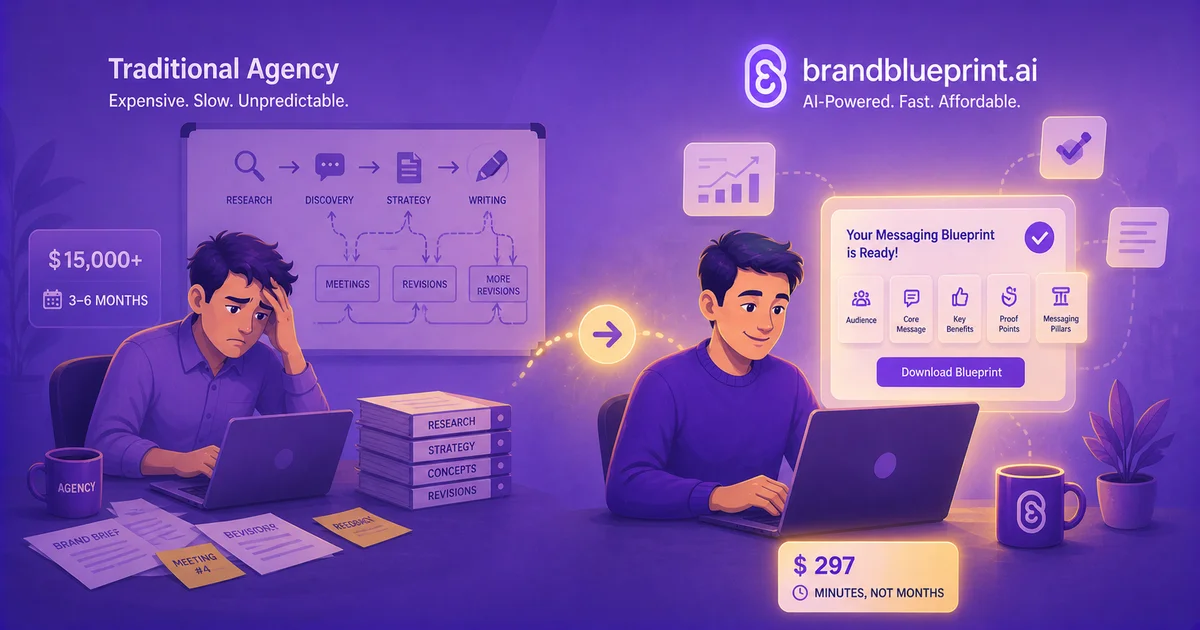
Most businesses need professional brand messaging strategy, but hiring a traditional agency isn't accessible or practical for many companies. Professional brand messaging used to be exclusively available through expensive agency engagements costing $5,000-$25,000 and taking months to complete. Now AI-powered platforms can deliver the same strategic frameworks and comprehensive messaging systems in minutes instead of months and at a fraction of the cost.
The real question isn't whether you need brand messaging expertise. You absolutely do. The question is how to get professional-grade strategy without the traditional barriers of cost, timeline, and complexity.
The Agency Reality: Who Actually Gets Professional Brand Messaging
Brand messaging agencies build the foundation for how your business communicates with the world. They develop strategic frameworks that guide every piece of content, sales conversation, and marketing campaign you create. But their services have traditionally been accessible only to certain types of businesses.
The Agency Sweet Spot
Most professional messaging agencies focus on clients who can invest $10,000 to $50,000 in brand strategy development. This typically includes established companies, venture-funded startups, and large professional service firms with significant marketing budgets.
These agencies excel at complex organizational challenges: aligning multiple stakeholder groups, managing regulatory requirements, facilitating executive workshops, and providing ongoing strategic consultation. They offer the white-glove service that larger organizations often need.
Who Gets Left Out
The traditional agency model leaves significant gaps in the market. Small professional service businesses, skilled trades, medical practices, law firms, consultants, and local service businesses typically can't justify the investment or timeline that agencies require.
These businesses need professional messaging strategy just as much as larger companies, but they've been priced out of the market. They're left choosing between expensive agency engagements they can't afford or DIY approaches that rarely produce professional results.
The Methodology Gap
What these underserved businesses miss isn't just professional messaging, it's the proven strategic framework that agencies use. Without proper methodology, businesses default to features-focused messaging instead of benefits-driven positioning. They talk about what they do instead of why it matters to customers.
What Professional Brand Messaging Actually Includes
Whether delivered by agencies or platforms, comprehensive brand messaging strategy includes specific strategic components that most businesses try to develop themselves and get wrong.
Strategic Positioning Framework
Professional messaging starts with positioning analysis that identifies exactly what territory you can own in your market. This isn't about brainstorming taglines. It's about strategic positioning that differentiates you from competitors and gives prospects clear reasons to choose you.
The positioning framework includes your unique value proposition, key differentiators, target audience definition, and the specific problems you solve better than anyone else. This becomes the foundation for everything else.
Competitive Intelligence
Professional messaging requires deep understanding of your competitive landscape. This means analyzing not just what competitors say about themselves, but identifying gaps in their positioning, understanding their messaging weaknesses, and finding opportunities they've missed.
Most businesses know their direct competitors but miss the broader competitive context that shapes customer expectations and buying behavior.
Voice and Tone Guidelines
Professional messaging includes specific voice and tone rules that ensure consistency across all communications. These guidelines define how your brand sounds in different contexts, what language to use and avoid, and how to maintain personality while staying professional.
Without these guidelines, different team members represent your brand differently, creating confusion for prospects and customers.
Implementation Roadmap
Strategy without implementation planning is useless. Professional brand messaging includes specific guidance for rolling out new messaging across your website, sales materials, content marketing, and team communications.
This roadmap prevents the common problem of developing great strategy that never actually gets used because no one knows how to implement it practically.
The Cost Barrier Problem
Traditional agency pricing has created a significant accessibility gap in professional brand messaging.
Agency Economics
Agency fees reflect the reality of human labor, overhead costs, and profit margins. Creative strategy agencies need to cover senior strategist salaries, account management, research time, presentation development, and multiple revision cycles.
A comprehensive brand messaging project requires 40-80 hours of strategic work spread across multiple team members. When you factor in agency overhead and profit margins, $15,000-$25,000 projects become necessary for agencies to maintain profitability.
Timeline Challenges
Agency timelines compound the accessibility problem. Most agency engagements require 6-12 weeks minimum, with multiple stakeholder meetings, feedback cycles, and revision rounds. For businesses needing messaging quickly for product launches, funding efforts, or competitive responses, these timelines don't work.
The Underserved Market
This pricing and timeline structure works for larger organizations but excludes the majority of businesses that need professional messaging strategy. Small professional service firms, local businesses, consultants, medical practices, and skilled trades simply can't justify the investment or timeline.
These businesses represent a massive underserved market that needs professional messaging methodology but has been priced out of traditional solutions.
How Technology Changes Everything
AI-powered platforms have fundamentally altered what's possible for professional brand messaging development, making strategic expertise accessible to businesses that could never afford traditional agency engagements.
Methodology Without Overhead
Modern platforms apply the same proven brand strategy methodologies that agencies use, but without the human labor costs that drive traditional pricing. You get strategic frameworks, competitive analysis, and comprehensive documentation delivered through software instead of consulting engagements.
The methodology remains identical, but the delivery mechanism eliminates most of the cost structure that makes agency work expensive.
Industry Research at Scale
Advanced platforms incorporate extensive industry research libraries that often exceed what individual agencies maintain. This research gets applied instantly rather than being collected during lengthy discovery phases.
Instead of agencies spending weeks researching your market, platforms draw on pre-built research covering dozens of industries, competitor dynamics, and customer psychology patterns.
Professional Documentation
Professional platforms generate the same strategic documents that agencies provide: messaging frameworks, competitive intelligence reports, implementation guides, voice and tone guidelines, and content strategy blueprints.
The output quality matches agency deliverables because the underlying methodology is identical. You're getting professional strategic thinking delivered through technology instead of human consultation.
When Agencies Still Make Sense
Certain situations genuinely require the full agency experience and investment, and it's important to understand when the traditional approach remains the better choice.
Large, Complex Organizations
Companies with multiple product lines, diverse stakeholder groups, and complex decision-making processes often benefit from agency facilitation. The agency serves as a neutral party helping different departments align on messaging strategy.
These organizations need the workshop facilitation, stakeholder management, and change management expertise that agencies provide. The strategic output is important, but the process of getting organizational alignment is equally valuable.
Highly Regulated Industries
Businesses in heavily regulated sectors like pharmaceuticals, medical devices, or financial services sometimes need agencies with specific compliance expertise and regulatory knowledge. Generic messaging frameworks may not account for industry-specific legal requirements.
Major Brand Repositioning
Companies undertaking fundamental brand changes, mergers, acquisitions, or complete market pivots may need the strategic depth and external perspective that agencies provide. These situations require extensive stakeholder interviews, market research, and change management.
Ongoing Strategic Partnership
Organizations needing continuous strategic guidance, content production at scale, and campaign management often find value in agency relationships that combine strategy development with ongoing execution support.
Making Professional Messaging Accessible
The emergence of AI-powered brand strategy platforms represents a fundamental shift in who can access professional messaging development.
Democratizing Strategic Expertise
Platforms like BrandBlueprint.ai make the same strategic methodologies that agencies use accessible to businesses regardless of size or budget. A medical practice, law firm, or consulting business can now get comprehensive brand messaging strategy that was previously available only to much larger organizations.
Speed Advantage
Instead of waiting months for agency deliverables, businesses can access complete messaging strategies in under an hour. This speed advantage becomes crucial for time-sensitive opportunities like product launches, competitive responses, or business development efforts.
Implementation Focus
Modern platforms often provide better implementation support than traditional agencies. The messaging strategy comes formatted for immediate use: content briefs ready for your marketing team, sales talk tracks for your business development efforts, and voice guidelines formatted to upload directly into AI tools like ChatGPT.
Cost Accessibility
The economics are fundamentally different. The same strategic outcome that costs $15,000 and takes three months through an agency can now be delivered for under $500 in less than an hour. This pricing makes professional messaging accessible to the vast majority of businesses that need it.
Industry-Specific Considerations
Different types of businesses have varying needs when it comes to brand messaging strategy development.
Professional Services
Law firms, medical practices, financial advisors, and consultants typically need messaging that establishes credibility, differentiates expertise, and builds trust with sophisticated buyers. These businesses benefit from proven messaging frameworks but often can't justify traditional agency investments.
Skilled Trades and Home Services
Contractors, electricians, plumbers, and home service businesses need messaging that builds trust with homeowners, communicates reliability, and differentiates from commodity competitors. Traditional agencies rarely understand these markets well enough to develop effective messaging.
B2B Service Businesses
Marketing agencies, technology consultants, and business service providers need sophisticated messaging that speaks to executive buyers and complex sales cycles. They understand marketing but often lack the strategic framework for their own positioning.
Medical and Wellness Practices
Healthcare providers, med spas, wellness centers, and alternative medicine practices need messaging that builds trust, communicates expertise, and navigates regulatory constraints while remaining accessible to patients.
The Future of Brand Messaging
The brand messaging landscape is evolving rapidly, with technology making professional strategy more accessible while traditional agencies focus on their highest-value services.
Platform Evolution
AI-powered platforms continue improving their strategic sophistication, industry research depth, and implementation support. The gap between platform output and agency deliverables continues narrowing while the cost and timeline advantages remain significant.
Agency Adaptation
Many agencies are adapting by focusing on larger, more complex engagements where human facilitation and ongoing partnership provide clear value. Some are also developing their own platform tools to serve smaller clients more efficiently.
Market Expansion
The biggest change is market expansion. Businesses that could never access professional brand messaging strategy can now get comprehensive frameworks, competitive intelligence, and implementation guidance that matches agency quality at platform economics.
Making Your Decision
Your choice between agencies and platforms should align with your specific situation, resources, and timeline requirements.
Choose Traditional Agencies When:
- You need extensive stakeholder facilitation and workshop management
- Your industry has complex regulatory requirements requiring specialized expertise
- You're undertaking major organizational change requiring external perspective
- You want ongoing strategic partnership beyond initial messaging development
- You have budget and timeline flexibility for comprehensive consultation
Choose AI Platforms When:
- You need comprehensive strategy quickly for time-sensitive opportunities
- You want proven methodology without traditional consultation overhead
- You prefer controlling implementation timing and approach yourself
- You want to invest in execution rather than extended strategy development
- You need professional messaging but traditional agency pricing isn't accessible
The Quality Question
The strategic quality between advanced platforms and traditional agencies is often comparable. Both apply proven methodologies, conduct competitive analysis, and deliver comprehensive documentation. The main differences lie in delivery mechanism, timeline, cost structure, and implementation support.
Common Questions About Brand Messaging Agencies
Q: How long does it typically take to develop brand messaging with an agency?
Most agency engagements require 6-12 weeks for complete brand messaging development. This includes discovery, research, strategy development, feedback cycles, and final deliverables. Rush projects can sometimes be completed in 4-6 weeks but often cost significantly more.
Q: What should I expect to pay for professional brand messaging?
Agency fees typically range from $5,000 to $25,000 for comprehensive messaging strategy, depending on business complexity and agency reputation. Enterprise-level projects often exceed $50,000. Platform alternatives typically cost $300-$500 for comparable strategic output.
Q: Can I develop effective brand messaging myself without professional help?
While possible, most business owners lack the strategic framework, competitive research, and objective perspective needed for effective messaging. DIY approaches often result in features-focused messaging instead of benefits-focused positioning that resonates with target audiences.
Q: How often should brand messaging be updated or refreshed?
Brand messaging should be reviewed annually and updated when entering new markets, launching new products, or facing significant competitive changes. Core messaging can remain stable for years, but tactical messaging often needs quarterly adjustments based on market feedback.
Q: What's the difference between brand messaging and marketing copy?
Brand messaging is the strategic foundation that defines what you communicate and why. Marketing copy is the tactical execution that applies this messaging in specific contexts like websites, ads, or sales materials. Strategy comes first, then execution follows.
Key Takeaways
- Professional brand messaging strategy is essential for business growth, but traditional agency pricing has made it inaccessible to most businesses that need it
- AI-powered platforms now deliver the same strategic frameworks, competitive intelligence, and comprehensive documentation that agencies provide, but at a fraction of the cost and time
- Traditional agencies remain valuable for complex organizations needing facilitation, specialized regulatory expertise, or ongoing strategic partnerships
- The emergence of accessible platform solutions means businesses can now access professional messaging methodology regardless of size or budget
- The quality difference between advanced platforms and agencies is often minimal, with the main distinctions being delivery approach, timeline, and cost structure
How BrandBlueprint.ai Solves This Problem
BrandBlueprint.ai makes professional brand messaging strategy accessible to businesses that have been priced out of traditional agency solutions. Our platform delivers the same comprehensive messaging frameworks, competitive intelligence, and implementation guidance you'd get from a $15,000 agency engagement, but in under an hour instead of waiting months.
You get six complete strategic documents including your core messaging blueprint, competitive analysis, sales and content toolkits, implementation roadmap, and voice guidelines formatted for immediate use with your team or AI tools.
This is professional brand strategy made accessible to the businesses that actually need it most.
Ready to develop your professional brand messaging strategy? BrandBlueprint.ai delivers everything covered in this guide as your complete brand messaging foundation.