
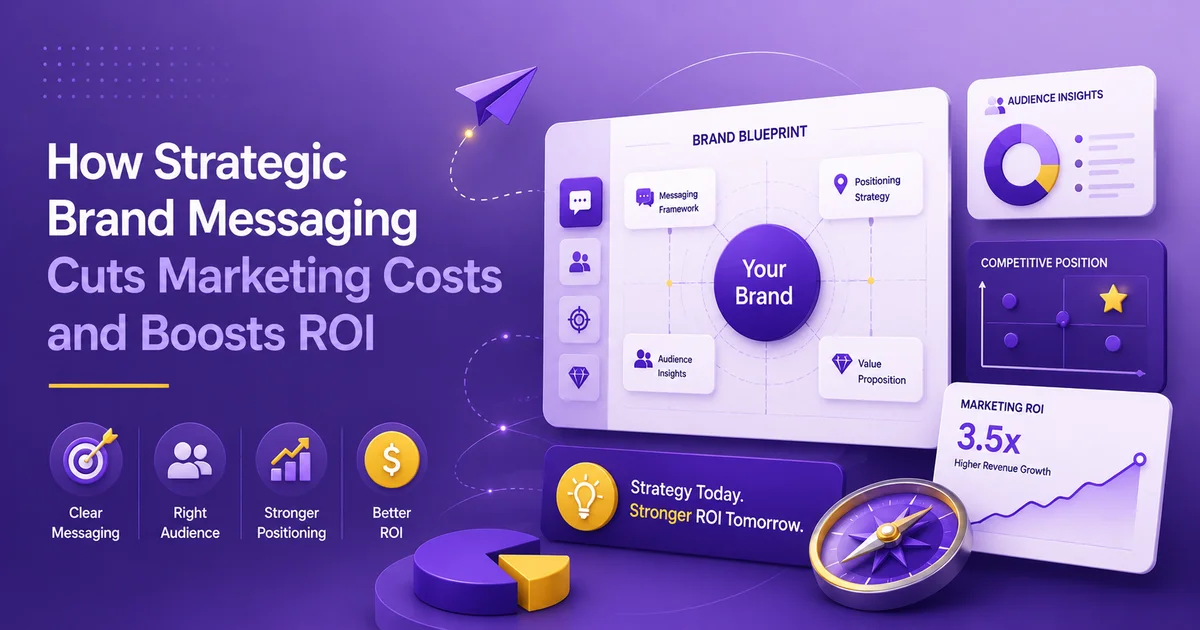
Most business owners hemorrhage money on marketing because they're building campaigns on quicksand. Without a strategic foundation, every dollar spent on ads, content, and outreach becomes a gamble instead of an investment in measurable growth.
A brand blueprint is a comprehensive strategic framework that defines your brand messaging, positioning, audience insights, and competitive differentiation before you create any marketing materials. When done correctly, this upfront strategy work eliminates the trial-and-error approach that drains marketing budgets and delivers measurable cost savings across every channel.
The numbers tell a clear story. Companies with documented brand strategy see 3.5 times higher revenue growth than those winging it. But the real impact shows up in what you stop wasting money on once you have clarity on your message, audience, and positioning.
The Hidden Costs of Marketing Without Strategy
Before we dive into how strategic brand messaging cuts costs, let's look at what happens when you skip this step.
Sarah runs a boutique consulting firm. Last year, she spent $15,000 on Facebook ads that generated exactly three leads. She hired two different copywriters who each delivered completely different messaging. Her website bounce rate hit 78% because visitors couldn't figure out what her company actually did. She launched a content strategy that produced 50 blog posts that no one read.
Sarah's story isn't unique. The Content Marketing Institute found that 69% of businesses admit their content marketing lacks a documented strategy. Without strategic direction, every marketing initiative becomes an expensive experiment.
The real tragedy isn't just the money lost on ineffective campaigns. It's the compound effect of mixed messaging confusing potential customers, diluting your market position, and training your audience to ignore your communications entirely.
How Strategic Brand Messaging Transforms Marketing ROI
Targeted Campaigns That Actually Convert
When you understand exactly who your ideal customer is and what messages resonate with them, your advertising spend becomes surgical instead of spray-and-pray.
Take the case of a commercial cleaning company that was burning through $8,000 monthly on Google Ads with a 2% conversion rate. After developing a comprehensive brand strategy, they discovered their highest-value prospects weren't searching for "commercial cleaning" at all. They were searching for "facility management solutions" and "building maintenance partners."
The strategy work revealed that decision-makers cared more about operational reliability than cost savings. This insight shifted their entire approach. New ad copy focused on "guaranteed coverage" and "backup protocols" instead of "affordable rates." Their conversion rate jumped to 8.4% while their cost per acquisition dropped by 60%.
The lesson here extends beyond paid advertising. Whether you're writing email campaigns, social media posts, or sales presentations, knowing your audience's exact language and priorities means every piece of content works harder. You spend less time creating materials that miss the mark and more time refining what actually moves the needle.
Strategic messaging also eliminates the expensive cycle of constantly testing new approaches. Instead of running ten different ad variations to see what sticks, you can confidently invest in fewer, more targeted campaigns that align with your established positioning.
Content That Builds Authority Instead of Noise
Most businesses treat content creation like throwing spaghetti at the wall. They publish blog posts, social media updates, and email newsletters without any unifying strategy. The result is a scattered brand presence that dilutes their expertise instead of building it.
A comprehensive brand strategy includes defined content pillars that support your core positioning. These pillars become the filter for every piece of content you create. Instead of writing about everything related to your industry, you focus on the specific topics that reinforce your unique value proposition.
Consider a financial advisor who previously wrote generic content about retirement planning, investment basics, and tax strategies. After developing her brand blueprint, she identified her core positioning as "the advisor who helps dual-career couples navigate complex financial decisions." Her content pillars became: career transition planning, dual-income tax optimization, and coordinated investment strategies.
This focused approach transformed her content ROI. Instead of competing with every other financial advisor writing about 401(k) basics, she owned a specific niche. Her blog traffic increased 180% within six months, but more importantly, the quality of her leads improved dramatically. Prospects arrived already understanding her specialization and ready to discuss higher-value engagements.
The cost savings here aren't just about creating less content. It's about creating content that actually builds your business instead of just filling your editorial calendar. When every blog post, email, and social media update reinforces your core message, you're not just saving money on content creation. You're building a marketing asset that compounds over time.
Sales Conversations That Close Faster
Nothing wastes money like lengthy sales cycles filled with confused prospects who can't understand what makes your business different. When your brand messaging is unclear, sales conversations become expensive education sessions instead of efficient closing opportunities.
Clear brand positioning dramatically shortens sales cycles by pre-qualifying prospects and setting proper expectations before they ever speak with your team. When someone visits your website or reads your marketing materials, they should immediately understand what you do, who you serve, and why you're different. This clarity filters out poor-fit prospects and attracts qualified leads who are ready to buy.
A software consulting firm discovered this firsthand after implementing a strategic messaging framework. Previously, their sales process averaged 4.2 meetings per closed deal, with prospects often confused about the firm's capabilities and pricing structure. The average sale took 127 days from first contact to signed contract.
After clarifying their positioning as "the team that transforms legacy systems without business disruption," their messaging became much more specific. Website copy explained exactly what types of companies they served and what outcomes clients could expect. Case studies highlighted specific transformation challenges they'd solved.
The results were immediate. Average meetings per sale dropped to 2.1. Sales cycle length decreased to 68 days. But the real ROI came from the sales team's productivity improvement. Instead of spending hours explaining basic service offerings, salespeople could focus on solution design and value demonstration.
Marketing Channels That Work in Harmony
When every marketing channel tells a different story about your business, you're essentially running multiple competing campaigns instead of one coordinated strategy. This fragmentation doesn't just confuse customers. It multiplies your costs by forcing you to build separate audiences for each disconnected message.
Integrated brand messaging creates compound effects across channels. Your email campaigns reinforce what prospects learned from your website. Your social media content supports the positioning established in your advertising. Your sales presentations build on the foundation your content marketing created.
A manufacturing company learned this lesson when they analyzed why their marketing felt so expensive despite reasonable individual channel performance. Their LinkedIn content positioned them as innovation leaders. Their website focused on cost efficiency. Their sales team emphasized quality and reliability. Each message was professionally executed, but they weren't working together.
After developing unified brand messaging, they aligned every touchpoint around a single core position: "the manufacturer that delivers custom solutions without custom delays." This positioning became the foundation for all communications across every channel.
The integrated approach reduced their overall marketing spend by 35% while improving lead quality. Instead of managing separate campaigns for each audience segment they'd created with conflicted messaging, they could focus resources on amplifying one clear, compelling story across all channels.
Competitive Advantages That Compound
The biggest cost saving comes from what strategic brand positioning prevents: expensive competitive battles you don't need to fight. When your messaging clearly differentiates your business, you compete on value instead of price. You attract customers who specifically want what you offer instead of those comparing you to every alternative.
Most businesses accidentally commoditize themselves by using the same generic language as their competitors. When everyone claims to offer "quality service" and "competitive pricing," customers have no choice but to make decisions based on cost alone.
Strategic differentiation gets you out of that trap entirely. Instead of competing for the same prospects as everyone else, you create your own category where you're the obvious choice for a specific type of customer with specific needs.
A commercial real estate firm achieved this by positioning themselves as "the team that specializes in healthcare facility relocations." This specific focus meant they rarely competed directly with generalist brokers. Healthcare organizations sought them out specifically for their specialized expertise. Their average commission increased 40% while their marketing costs decreased because they no longer needed to outshout competitors for general commercial real estate keywords.
What Makes a Complete Brand Blueprint
Not every brand strategy document delivers these kinds of cost savings. The difference lies in the depth and specificity of the strategic work.
A complete brand blueprint goes beyond surface-level exercises like mission statements and taglines. It includes detailed buyer journey mapping that shows exactly how prospects move toward a purchase decision. It provides specific messaging for each stage of awareness, from problem-unaware prospects to solution-seeking buyers ready to evaluate options.
The competitive analysis component reveals not just what your competitors are doing, but where the gaps exist in your market. This intelligence helps you position your business in spaces your competitors have overlooked, reducing the cost of fighting for saturated market segments.
Perhaps most importantly, a comprehensive brand blueprint includes implementation guidance that connects strategy to execution. It's not enough to know your core positioning. You need specific messaging frameworks that translate that positioning into website copy, email campaigns, sales presentations, and advertising copy.
What the Data Says
Brand consistency across all platforms increases revenue by up to 23% (Lucidpress, 2023): Companies with consistent brand presentation see significantly higher revenue growth because every marketing dollar reinforces the same strategic message instead of competing with mixed signals.
69% of businesses admit their content marketing lacks a documented strategy (Content Marketing Institute, 2023): This strategic gap explains why most content investments fail to generate measurable returns and why businesses with documented strategies outperform their competitors.
Companies with a defined brand strategy are 3.5 times more likely to experience strong brand visibility (Salesforce, 2023): Strategic clarity directly correlates with market presence because focused messaging cuts through noise more effectively than scattered communications.
71% of buyers consume blog content during their buyer's journey (Demand Gen Report, 2023): Content marketing ROI depends entirely on whether your content aligns with how prospects actually make buying decisions, making buyer journey mapping essential for content strategy.
Businesses with aligned sales and marketing teams are 67% better at closing deals (HubSpot, 2023): Message alignment between departments eliminates the confusion and competing narratives that extend sales cycles and reduce close rates.
Common Questions About Brand Strategy
Q: How long does it take to see cost savings from brand strategy work?
Most businesses see immediate improvements in content creation efficiency and campaign focus within 30 days. Measurable ROI improvements in advertising and sales typically appear within 90 days as aligned messaging reaches the market and begins attracting better-qualified prospects.
Q: Can you implement brand strategy in phases, or does it need to be comprehensive from the start?
While comprehensive strategy work delivers the best results, you can phase implementation starting with core messaging and audience definition. However, partial implementation limits the compound effects that create the most significant cost savings across multiple marketing channels.
Q: How do you measure the ROI of brand strategy work?
Track metrics like cost per qualified lead, sales cycle length, customer acquisition cost, and content engagement rates. Compare these metrics before and after strategy implementation to quantify improvements in marketing efficiency and effectiveness.
Q: What's the difference between brand strategy and brand identity design?
Brand strategy defines what you say and why you say it. Brand identity design determines how it looks visually. Strategy must come first because visual design decisions should reinforce your strategic positioning, not drive it.
Q: How often should you update your brand strategy?
Review your brand strategy annually and update it when you enter new markets, launch new service lines, or notice significant shifts in your competitive landscape. The core positioning typically remains stable for 3-5 years unless major business changes occur.
Key Takeaways
- Strategic brand messaging eliminates the trial-and-error approach that drains marketing budgets by providing clear direction for all campaigns and content creation.
- Comprehensive audience insights and buyer journey mapping enable targeted campaigns that convert at higher rates while reducing overall advertising spend.
- Unified messaging across all channels creates compound effects that amplify your marketing investment instead of fragmenting it across competing narratives.
- Clear competitive positioning helps you avoid expensive price-based competition by differentiating your business in ways that matter to your ideal customers.
- Content strategy built on defined brand pillars generates higher engagement and better lead quality while requiring fewer resources to maintain.
How Your Brand Blueprint Can Help with This
A complete Brand Blueprint includes detailed competitive analysis, buyer journey mapping, and messaging frameworks that directly address every cost-saving opportunity discussed in this post. The Credibility, Proof & Transformation section helps you articulate clear differentiation, while the Sales Tools section provides conversation frameworks that shorten sales cycles and improve close rates.
Ready to put this into practice? BrandBlueprint.ai builds your complete brand messaging strategy -- including the sections that cover exactly what we talked about here.