
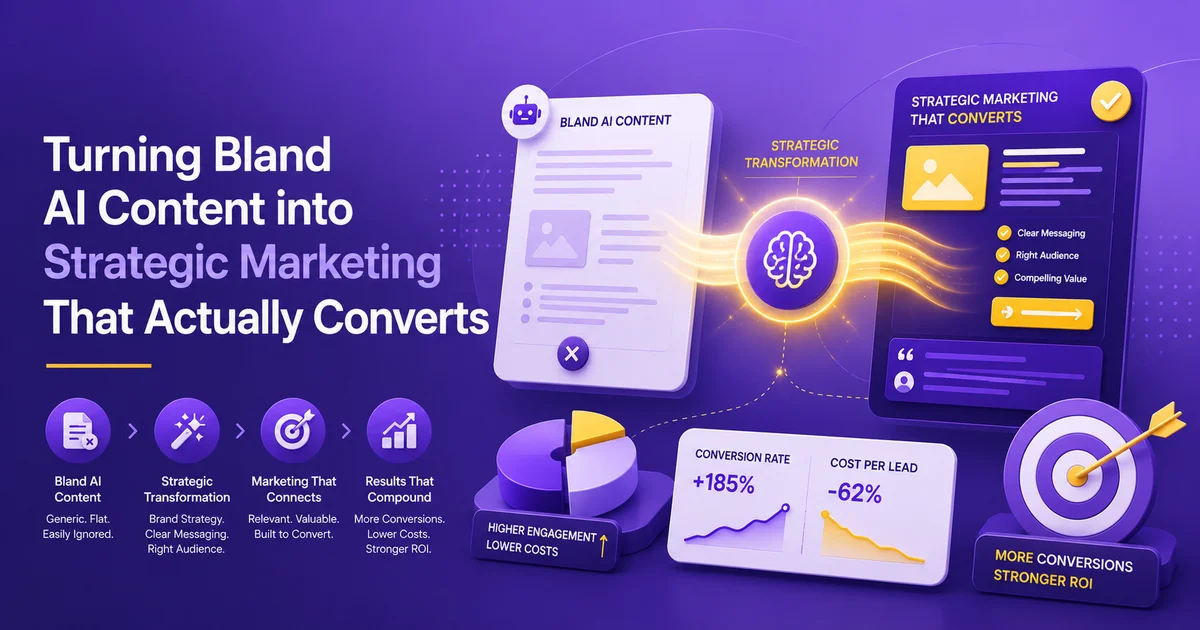
Most businesses jump into AI content creation hoping to solve their marketing efficiency problem. They generate blog posts, social media captions, and website copy in minutes instead of hours. But there's a catch: when everyone uses the same prompts and tools, everything starts to sound the same. Your AI-generated content blends into the background noise, failing to connect with your specific audience or communicate what makes your business different.
The solution isn't avoiding AI tools entirely. It's using them strategically with a clear brand foundation that guides every piece of content you create. When you know your core message, your buyer's journey, and your competitive position, AI becomes a powerful amplifier of your unique brand voice instead of a generic content machine.
Why Generic AI Content Fails to Convert
Generic AI content fails because it lacks the strategic foundation that drives real marketing results. When you feed a tool a basic prompt like "write a blog post about customer service," it produces surface-level content that could apply to any business in any industry.
The problem runs deeper than just bland writing. Without understanding your specific buyer's psychology, your competitive landscape, and your unique value proposition, AI tools default to the most common, safe approaches. They pull from patterns across millions of pieces of content, creating something that sounds professional but says nothing distinctive.
This generic approach wastes more than just time. It wastes advertising spend when your content doesn't convert. It confuses potential customers who can't figure out why they should choose you over competitors. It forces your sales team to work harder because your marketing materials don't do the heavy lifting of differentiation and positioning.
The businesses that succeed with AI content have something different: a clear strategic framework that informs every piece of content they create. They know exactly who they're talking to, what problems they solve, and how they're different from everyone else in their market.
1. Build Your Content Around Specific Buyer Stages
Most businesses create content without understanding where their prospects are in the buying process. They write generic pieces that try to serve everyone and end up serving no one effectively. Strategic content creation starts with mapping your buyer's journey and creating targeted messages for each stage.
Your prospects move through distinct phases before making a purchase decision. In the early awareness stage, they're identifying and researching their problem. During consideration, they're evaluating different solutions and approaches. At the decision stage, they're comparing specific vendors and making final choices.
Each stage requires different information and different messaging approaches. Someone just recognizing they have a problem needs educational content that helps them understand their situation. Someone ready to buy needs detailed comparisons, case studies, and proof points that demonstrate your specific expertise.
When you understand these stages, you can prompt AI tools with much more precision. Instead of asking for "content about our services," you can request "an educational blog post for prospects who are just realizing they need help with inventory management" or "a comparison guide for decision-makers evaluating different accounting software options."
This stage-specific approach transforms generic AI output into targeted content that actually moves prospects through your sales process. The tool still does the heavy lifting of writing, but your strategic framework ensures the content serves a specific purpose for specific people at specific moments.
Creating Stage-Specific Content Prompts
Start by identifying the key questions your prospects ask at each stage of their journey. Early-stage prospects ask broad questions about problems and solutions. Mid-stage prospects want to understand different approaches and methodologies. Late-stage prospects need specific details about implementation, pricing, and outcomes.
Map these questions to content types that work best for each stage. Educational blog posts and guides work well for early-stage awareness. Comparison articles and case studies serve mid-stage consideration. Detailed service descriptions and client testimonials support final decision-making.
When you prompt AI tools, include this context. Specify not just what you want to write about, but who you're writing for and what stage of the buying process they're in. This single change will dramatically improve the relevance and effectiveness of your AI-generated content.
2. Inject Industry-Specific Language and Examples
Generic AI content sounds generic because it uses generic language. It relies on broad, safe terminology that applies to any business instead of the specific language your industry uses and your customers recognize.
Every industry has its own vocabulary, common challenges, and familiar examples. Professional services talk about "deliverables" and "scope creep." E-commerce businesses focus on "conversion rates" and "cart abandonment." Manufacturing companies discuss "lead times" and "quality control."
When you use your industry's natural language, your content immediately feels more credible and relevant to your target audience. It demonstrates that you understand their world and speak their language. More importantly, it helps your content rank better in search results because you're using the specific terms your prospects actually search for.
Beyond vocabulary, industry-specific examples make your content more concrete and actionable. Instead of talking about "improving customer satisfaction," discuss specific scenarios your audience faces. A restaurant might talk about handling busy weekend rushes. A law firm might address client communication during complex litigation.
Research Your Industry's Language Patterns
Before creating content, research how your industry talks about common problems and solutions. Look at trade publications, industry forums, and competitor websites. Pay attention to the specific terms, phrases, and examples they use consistently.
Create a reference document with industry-specific terminology, common pain points, and relevant examples. Use this as context when prompting AI tools. Instead of generic prompts, provide specific industry context that guides the tool toward more targeted, relevant output.
This approach works particularly well for service businesses that need to demonstrate deep industry expertise. When your content uses the right language and addresses specific industry challenges, prospects immediately recognize that you understand their world.
3. Develop Your Unique Perspective and Methodology
The most effective businesses don't just offer services - they have a unique point of view about how their industry should work. They've developed proprietary methodologies, frameworks, or approaches that differentiate them from standard competitors.
This unique perspective becomes the foundation for all your content. Instead of writing generic pieces about "the importance of good customer service," you write about your specific approach to customer retention or your proprietary framework for handling client onboarding.
Your methodology might be a structured process you've developed through years of client work. It could be a unique way of thinking about common problems. It might be a combination of services that no one else offers together. Whatever it is, this becomes your content's competitive advantage.
When you prompt AI tools, you're not asking for generic content about broad topics. You're asking for content that explains, supports, or applies your specific methodology. This ensures every piece of content reinforces your unique market position.
Codifying Your Approach
Most businesses have unique approaches but haven't clearly articulated them. Start by identifying what you do differently from competitors. Look at your most successful client outcomes and reverse-engineer the process that created those results.
Document your methodology in clear, repeatable steps. Give it a name that you can reference consistently across all content. Create supporting frameworks, checklists, or tools that demonstrate your approach in action.
Use this documented methodology as the foundation for all content creation. When you prompt AI tools, reference your specific approach and ask for content that explains or applies it. This transforms generic advice into distinctive, branded content that positions you as a thought leader.
4. Leverage Customer Stories and Real Results
Generic AI content relies on hypothetical examples and theoretical benefits. Strategic content uses real customer stories and specific outcomes to demonstrate value and build credibility.
Your customer success stories provide the raw material for compelling, differentiated content. These stories show exactly how your unique approach works in practice and what results it delivers. They're impossible for competitors to replicate because they're based on your actual client relationships and outcomes.
Customer stories work across all content types. Blog posts can feature detailed case studies. Social media content can highlight specific client wins. Website copy can include customer quotes and transformation stories. Each piece of content becomes more credible and persuasive when it's grounded in real experience.
When you prompt AI tools with specific customer scenarios and outcomes, the resulting content automatically becomes more concrete and actionable. Instead of generic advice, you get content that shows exactly how your approach works in practice.
Mining Your Client Experience
Review your client files to identify compelling transformation stories. Look for clients who achieved significant, measurable results through your work. Focus on outcomes that clearly demonstrate your unique value proposition.
Document these stories with specific details: the client's initial situation, the challenges they faced, your specific approach, and the measurable outcomes. Include quotes from clients whenever possible - their words carry more credibility than your own claims.
Use these documented stories as inputs for AI content creation. Prompt the tools to create content that explains the lessons from specific client experiences or applies successful approaches to new situations. This grounds your content in reality and makes it immediately more credible.
5. Create Content Pillar Systems That Reflect Your Expertise
Most businesses create content randomly, jumping from topic to topic without any strategic coherence. Effective content creation follows a pillar system that consistently reinforces your key areas of expertise and thought leadership.
Content pillars are the 3-5 core topics that your business can own in its market. They represent your unique expertise and the areas where you want to be known as a thought leader. Every piece of content you create should support one of these pillars.
For a marketing agency, content pillars might include brand strategy, conversion optimization, and customer retention. For a consulting firm, they might cover operational efficiency, team development, and strategic planning. For a service business, they might focus on customer experience, process improvement, and industry expertise.
When you create content within a pillar system, every piece reinforces your overall positioning. Blog posts, social media content, and website copy all work together to build recognition in your core expertise areas. Over time, this creates powerful thought leadership that's impossible to achieve with random content creation.
Building Your Pillar Framework
Start by identifying the 3-5 areas where your business has unique expertise or perspective. These should align with your service offerings but go deeper than just describing what you do. They should represent the big ideas you want to own in your market.
For each pillar, develop supporting sub-topics, common questions, and key messages. Create a content calendar that ensures you're regularly producing content for each pillar. This systematic approach ensures your content strategy builds cumulative authority over time.
When prompting AI tools, specify which content pillar each piece supports. Ask for content that advances your thought leadership in that specific area. This ensures every piece of content contributes to your long-term positioning goals.
Making Pillars Work for Service Businesses
Service businesses often struggle with content creation because their work feels too specific or specialized to generate broad appeal. Content pillars solve this problem by identifying the underlying expertise that makes your specific services valuable.
A financial planner doesn't just create content about retirement planning and investment management. They create content around their pillars of "financial security," "wealth building," and "risk management." These broader themes allow for more varied content while still reinforcing core expertise.
The key is connecting your specific services to larger themes that your target audience cares about. This allows you to create educational, thought leadership content that builds trust and positions you as an expert without simply describing your services.
What the Data Says
87% of B2B marketers report that AI-generated content requires significant editing to meet their brand standards, according to the Content Marketing Institute's latest research. This suggests most businesses struggle to create on-brand content with AI tools.
Content that includes specific industry examples gets 3x more engagement than generic advice content, based on social media performance data from 2024. Industry-specific content clearly resonates better with target audiences.
Companies with documented brand messaging frameworks see 23% higher conversion rates from their content marketing efforts, according to recent marketing effectiveness studies. Strategic foundation drives better results.
73% of buyers report that generic content makes it harder to differentiate between vendors in their decision-making process, per recent B2B purchasing research. Generic content actively hurts competitive positioning.
Businesses using customer success stories in their content see 45% more qualified leads than those relying on theoretical benefits, according to lead generation performance data from 2024. Real stories outperform generic claims.
Common Questions About AI Content Customization
Q: How do I know if my AI content sounds too generic?
Read your content out loud and ask yourself if it could apply to any of your competitors. If you can imagine your biggest competitor publishing the exact same piece with their logo, it's too generic. Effective content should clearly reflect your unique perspective and approach.
Q: Can I use the same AI prompts as other businesses in my industry?
Using the same prompts as competitors guarantees generic results. Your prompts should include your specific methodology, target audience details, and unique value proposition. The more specific your inputs, the more differentiated your outputs will be.
Q: How often should I update my content strategy to avoid sounding repetitive?
Focus on deepening your expertise rather than constantly changing topics. Your content pillars should remain stable, but you should continuously develop new angles, examples, and applications within those pillars. Consistency builds authority better than constant change.
Q: What's the biggest mistake businesses make when customizing AI content?
The biggest mistake is trying to customize at the output level instead of the strategy level. Editing generic AI content to sound less generic is much harder than starting with strategic inputs that generate differentiated content from the beginning.
Key Takeaways
- Generic AI content fails because it lacks the strategic foundation that drives marketing results - know your buyer's journey, competitive position, and unique value before creating any content.
- Stage-specific content targeting transforms basic AI output into precise messages that move prospects through your sales process at exactly the right moment.
- Industry-specific language and examples immediately make your content more credible and relevant to your target audience while improving search rankings.
- Your unique methodology or perspective should guide every content creation decision, ensuring each piece reinforces your competitive differentiation.
- Real customer stories and documented outcomes provide the concrete details that separate your content from theoretical, generic advice that anyone could publish.
How Your Brand Blueprint Can Help with This
Your Brand Blueprint includes detailed buyer's journey mapping and content pillar frameworks that solve exactly this customization challenge. The Buyer's Journey section identifies the specific questions prospects ask at each stage, while the Brand Profile & Content Pillars section gives you the strategic themes that should guide all content creation.
Ready to put this into practice? BrandBlueprint.ai builds your complete brand messaging strategy -- including the section that covers exactly what we talked about here.