
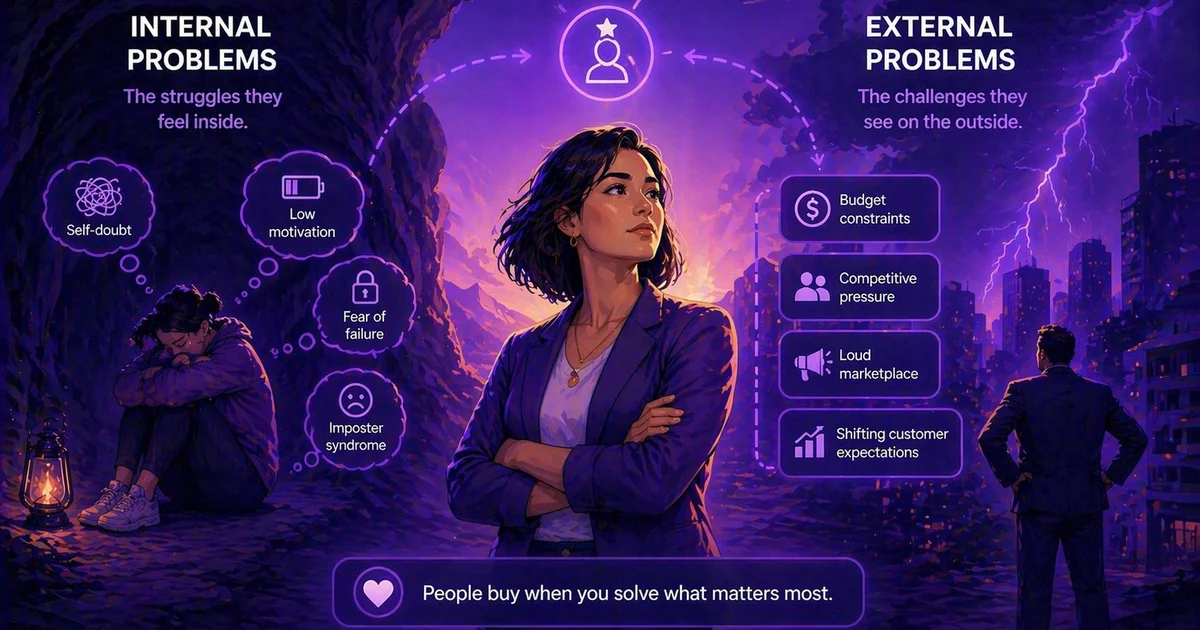
Most small business owners think they sell solutions to external problems. A plumber fixes broken pipes. A financial advisor manages investments. A fitness coach helps people lose weight. But here's what actually drives customer experience improvement and creates competitive advantage: people buy based on internal problems you solve, not just external ones.
Internal problems are the emotional, psychological, and aspirational challenges customers face, while external problems are the practical, visible issues they need resolved. Customers make purchasing decisions primarily based on how you address their internal problems, but they justify those decisions with external problem solutions.
The Hidden Psychology Behind Purchase Decisions
When someone calls a plumber about a broken pipe, they're not just buying pipe repair. They're buying peace of mind, the removal of stress, and the restoration of normalcy in their home. The external problem is water flooding their kitchen. The internal problem is feeling helpless, frustrated, and worried about potential damage to their most valuable asset.
This distinction transforms how you approach your brand messaging. Companies that only address external problems compete on price and features. Those that connect with internal problems build loyalty and command premium pricing.
Research shows that approximately 38.6% of consumers exhibit impulse purchasing based on emotional drive, demonstrating that feelings often override logic in buying decisions. The most successful brands understand this dynamic and craft their messaging accordingly.
Consider how luxury car brands operate. BMW doesn't just sell transportation from point A to point B. They sell the internal transformation of feeling successful, confident, and in control. Their "Ultimate Driving Machine" positioning speaks directly to how you want to feel behind the wheel, not just how the engine performs.
Why External Problems Aren't Enough
External problems are table stakes. Every business in your category solves similar external issues. What creates competitive advantage is how you understand and address the deeper, internal struggles your customers face.
Here's the key difference in action:
External Problem Focus:
- "We repair HVAC systems quickly"
- "Our tax preparation is accurate and thorough"
- "We provide comprehensive insurance coverage"
- "Our consulting improves operational efficiency"
Internal Problem Focus:
- "We restore comfort to your home so you can focus on what matters most to your family"
- "We handle the stress and confusion of tax season so you can sleep soundly"
- "We protect what you've worked your whole life to build"
- "We eliminate the overwhelm of running a growing business"
The external version describes what you do. The internal version describes what life feels like after you've done it.
The Three Layers of Customer Problems
Every customer faces problems at three distinct levels, and understanding all three gives you the complete picture of why they buy.
External Problems: The Visible Challenge
These are the obvious, practical issues customers can easily articulate. A restaurant owner needs more customers. A homeowner has a leaky roof. A small business needs better accounting software.
External problems are important because they initiate the buyer's journey. Something breaks, performs poorly, or stops working entirely. This creates the conscious awareness that a solution is needed.
But external problems alone don't explain customer loyalty or why some businesses thrive while others struggle. They're necessary but not sufficient for building a lasting brand.
Internal Problems: The Emotional Reality
Internal problems are how external problems make people feel. They're harder to articulate but far more powerful in driving decisions. The restaurant owner doesn't just need more customers - they feel anxious about making payroll, worried about their family's future, and frustrated that their hard work isn't paying off.
The homeowner with a leaky roof doesn't just need repair work. They feel vulnerable, concerned about protecting their investment, and stressed about finding trustworthy contractors who won't take advantage of them.
Internal problems tap into universal human emotions: fear, frustration, anger, confusion, helplessness, and the desire for peace, confidence, and control. When you address these feelings directly, customers feel understood at a deeper level.
Philosophical Problems: The Bigger Picture
These represent what's wrong with the world when external problems persist. They're about injustice, unfairness, or things that "shouldn't happen." A philosophical problem for the restaurant owner might be that small businesses are the backbone of communities, and they deserve to succeed when they work hard and serve others well.
For the homeowner, it might be that everyone deserves to feel secure and protected in their own home, and predatory contractors who exploit vulnerable homeowners are undermining that basic right.
Philosophical problems position your business as more than a vendor - you become a champion fighting for what's right. This creates powerful emotional connections and turns customers into advocates.
How Internal Problems Drive Customer Experience Improvement
When you understand your customers' internal problems, every touchpoint becomes an opportunity to address them. This dramatically improves the customer experience because you're solving problems they didn't even know they could articulate.
Take a home security company. The external problem is protecting property from break-ins. The internal problem is the fear and anxiety of not feeling safe in your own home. The philosophical problem is that families deserve to feel secure and protected.
A company focused only on external problems markets features: cameras, sensors, monitoring services. Their customer experience revolves around technical specifications and response times.
A company that understands internal problems designs experiences around peace of mind. Their sales process acknowledges the emotional weight of security concerns. Their installation team explains not just what they're doing, but how each component contributes to family safety. Their monitoring service proactively communicates, knowing that silence creates anxiety.
The result is customers who feel understood, valued, and genuinely cared for - not just sold to.
The Messaging Framework That Converts
Effective brand messaging follows a specific pattern that addresses problems in order of psychological importance:
- Lead with the internal problem to create immediate emotional connection
- Acknowledge the external problem to demonstrate practical understanding
- Hint at the philosophical problem to elevate the stakes and your role
Here's how this looks in practice:
For a Financial Advisor:
Internal: "Money stress is keeping you awake at night, and you're tired of feeling anxious about your family's future."
External: "Creating a comprehensive financial plan that actually works for your situation is more complex than it should be."
Philosophical: "Everyone who works hard and makes responsible choices deserves financial peace of mind."
For a Marketing Consultant:
Internal: "You started your business to make a difference, but you feel invisible in a crowded market, and that's incredibly frustrating."
External: "Getting consistent, quality leads without spending a fortune on advertising seems impossible."
Philosophical: "Great businesses with valuable services shouldn't struggle to connect with the people who need them most."
This framework works because it mirrors how customers actually experience their problems - feelings first, facts second, values third.
Common Mistakes When Addressing Internal Problems
Many businesses that attempt to address internal problems make critical errors that undermine their effectiveness.
Being Too Dramatic or Manipulative
Internal problems are real emotional experiences, but exploiting them for sales purposes backfires. Heavy-handed emotional manipulation feels inauthentic and damages trust. The goal is acknowledgment and understanding, not exploitation.
Assuming All Customers Have the Same Internal Problems
Different customer segments face different internal challenges, even when they share external problems. A first-time homebuyer and someone downsizing in retirement both need real estate services, but their internal problems are completely different.
Focusing Only on Negative Emotions
While many internal problems involve negative feelings, customers also have positive aspirations. They want to feel proud, accomplished, confident, and successful. Address both the problems you solve and the positive feelings you enable.
Making It About You Instead of Them
Internal problems are about customer emotions, not your expertise or credentials. Saying "we understand your frustration" is less powerful than describing the frustration in detail and offering a path forward.
Competitive Advantage Through Problem Understanding
Most businesses compete by claiming to solve external problems better, faster, or cheaper than competitors. This creates a race to the bottom where price becomes the primary differentiator.
Understanding internal problems creates sustainable competitive advantage because emotional connections are much harder to replicate than features or pricing. When customers feel genuinely understood and cared for, they become loyal regardless of competitive offerings.
Social status and culture rank as top external influences, but internal emotional drivers often override these factors when businesses address them effectively.
Consider two accounting firms. Firm A markets superior software, faster turnaround times, and competitive pricing. Firm B understands that small business owners feel overwhelmed by financial complexity and worried about making costly mistakes that could threaten their business.
Firm A competes on external factors. Firm B owns the internal problem space. Which one do you think builds stronger client relationships and commands higher fees?
Building Your Internal Problem Strategy
Start by getting beyond surface-level customer feedback. When customers tell you what they need, dig deeper into how their current situation makes them feel and what they're really trying to achieve.
Conduct interviews that explore emotional experiences, not just functional requirements. Ask questions like:
- "Describe how this problem affects your daily life"
- "What's the worst part about dealing with this situation?"
- "How would you feel if this problem went away completely?"
- "What would be different about your life or business if this was resolved?"
Look for patterns in emotional language, not just rational descriptions. Customers might use different words to describe the same external problem, but they often use remarkably similar emotional language to describe how those problems make them feel.
Document both what customers say and how they say it. Their specific words for describing frustration, worry, excitement, or relief become powerful messaging elements because they feel authentic and familiar.
The Implementation Advantage
Understanding internal problems isn't just about marketing and sales - it should influence every aspect of how you deliver value. Your service process, communication style, follow-up procedures, and problem resolution approaches should all acknowledge and address the emotional dimensions of customer experience.
This creates a powerful feedback loop where your improved customer experience leads to stronger testimonials and word-of-mouth referrals that specifically mention how you made customers feel, not just what you accomplished for them.
When customers say things like "they made me feel confident throughout the entire process" or "I finally felt like someone understood what I was going through," you've successfully positioned your business around internal problems.
What the Data Says
- 38.6% of consumers exhibit impulse purchasing based on emotional drive, demonstrating that feelings often override rational decision-making in purchase behavior
- Social status and culture rank as top external influences on buying behavior, yet internal emotional drivers frequently supersede these factors when businesses address them directly
- Problem recognition in the buyer decision process begins with internal stimuli (personal needs) or external stimuli, with internal factors often proving more powerful for long-term customer relationships
- Internal factors affecting purchases include motivation, perception, attitudes, personality, and values, creating multiple touchpoints for businesses to connect with customers emotionally
- Marketing strategies rank among key external factors, but only succeed when they acknowledge and address underlying internal customer problems
Frequently Asked Questions
What's the difference between internal and external problems in customer decision-making?
External problems are the practical, visible issues customers need resolved (broken equipment, lack of leads, financial planning needs). Internal problems are how those external issues make customers feel (stressed, frustrated, worried, helpless). Customers buy based on internal problems but justify purchases with external ones.
How do I identify my customers' internal problems?
Conduct in-depth interviews focusing on emotions rather than features. Ask how their current situation affects daily life, what's most frustrating about their problem, and how they'd feel if it was completely resolved. Look for emotional language patterns across multiple customer conversations.
Can addressing internal problems help me charge higher prices?
Yes. When customers feel genuinely understood and emotionally connected to your solution, they're less price-sensitive. Emotional connections create loyalty and perceived value that transcends cost comparisons with competitors who only address external problems.
Should I ignore external problems and focus only on internal ones?
No. External problems are important because they initiate the buyer's journey and provide rational justification for purchase decisions. The most effective approach acknowledges external problems while emphasizing how solving them addresses deeper internal concerns.
How do internal problems relate to customer retention?
Customers who feel emotionally understood and valued stay longer and refer more business. When you consistently address internal problems through your service delivery, communication, and follow-up processes, you create experiences that competitors focused only on external problems can't replicate.
Key Takeaways
- Customers make purchasing decisions based primarily on internal emotional problems, but justify those decisions with external practical concerns
- The most effective brand messaging acknowledges internal problems first, then demonstrates understanding of external problems and hints at philosophical stakes
- Competitive advantage comes from understanding and addressing internal problems because emotional connections are harder for competitors to replicate than features or pricing
- Customer experience improvement requires designing every touchpoint to address both practical needs and emotional concerns
- Implementation should extend beyond marketing to influence service delivery, communication styles, and problem resolution approaches
How Your Brand Blueprint Can Help with This
Your Brand Blueprint's 360 View section specifically identifies customer psychographics and pain points, uncovering both the external challenges and internal emotional struggles your ideal clients face. The Buyer's Journey section then maps how these problems evolve throughout their decision-making process, while the Brand Messaging section translates this understanding into compelling messages that connect with customers at an emotional level. Ready to put this into practice? BrandBlueprint.ai builds your complete brand messaging strategy -- including the section that covers exactly what we talked about here.