
Every business owner knows the frustration of perfect customers slipping away. You create compelling content, run targeted ads, and showcase your best work, but prospects still vanish without buying. The problem isn't your product or service quality. It's that your small business marketing treats all potential customers the same when they're actually at completely different stages of readiness to buy.
Small businesses lose customers daily by using one-size-fits-all marketing messages that only speak to prospects ready to purchase immediately, while ignoring the 80% of their audience that needs different information at earlier stages of the customer journey.
The 5 Stages of Customer Awareness — And Why Most Small Businesses Only Talk to One
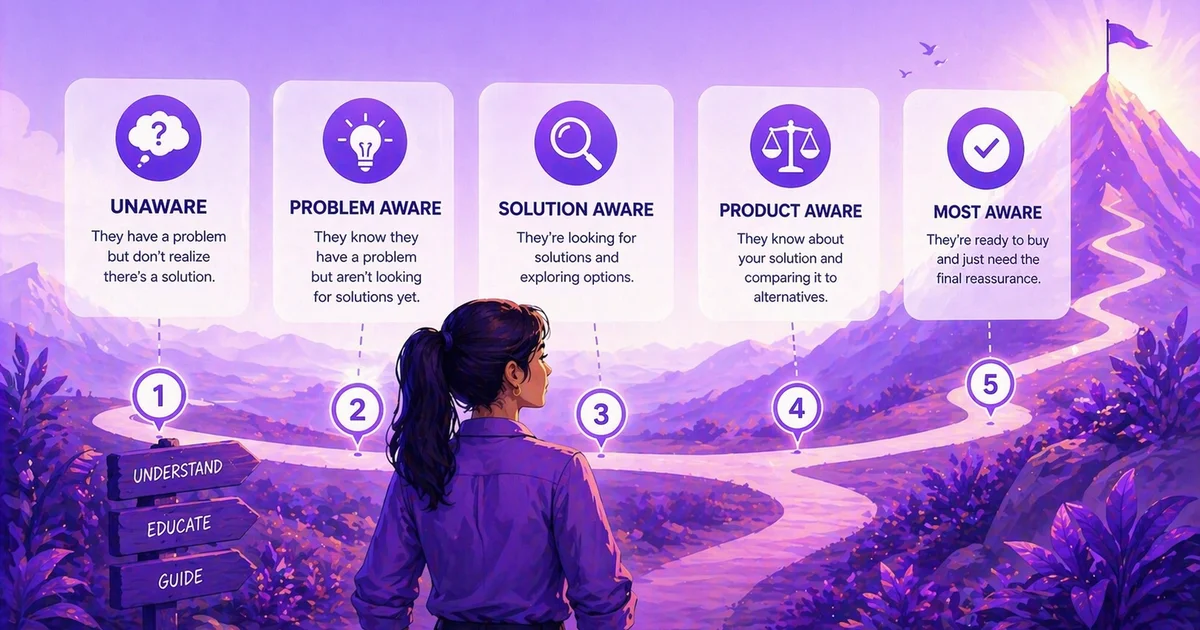
Most businesses craft their entire marketing strategy around customers who already know they need their service and are comparing options. This approach captures the low-hanging fruit but misses the majority of their potential market. The five stages of customer awareness reveal why your current messaging strategy might be costing you more customers than it's winning.
The framework, originally developed by copywriting legend Eugene Schwartz, identifies five distinct types of customers based on how aware they are of their problem and your solution. Each type needs fundamentally different messaging to move toward a purchase.
Stage 1: The Unaware Customer
These prospects don't know they have a problem that your business solves. A homeowner with rising energy bills doesn't realize their HVAC system is inefficient. A small business owner struggling with cash flow doesn't connect it to poor invoicing processes. A real estate agent losing listings doesn't see how their generic marketing messages blend into the noise.
Unaware customers need education, not sales pitches. Marketing to this group requires raising awareness about the problem itself before introducing any solution. Content for unaware prospects focuses on symptoms, consequences, and helping them diagnose what's really happening in their situation.
For an HVAC company, this might be blog posts about "Why Your Energy Bills Keep Rising" or "5 Signs Your Home Isn't as Comfortable as It Should Be." The goal isn't to sell a service call immediately. It's to help prospects realize they have a problem worth solving.
Most small businesses completely ignore unaware customers because the payoff seems distant. But this group often represents your largest potential market. They're not yet shopping your competitors because they don't know they need to shop at all.
Stage 2: The Problem-Aware Customer
Problem-aware customers know something is wrong but haven't figured out what to do about it. They're researching, asking questions, and trying to understand their options. They may have seen your social media posts and know you exist, unlike completely unaware prospects, but they're not ready to evaluate specific service providers yet.
A homeowner knows their house feels uncomfortable and their energy bills are too high, but they don't know if they need repairs, replacement, maintenance, or something else entirely. A business owner knows they're losing money somewhere but hasn't pinpointed whether it's a marketing problem, operations issue, or pricing strategy.
Problem-aware customers need guidance and education about solutions, not product details. Your messaging should focus on the range of approaches available, how to think about their situation, and what questions to ask. This builds trust and positions your business as knowledgeable before they start comparing specific providers.
Content for problem-aware customers includes comprehensive guides, comparison articles between different approaches, and educational content that helps them understand their options. An HVAC company might create content about "Repair vs. Replace: How to Decide What Your System Needs" or "Understanding the Real Causes of High Energy Bills."
Stage 3: The Solution-Aware Customer
Solution-aware customers understand their problem and know what type of solution they need, but they haven't identified which specific company or product to choose. They know they need HVAC repair, marketing help, or financial planning, but they're not evaluating individual providers yet.
These prospects are researching the solution category. They want to understand how services work, what to expect from the process, typical costs, and how to choose the right provider. They're building their knowledge before they start getting quotes or scheduling consultations.
Solution-aware customers need confidence and criteria for choosing well. Your content should establish expertise while helping them understand what separates good providers from poor ones. This positions your business as the expert authority while giving them a framework that naturally favors your approach.
An accounting firm targeting solution-aware prospects might create content about "What to Expect from Professional Financial Planning" or "5 Questions Every Good Financial Planner Should Ask You." The goal is building confidence in the solution category while establishing your expertise and approach.
Stage 4: The Product-Aware Customer
Product-aware customers know they want your type of solution and they know your business exists as an option. They're comparing you directly to your competitors, evaluating features, pricing, processes, and fit. Marketing messages here should focus on differentiating your product from competitors, highlighting unique benefits and value propositions.
These prospects visit your website, read your case studies, and might request quotes or consultations. They're looking for reasons to choose you specifically. They need content that addresses last-minute concerns with FAQ pages, testimonials, and detailed process explanations.
Product-aware customers need proof and differentiation. They want to see your work, understand your process, and feel confident you're the right choice. Social proof becomes critical at this stage. Detailed case studies, client testimonials, and transparent explanations of your approach matter more than general benefits.
Most small businesses focus heavily on this stage because these prospects feel "sales-ready." But concentrating only here means missing the larger pool of customers in earlier stages who could become product-aware with proper nurturing.
Stage 5: The Most-Aware Customer
Most-aware customers have decided to work with you specifically. They're ready to buy but need the process made simple and obstacles removed. Your job isn't to sell them on buying, it's to make it as easy as possible for them to say yes.
These customers might be returning clients, referrals from happy customers, or prospects who've been thoroughly convinced through your nurturing process. They need clear next steps, simple purchasing processes, and confidence that they're making the right decision.
Most-aware customers need simplicity and assurance. Don't make the mistake of neglecting this customer for new acquisition work. Make it easy to move forward with clear calls-to-action, streamlined processes, and immediate confirmation they've made a good choice.
They're yours to lose, so remove friction and provide exceptional experience from the first interaction through project completion.
Why Most Small Businesses Only Market to Stage 4 Customers
Small business owners gravitate toward product-aware customers (Stage 4) because they seem like the fastest path to revenue. These prospects are actively comparing options, requesting quotes, and appear ready to buy immediately. It feels more productive to spend time with someone who might purchase this week rather than educate someone who won't buy for months.
This approach creates several hidden problems that limit growth and increase customer acquisition costs.
The Competition Problem
When you only target customers actively shopping, you're competing in the most crowded space. Every competitor is fighting for the same small pool of ready-to-buy prospects. This drives up advertising costs, forces price competition, and makes differentiation harder.
Prospects comparing multiple providers often choose based on price or convenience rather than value. They haven't been educated about what makes one provider better than another because they're focused on making a quick decision.
The Relationship Problem
Customers who first encounter your business while comparing final options have no relationship with you. They haven't learned from your expertise or been helped by your guidance. You're just another name on their list of providers to evaluate.
Contrast this with customers who discovered your business while researching their problem, learned from your educational content, and developed trust in your expertise over time. By the time they're ready to buy, the relationship already exists and the decision becomes much easier.
The Volume Problem
The pool of ready-to-buy customers is always small compared to the total market of people who will eventually need your service. Focusing exclusively on Stage 4 customers means missing the much larger group of future customers currently in earlier stages.
A landscaping company targeting only homeowners actively requesting quotes might reach 50 prospects per month. But hundreds more homeowners in their service area are beginning to notice yard problems, researching solutions, or considering whether to DIY or hire professionals. These early-stage prospects represent the majority of future revenue.
The Sustainability Problem
Your audience isn't monolithic, but single-stage marketing treats them as if they are. This creates an exhausting cycle where you're constantly hunting for new ready-to-buy customers instead of developing a pipeline of prospects moving through the awareness stages.
Businesses that only target Stage 4 customers often experience feast-or-famine revenue cycles because they have no systematic way to create future demand.
The Hidden Costs of Single-Stage Marketing
Focusing exclusively on ready-to-buy customers creates costs that most small business owners never calculate. These hidden expenses add up to significant lost revenue and wasted marketing investment.
Higher Customer Acquisition Costs
Competition for Stage 4 customers drives up the cost of reaching them through advertising platforms. Google Ads keywords like "emergency plumber near me" or "hire accountant" command premium prices because every provider wants to capture those high-intent searches.
Meanwhile, keywords targeting earlier awareness stages often cost significantly less because fewer businesses compete for them. Content targeting problem-aware customers can attract prospects at a fraction of the cost while building relationships that convert later.
Shorter Customer Relationships
Customers who choose you based primarily on price or convenience have weak loyalty. They haven't developed a relationship with your business or deep understanding of your value. When another provider offers a lower price or more convenient option, they switch easily.
Customers who discovered your business early in their journey and learned from your expertise over time become much stronger advocates. They understand your value proposition, trust your recommendations, and refer others because they've experienced your knowledge firsthand.
Limited Market Share Growth
Single-stage marketing caps your growth potential at the size of your immediate market. You can only capture prospects currently ready to buy, which represents a small fraction of people who will eventually need your service.
Businesses that nurture prospects through all awareness stages effectively expand their addressable market. They're building relationships with future customers before competitors have any contact with them.
How to Identify Which Stage Your Customers Are In
Understanding customer awareness stages is only valuable if you can recognize where specific prospects and marketing channels fit. Different marketing activities and customer touchpoints naturally attract people at different awareness levels.
Mapping Your Current Marketing to Awareness Stages
Most small businesses unknowingly concentrate their marketing in Stage 4 without realizing it. Review your current marketing messages and content through the awareness stage lens.
Stage 4 (Product-Aware) marketing includes:
- Service pages describing what you do
- Case studies and testimonials
- Pricing information and service packages
- "Get a quote" or "Schedule consultation" calls-to-action
- Google Ads targeting service-specific keywords
Stage 3 (Solution-Aware) marketing includes:
- Educational content about choosing providers
- Process explanations and methodology content
- Industry insight and expertise demonstration
- "How to choose" guide content
Stages 1 and 2 marketing includes:
- Problem symptom and diagnostic content
- Industry trend and insight sharing
- Educational webinars and workshops
- Social media content addressing common challenges
Most small business marketing heavily skews toward Stage 4, with some Stage 3 content. Stages 1 and 2 often get completely ignored because they don't generate immediate sales calls.
Customer Behavior Indicators by Stage
Different customer behaviors signal which awareness stage someone is currently in. Understanding these patterns helps you deliver appropriate messaging and avoid pushing prospects before they're ready.
Unaware stage behaviors:
- Consuming general industry content without specific focus
- Asking broad questions about symptoms or situations
- Not using solution-specific terminology in their language
- Showing interest in educational content but not service pages
Problem-aware stage behaviors:
- Searching for symptom-related information
- Asking "why" questions about their situation
- Engaging with diagnostic and educational content
- Beginning to use some problem-specific language
Solution-aware stage behaviors:
- Researching different approaches and methodologies
- Asking "how" questions about processes
- Consuming comparison content between solution types
- Using solution category terminology correctly
Product-aware stage behaviors:
- Comparing specific providers and companies
- Requesting information about your specific services
- Reading case studies and testimonials
- Asking about pricing, timelines, and processes
Most-aware stage behaviors:
- Ready to discuss implementation details
- Asking about next steps and logistics
- Seeking confirmation rather than evaluation
- Using language that assumes they'll work with you
Creating Content for Each Awareness Stage
Your job isn't to rush people through the stages, it's to meet them where they are so you can guide them naturally toward a purchase. This requires different content strategies and messaging approaches for each stage.
Stage 1: Educational and Diagnostic Content
Unaware customers need help recognizing and understanding their situation. Content for this stage focuses on symptoms, consequences, and helping prospects diagnose what's happening.
Effective Stage 1 content examples:
- "5 Signs Your Marketing Isn't Working (And You Might Not Notice)"
- "Why Small Businesses Fail in Their First Five Years"
- "The Hidden Costs of DIY Bookkeeping"
- "How to Tell if Your HVAC System Is Costing You Money"
This content avoids mentioning your services directly. Instead, it helps readers understand their situation better and recognize when they have a problem worth addressing. The goal is moving them from unaware to problem-aware.
Stage 2: Solution Category Education
Problem-aware customers need to understand their options and how to think about solutions. Content for this stage introduces solution categories without promoting specific providers.
Effective Stage 2 content examples:
- "Outsourced vs. In-House Marketing: How to Decide"
- "Understanding Different Types of Financial Planning"
- "Repair, Maintain, or Replace: HVAC Decision Framework"
- "The Complete Guide to Small Business Legal Protection"
This content establishes your expertise while helping prospects understand the solution landscape. You're positioning yourself as a knowledgeable guide while moving them toward solution awareness.
Stage 3: Methodology and Approach Content
Solution-aware customers want to understand how services work and what makes providers different. Content for this stage explains your approach while helping prospects develop criteria for choosing well.
Effective Stage 3 content examples:
- "Our 5-Step Brand Strategy Process"
- "What to Expect from Professional Financial Planning"
- "How the Best HVAC Companies Diagnose Problems"
- "The Right Way to Handle Small Business Legal Setup"
This content demonstrates your expertise and methodology while giving prospects a framework for evaluation. You're subtly showing why your approach is superior while helping them become more sophisticated buyers.
Stage 4: Proof and Differentiation Content
Product-aware customers need confidence in choosing you specifically over competitors. Content for this stage provides social proof, demonstrates results, and clearly differentiates your value proposition.
Effective Stage 4 content examples:
- Detailed case studies with specific results
- Client testimonials and success stories
- Process explanations and methodology details
- Frequently asked questions and objection handling
This content directly supports the buying decision by providing evidence and addressing concerns. Prospects at this stage need reassurance they're making the right choice.
Stage 5: Conversion and Onboarding Content
Most-aware customers need the buying process simplified and obstacles removed. Content for this stage focuses on next steps, process clarity, and immediate value delivery.
Effective Stage 5 content examples:
- Clear service descriptions and package options
- Streamlined contact forms and scheduling systems
- Onboarding process explanations
- Quick wins and immediate value demonstrations
The focus shifts from persuasion to facilitation. Make it easy for ready customers to move forward without friction or confusion.
What the Data Says
75% of marketing strategies fail because they don't align with where audiences are in their awareness journey. This misalignment costs small businesses customers and revenue daily. Research shows that businesses successfully engaging prospects at all awareness stages see 20-40% higher conversion rates compared to those focusing only on ready-to-buy customers.
The most successful small businesses distribute their marketing efforts across all five stages, with approximately 20% of content targeting unaware prospects, 25% for problem-aware, 25% for solution-aware, 20% for product-aware, and 10% for most-aware customers. This distribution creates a sustainable pipeline of prospects moving naturally toward purchase decisions.
Building Your Multi-Stage Marketing System
Creating effective customer journey stages marketing requires systematic planning and content distribution across all awareness levels. Start by auditing your current content and identifying gaps in earlier stages.
Month 1: Assess Your Current Stage Coverage
Review all your existing marketing materials and categorize them by awareness stage. Most small businesses discover 70-80% of their content targets Stage 4 customers, with significant gaps in Stages 1 and 2.
Document which stage each piece of content serves and identify the biggest gaps. Focus first on creating Stage 1 and 2 content since these stages are most often neglected.
Month 2-3: Create Early-Stage Content
Develop content that helps unaware prospects recognize problems and understand their options. This content should be educational and helpful without directly promoting your services.
Create blog posts, social media content, and resources that address symptoms and consequences your ideal customers experience. Focus on making people aware of problems they might not realize they have.
Month 4-6: Develop Nurture Sequences
Build email sequences and retargeting campaigns that guide prospects naturally from one awareness stage to the next. Someone who downloads your Stage 1 content should receive Stage 2 information over time.
Create clear progression paths that provide value at each stage while moving prospects closer to purchase readiness. Avoid rushing people or skipping stages.
Ongoing: Monitor and Optimize
Track which content performs best at each stage and optimize based on engagement and conversion data. Different audiences may progress through stages at different speeds or need different types of content.
Pay attention to where prospects typically exit your funnel and create additional content to address those specific gaps or objections.
Key Takeaways
- 80% of your potential market isn't ready to buy immediately but needs different information at earlier customer journey stages
- Most small businesses only target Stage 4 customers, missing the larger pool of future buyers in earlier awareness stages
- Single-stage marketing creates higher costs, stronger competition, and weaker customer relationships
- Different awareness stages require completely different messaging approaches to be effective
- Building relationships early in the customer journey creates stronger loyalty and better conversion rates than competing only for ready-to-buy prospects
- Success requires systematic content distribution across all five awareness stages, not just the final one
Common Questions about Customer Types
Q: How long does it typically take for a customer to move through all awareness stages?
A: The timeline varies significantly by industry and purchase complexity. B2B services might take 6-18 months, while simpler consumer services could be days or weeks. The key is providing value at each stage rather than rushing the process.
Q: Should I create different content for each stage or can one piece serve multiple stages?
A: While some content can address adjacent stages, the most effective approach is creating specific content for each stage. Trying to serve all stages with one piece typically dilutes the message and serves none well.
Q: How do I know which stage a prospect is in when they first contact me?
A: Listen to their language and questions. Unaware prospects ask about symptoms, problem-aware customers want to understand options, solution-aware prospects research methodologies, product-aware customers compare providers, and most-aware customers discuss implementation details.
Q: Is it worth targeting Stage 1 customers if they won't buy for months or years?
A: Absolutely. Stage 1 prospects represent your largest potential market and face the least competition. Building relationships early creates stronger loyalty and higher lifetime value than competing only for ready-to-buy customers.
Q: How much of my marketing budget should go to each stage?
A: A balanced approach typically allocates 20% to Stage 1, 25% each to Stages 2 and 3, 20% to Stage 4, and 10% to Stage 5. Adjust based on your industry and current pipeline needs.
Ready to stop losing customers to competitors who understand awareness stages better than you do? Start by auditing your current content and identifying which stages you're ignoring. Create one piece of Stage 1 content this week and see how it performs compared to your typical Stage 4 marketing. The results might surprise you.
How Your Brand Blueprint Can Help with This
Section 2 of your Brand Blueprint is built entirely around this concept. Called The Buyer's Journey, it maps exactly how your prospects move toward a purchase, identifies the questions they ask at each stage of awareness, and gives you targeted messaging tailored to each point in that journey. Instead of guessing which stage a prospect is in, you'll have a clear framework built specifically around your business and your customers. Ready to put this into practice? BrandBlueprint.ai builds your complete brand messaging strategy, including the section that covers exactly what we talked about here.