
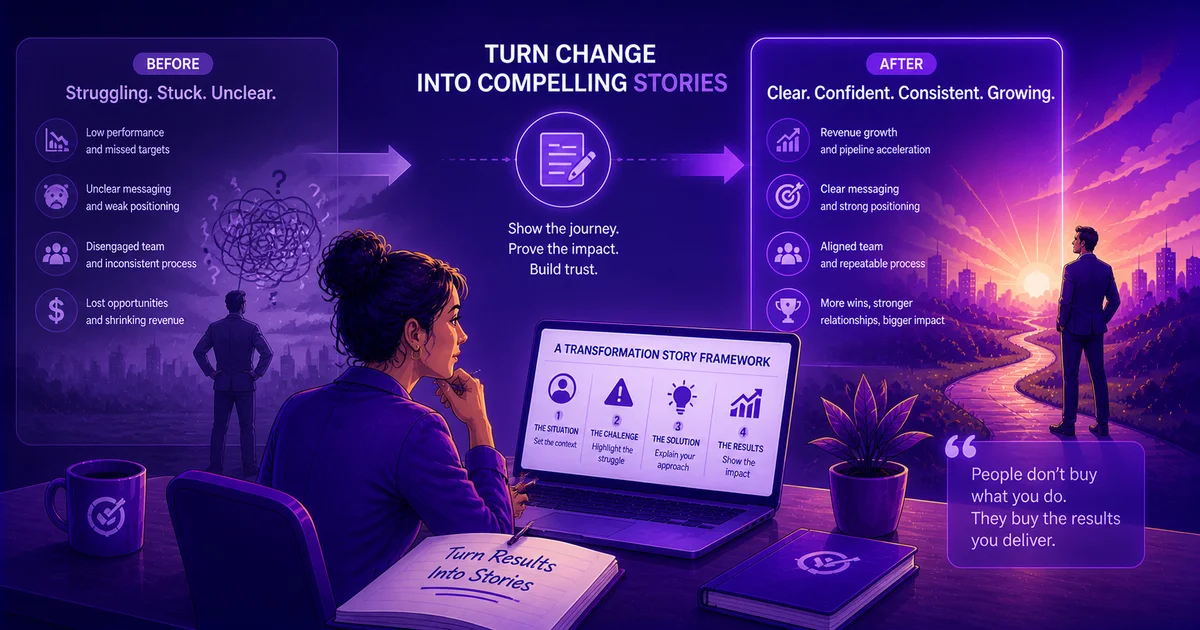
Every business solves problems and creates change, but most struggle to articulate exactly what that transformation looks like. Your business value proposition becomes dramatically more powerful when prospects can visualize their life before and after working with you. The difference between "we help businesses grow" and "we transform chaos into systems that save 10 hours per week" is the difference between forgettable and memorable.
A compelling transformation story distills your business value into a clear before-and-after narrative that prospects can understand and repeat in 60 seconds or less. This elevator pitch script structure moves beyond features and benefits to paint a specific picture of the problem you solve and the measurable outcome you deliver.
Why Transformation Stories Matter More Than Features
Most businesses default to listing what they do instead of describing what changes for their customers. This approach misses how people actually make buying decisions. Prospects don't buy services - they buy better versions of themselves, their businesses, or their situations.
Consider how Monday.com positions their CRM platform. Instead of leading with features like "pipeline management and forecasting tools," their pitch transforms the narrative: "How confident are you in your Q4 forecast right now?" The story moves from "flying blind on revenue predictions" to "real-time pipeline visibility with 25% improved forecast accuracy." That specific transformation - from uncertainty to confidence with measurable results - creates a clear before-and-after picture.
This storytelling approach works because it mirrors how your brain processes problems. When facing a challenge, you naturally envision what success would look like. Transformation stories tap into that mental process by explicitly describing both states.
The 60-Second Transformation Formula
Problem Recognition (15 seconds): Start with a specific pain point your prospect experiences daily. Make it concrete and relatable, not abstract.
Current State Description (15 seconds): Briefly describe the frustration, inefficiency, or gap they're living with right now. Use their language, not industry jargon.
Transformation Bridge (15 seconds): Explain your solution as a bridge between their current state and desired outcome. Focus on the change process, not the service details.
Future State Visualization (15 seconds): Paint a specific picture of their life after working with you. Include measurable outcomes when possible.
The Style Foundry uses this formula effectively in their wardrobe styling pitch. They start with the daily frustration: standing in front of a full closet with nothing to wear. The transformation moves from "closet clutter and morning stress" to "100+ mix-and-match outfits from existing items via our app." The specific outcome - eliminating daily dressing stress while maximizing existing wardrobe value - creates a clear visualization of life improvement.
Building Credible Before-and-After Narratives
Start with Real Client Outcomes
Your transformation story needs concrete evidence, not wishful thinking. Look through your client results for patterns. What consistent changes do you create? How do clients describe their experience before and after working with you?
Merchant Machine built their entire positioning around one clear transformation. Their pitch addresses the common pain of high payment processing costs: "We save you money on credit card processing. Free comparison, no obligations, one minute." The transformation moves from "confusion about processing costs" to "25% savings with instant clarity." The specificity makes it believable and repeatable.
Use Specific Metrics When Available
Vague promises like "better results" or "increased efficiency" lack credibility. When you have real data, use it. Numbers make transformations tangible and memorable.
The sales professional example from Salesforce's pitch guidance demonstrates this principle. Instead of saying "I'm good at sales," the pitch specifies: "I've built a $100 million book of business and consistently grown revenue 15% year-over-year." The transformation story becomes: from companies struggling with sales growth to businesses with proven, repeatable revenue increases.
Address the Emotional Journey
Transformation isn't just about metrics. People buy solutions to problems that frustrate, stress, or overwhelm them. Your story should acknowledge both the emotional current state and the relief that comes with resolution.
Hux, the house cleaning platform, addresses this in their positioning as the "Uber of house cleaning." The transformation moves from "booking hassles with traditional cleaning services" to "instant matches with local cleaners at the tap of a button." The emotional shift from frustration to convenience drives the appeal.
Common Transformation Story Mistakes
The Feature Trap
Many businesses get stuck describing what they do instead of what changes. "We provide accounting services" tells prospects nothing about transformation. "We turn monthly bookkeeping chaos into organized finances that save you 5 hours per week" creates a clear before-and-after picture.
Overselling the After
Your transformation story must be believable. Promising to "revolutionize" or "completely transform" everything sounds like marketing hyperbole. Focus on specific, achievable changes you consistently deliver.
Ignoring the Buyer's Journey Stage
A first-time prospect needs a different transformation story than someone already evaluating solutions. Early-stage buyers need broad problem recognition. Later-stage buyers want specific outcome details. Tailor your 60-second story to where your audience sits in their decision process.
Crafting Your Service Transformation Story
Step 1: Identify Your Core Transformation
List your last 10 successful client engagements. What consistent "before state" did they share? What specific "after state" did you help them achieve? Look for patterns in both the problems you solve and the outcomes you create.
Step 2: Quantify the Change
Wherever possible, attach numbers to your transformation. Time saved, revenue increased, costs reduced, efficiency gained - specific metrics make your story credible and memorable.
Step 3: Test Your Story
Practice your transformation narrative with colleagues, current clients, or networking contacts. Can they repeat the core transformation back to you? Do they ask follow-up questions? A strong story should be both clear and conversation-starting.
Step 4: Adapt for Different Audiences
Your core transformation stays consistent, but the emphasis shifts based on who's listening. A CEO cares about strategic outcomes. An operations manager focuses on efficiency gains. Adjust your 60-second pitch accordingly.
Making Your Transformation Story Stick
Use Concrete Language
Replace abstract terms with specific descriptions. Instead of "improved efficiency," say "eliminated 3 hours of weekly data entry." Instead of "better customer service," say "reduced response time from 24 hours to 2 hours."
Create Visual Contrast
Help prospects see the difference between their current state and their potential future. Uber's classic pitch creates this contrast effectively: from "the hassle of cabs and public transit" to "instantly hail an affordable ride with the tap of a button." The visual difference between waiting on a street corner and summoning transportation via smartphone is immediate and compelling.
End with Forward Motion
Your transformation story should create momentum toward the next conversation. Don't end with your description of the "after state." Close with a question or invitation that moves the relationship forward: "Are you dealing with anything like this?" or "Would you like to see how this might work for your situation?"
Practice the Conversational Version
Your written transformation story might be perfect, but can you deliver it naturally in conversation? Practice until it feels like normal speaking, not a rehearsed pitch. The goal is confident, conversational clarity - not memorized perfection.
Remember that your transformation story evolves as your business grows and your results improve. Regularly revisit and refine your before-and-after narrative based on new client outcomes and market feedback. The most compelling transformation stories feel fresh and current, grounded in recent client successes rather than outdated examples.
What the Data Says
- Sales teams spend 30% of their week on data entry instead of selling activities, according to Monday.com's research. This statistic reveals why transformation stories about efficiency gains resonate so strongly with sales professionals.
- Teams see 25% improvement in forecast accuracy within the first quarter of implementing proper pipeline visibility tools. This specific metric demonstrates how concrete outcomes make transformation stories more believable and compelling.
- Merchant Machine clients achieve 25% reduction in payment processing costs through their comparison platform. This real-world outcome shows how specific savings percentages create stronger transformation narratives than vague promises of "reduced costs."
- Mock portfolios realized 24% gains over the previous year when properly managed, providing concrete evidence for financial service transformation stories that move beyond generic "growth" promises.
Common Questions About Transformation Storytelling
Q: How do I create a transformation story if my results vary widely by client?
Focus on the most common transformation pattern across your client base. Even if specific metrics vary, the core before-and-after journey likely follows similar themes. Use ranges when appropriate: "clients typically save 15-30% on costs" rather than trying to find one perfect number.
Q: What if my service prevents problems rather than solving existing ones?
Reframe prevention as transformation from risk to security. Instead of "we prevent data breaches," try "we transform your cybersecurity from crossing your fingers to sleeping soundly knowing your data is protected." The before state is anxiety and vulnerability; the after state is confidence and peace of mind.
Q: How specific should I get about my process in a 60-second story?
Keep process details minimal in your transformation story. Focus on outcomes, not methodology. Save the "how we do it" details for follow-up conversations when prospects are already interested in the transformation you promise.
Q: Can I use the same transformation story for different types of prospects?
Your core transformation remains consistent, but emphasize different aspects for different audiences. A CEO might care most about revenue impact, while an operations manager focuses on time savings. Adjust your emphasis while maintaining the same basic before-and-after structure.
Q: How do I handle prospects who don't see themselves in my transformation story?
This usually means your story is either too narrow or targeting the wrong pain point. Broaden your before-state description to capture more prospects, or develop multiple transformation stories for different market segments you serve.
Key Takeaways
- Start your transformation story with a specific problem your prospect experiences daily, not with what you do or how you do it.
- Use concrete metrics and measurable outcomes whenever possible to make your after-state believable and memorable.
- Practice delivering your story conversationally until it feels natural rather than rehearsed, aiming for confident clarity over perfect memorization.
- Adapt your emphasis for different audiences while maintaining the same core transformation structure of problem, current state, bridge, and future outcome.
- Test your story regularly with real prospects and refine based on their responses and questions to ensure it resonates and creates forward momentum.
How Your Brand Blueprint Can Help with This
Your Brand Blueprint's Credibility, Proof & Transformation section specifically addresses this challenge by documenting your proven transformations and the "life after" outcomes your clients experience. This section captures the specific problems you solve and the measurable changes you create, giving you the foundation for compelling transformation stories. Additionally, the Brand Messaging section helps you articulate these transformations in ways that resonate with your specific market.
Ready to put this into practice? BrandBlueprint.ai builds your complete brand messaging strategy -- including the section that covers exactly what we talked about here.